
research use only
DNAJA1 Antibody [J3K12]
Cat.No.: F4809
Application:
Reactivity:
-
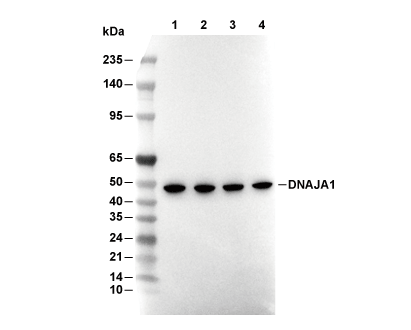 Lane 1: HepG2, Lane 2: SK-BR-3, Lane 3: Jurkat, Lane 4: Raji
Experiment Essentials
WB
Recommended WB dilution ratio: 1:10000
Recommended WB dilution ratio: 1:10000
Usage Information
| Dilution |
|---|
|
| Application |
|---|
| WB, FCM |
| Reactivity |
|---|
| Human |
| Source |
|---|
| Rabbit Monoclonal Antibody |
| Storage Buffer |
|---|
| PBS, pH 7.2+50% Glycerol+0.05% BSA+0.01% NaN3 |
| Storage (from the date of receipt) |
|---|
| -20°C (avoid freeze-thaw cycles), 2 years |
| Predicted MW Observed MW |
|---|
| 45 kDa 45 kDa, 49 kDa |
| *Why do the predicted and actual molecular weights differ? The following reasons may explain differences between the predicted and actual protein molecular weight. |
| Positive Control | Jurkat cells; HepG2 cells; HEK293T cells; SKBR 3 cells; HAP1 cells; Jurkat cells; Raji cells |
|---|---|
| Negative Control |
Experimental Methods
| WB |
|---|
Experimental Protocol:
Sample preparation
1. Tissue: Lyse the tissue sample by adding an appropriate volume of ice-cold RIPA/NP-40 Lysis Buffer (containing Protease Inhibitor Cocktail),and homogenize the tissue at a low temperature. 2. Adherent cell: Aspirate the culture medium and wash the cells with ice-cold PBS twice. Lyse the cells by adding an appropriate volume of RIPA/NP-40 Lysis Buffer (containing Protease Inhibitor Cocktail) and put the sample on ice for 5 min. 3. Suspension cell: Transfer the culture medium to a pre-cooled centrifuge tube. Centrifuge and aspirate the supernatant. Wash the cells with ice-cold PBS twice. Lyse the cells by adding an appropriate volume of RIPA/NP-40 Lysis Buffer (containing Protease Inhibitor Cocktail) and put the sample on ice for 5 min. 4. Place the lysate into a pre-cooled microcentrifuge tube. Centrifuge at 4°C for 15 min. Collect the supernatant;
5. Remove a small volume of lysate to determine the protein concentration;
6. Combine the lysate with protein loading buffer. Boil 20 µL sample under 95-100°C for 5 min. Centrifuge for 5 min after cool down on ice.
Electrophoretic separation
1. According to the concentration of extracted protein, load appropriate amount of protein sample and marker onto SDS-PAGE gels for electrophoresis. Recommended separating gel (lower gel) concentration: 10%. Reference Table for Selecting SDS-PAGE Separation Gel Concentrations 2. Power up 80V for 30 minutes. Then the power supply is adjusted (110 V~150 V), the Marker is observed, and the electrophoresis can be stopped when the indicator band of the predyed protein Marker where the protein is located is properly separated. (Note that the current should not be too large when electrophoresis, too large current (more than 150 mA) will cause the temperature to rise, affecting the result of running glue. If high currents cannot be avoided, an ice bath can be used to cool the bath.)
Transfer membrane
1. Take out the converter, soak the clip and consumables in the pre-cooled converter;
2. Activate PVDF membrane with methanol for 1 min and rinse with transfer buffer;
3. Install it in the order of "black edge of clip - sponge - filter paper - filter paper - glue -PVDF membrane - filter paper - filter paper - sponge - white edge of clip"; 4. The protein was electrotransferred to PVDF membrane. ( 0.45 µm PVDF membrane is recommended ) Reference Table for Selecting PVDF Membrane Pore Size Specifications Recommended conditions for wet transfer: 200 mA, 120 min. ( Note that the transfer conditions can be adjusted according to the protein size. For high-molecular-weight proteins, a higher current and longer transfer time are recommended. However, ensure that the transfer tank remains at a low temperature to prevent gel melting.)
Block
1. After electrotransfer, wash the film with TBST at room temperature for 5 minutes;
2. Incubate the film in the blocking solution for 1 hour at room temperature;
3. Wash the film with TBST for 3 times, 5 minutes each time.
Antibody incubation
1. Use 5% skim milk powder to prepare the primary antibody working liquid (recommended dilution ratio for primary antibody 1:10000), gently shake and incubate with the film at 4°C overnight; 2. Wash the film with TBST 3 times, 5 minutes each time;
3. Add the secondary antibody to the blocking solution and incubate with the film gently at room temperature for 1 hour;
4. After incubation, wash the film with TBST 3 times for 5 minutes each time.
Antibody staining
1. Add the prepared ECL luminescent substrate (or select other color developing substrate according to the second antibody) and mix evenly;
2. Incubate with the film for 1 minute, remove excess substrate (keep the film moist), wrap with plastic film, and expose in the imaging system. |
Biological Description
| Specificity |
|---|
| DNAJA1 Antibody [J3K12] detects endogenous levels of total DNAJA1 protein. |
| Subcellular Location |
|---|
| Cytoplasm, Endoplasmic reticulum, Membrane, Microsome, Mitochondrion, Nucleus |
| Uniprot ID |
|---|
| P31689 |
| Clone |
|---|
| J3K12 |
| Synonym |
|---|
| DNAJ2; HDJ2; HSJ2; HSPF4; DNAJA1; DnaJ homolog subfamily A member 1; DnaJ protein homolog 2; HSDJ; Heat shock 40 kDa protein 4; Heat shock protein J2; Human DnaJ protein 2; HSJ-2; hDj-2 |
| Background |
|---|
| DNAJA1 (DnaJ homolog subfamily A member 1) is a cytosolic type I Hsp40 co-chaperone essential for proteostasis and stress signaling. It features an N-terminal J-domain (residues 4–70, with an HPD motif at His33-Pro34-Asp35 crucial for Hsp70 ATPase stimulation), a C4 zinc finger domain (aa 78–115, containing eight cysteines that coordinate two Zn²⁺ ions to probe hydrophobic patches on client proteins), a glycine/phenylalanine-rich flexible linker (aa 116–165), and a C-terminal substrate-binding domain (aa 166–397) comprising stacked β-sheets and α-helices, plus a farnesylated CTIL355–358 motif for dynamic tethering to the ER or plasma membrane. In the Hsp70 chaperone cycle, the J-domain’s α-helix II docks to Hsp70’s nucleotide-binding domain, accelerating ATP hydrolysis over 1000-fold and trapping substrates in the ADP-bound state. The zinc fingers deliver clients such as conformational mutant p53 (where DNAJA1 binds the mutp53 core domain to sterically block CHIP E3 ubiquitination at Lys620, stabilizing oncogenic conformers that drive pancreatic and cholangiocarcinoma invasion via Cdc42/Rac1-mediated filopodia), CFTR ΔF508 (directing triage for ER retention and retrotranslocation via Hsc70), tau fibrils (facilitating Hsp104-independent disaggregation), and influenza PB2/PA nuclear import complexes. DNAJA1 also restrains JNK/c-Jun hyperactivation under oxidative and ER stress by promoting Hsc70-mediated SAPK sequestration, thereby preventing BAX-mediated mitochondrial outer membrane permeabilization and apoptosis. Additionally, it modulates polyQ-htt aggregation in Huntington’s models and hERG channel trafficking. DNAJA1 downregulation in PDAC tumors paradoxically increases mutp53 persistence and tumor growth, sensitizing these tumors to J-domain inhibitors (such as A11, which targets Y7/K44/Q47 to disrupt mutp53 interaction and promote its proteasomal clearance). |
| References |
|---|
|
Tech Support
Tel: +1-832-582-8158 Ext:3
If you have any other enquiries, please leave a message.

Products are for research use only. Not for human use. We do not sell to patients.
©Copyright 2013 Selleck Chemicals. All Rights Reserved.