
Technical Data
| Formula | C22H17N3O6 |
||||||
| Molecular Weight | 419.39 | CAS No. | 1009817-63-3 | ||||
| Solubility (25°C)* | In vitro | DMSO | 48 mg/mL (114.45 mM) | ||||
| Water | Insoluble | ||||||
| Ethanol | Insoluble | ||||||
| In Vivo (Add solvents to the product individually and in order.) |
|
||||||
|
* <1 mg/ml means slightly soluble or insoluble. * Please note that Selleck tests the solubility of all compounds in-house, and the actual solubility may differ slightly from published values. This is normal and is due to slight batch-to-batch variations. * Room temperature shipping (Stability testing shows this product can be shipped without any cooling measures.) |
|||||||
Preparing Stock Solutions
Biological Activity
| Description | b-AP15 (NSC687852) is a deubiquitinases inhibitor for 19S proteasomes activity of Ub-AMC cleavage with IC50 of 2.1 μM. | ||||
|---|---|---|---|---|---|
| Targets |
|
||||
| In vitro | b-AP15 inhibits the activity of two 19S regulatory-particle-associated deubiquitinases, Ubiquitin C-terminal hydrolase 5 (UCHL5) and ubiquitin-specific peptidase 14 (USP14), resulting in accumulation of polyubiquitin. This compound results in a dose-dependent accumulation of the UbG76V-YFP reporter with IC50 of 0.8 μM, indicating impaired proteasome degradation. It (1 μM) results in rapid accumulation of polyubiquitinated proteins in human colon carcinoma HCT-116 cells. This chemical (2.2 μM) increases the amounts of the cyclin-dependent kinases CDKN1A and CDKNIB and the tumour suppressor TP53 in a dose-dependent manner without altering the amounts of ornithine decarboxylase 1 (ODC1) in HCT-116 cells. It (1 μM) results in G2/M phase cell-cycle arrest in HCT-116 cells, consistent with the accumulation of cell-cycle inhibitors. This compound treatment increases the number of hypodiploid cells and is associated with increased amounts of apoptotic markers, including activated caspase-3, caspase-cleaved poly-ADP ribose polymerase (PARP) and cytokeratin-18 (CK18). It is more toxic to HCT-116 cells as compared to immortalised epithelial cells (hTERT-RPE1) or peripheral blood mononuclear cells. This inhibitor inhibits DUB activity using a variety of substrates, including Ub-AMC, Ub-GFP22, ubiquitinated p53-binding protein homolog (HDM2), and K48- and K63-linked Ubiquitin tetramer chains. It is an inhibitor of the UPS that induced cell death via induction of the lysosomal apoptosis pathway in a cathepsin-D dependent manner. This compound elicits characteristic UPS defects including the accumulation of Ubiquitin conjugates and cell cycle inhibitors such as p21, p27 and the tumour suppressor p53. It inhibits the DUB activity of both cysteine DUBs, with USP14 being slightly more sensitive than UCHL5. This chemical induces apoptosis in cells over-expressing the anti-apoptotic Bcl-2 protein and in cells lacking the p53 gene. It (1 μM) inhibits ATP-induced IL-1β release from LPS-primed peritoneal macrophages. This compound (1 μM) reduces the levels of cell death induced by nigericin treatment in THP-1 cells. It (1 μM) significantly reduces the numbers of ASC specks formed after nigericin treatment in LPS-primed THP-1 cells. | ||||
| In Vivo | b-AP15 (5 mg/kg) shows significant antitumour activity in severe combined immunodeficiency (SCID) mice with FaDu squamous carcinoma xenografts. This compound significantly delays tumour onset in mice with HCT-116 colon carcinoma xenografts. | ||||
| Features | Not a general deubiquitinase inhibitor. Has minimal inhibition on recombinant and cytosolic nonproteasomal cysteine deubiquitinases. |
Protocol (from reference)
| Animal Study: |
|
|---|
References
|
Customer Product Validation
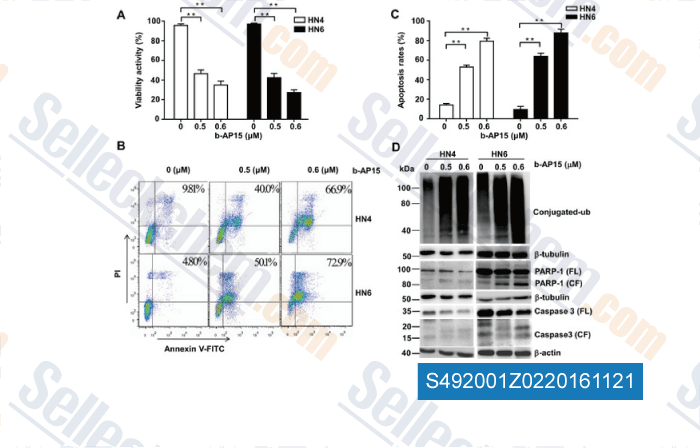
-
Data from [ , , Int J Biochem Cell Biol, 2016, 79:350-359. ]
Sellecks b-AP15 Has Been Cited by 23 Publications
| A chaperone-proteasome-based fragmentation machinery is essential for aggrephagy [ Nat Cell Biol, 2025, 27(9):1448-1464] | PubMed: 40866512 |
| Macrophage-targeting nano-formulated bicalutamide alleviates colitis by inducing MAP3K1-mediated degradation of NLRP3 [ J Control Release, 2025, 380:417-432] | PubMed: 39892647 |
| PSMC6 regulation of ovarian cancer cisplatin resistance unravels a new mode for proteasome targeting [ Int J Biol Sci, 2025, 21(5):2258-2274] | PubMed: 40083690 |
| Ubiquitin-specific protease 14 targets PFKL-mediated glycolysis to promote the proliferation and migration of oral squamous cell carcinoma [ J Transl Med, 2024, 22(1):193] | PubMed: 38388430 |
| A carboxy-terminal ubiquitylation site regulates androgen receptor activity [ Commun Biol, 2024, 7(1):25] | PubMed: 38182874 |
| An abundance of free regulatory (19S) proteasome particles regulates neuronal synapses [ Science, 2023, 380(6647):eadf2018] | PubMed: 37228199 |
| FAAH served a key membrane-anchoring and stabilizing role for NLRP3 protein independently of the endocannabinoid system [ Cell Death Differ, 2022, 10.1038/s41418-022-01054-4] | PubMed: 36104448 |
| Inhibition of proteasomal deubiquitinases USP14 and UCHL5 overcomes tyrosine kinase inhibitor resistance in chronic myeloid leukaemia [ Clin Transl Med, 2022, 12(9):e1038] | PubMed: 36082692 |
| Treatment with b-AP15 to Inhibit UCHL5 and USP14 Deubiquitinating Activity and Enhance p27 and Cyclin E1 for Tumors with p53 Deficiency [ Technol Cancer Res Treat, 2022, 21:15330338221119745] | PubMed: 35971329 |
| SF3B1 homeostasis is critical for survival and therapeutic response in T cell leukemia [ Sci Adv, 2022, 8(3):eabj8357] | PubMed: 35061527 |
RETURN POLICY
Selleck Chemical’s Unconditional Return Policy ensures a smooth online shopping experience for our customers. If you are in any way unsatisfied with your purchase, you may return any item(s) within 7 days of receiving it. In the event of product quality issues, either protocol related or product related problems, you may return any item(s) within 365 days from the original purchase date. Please follow the instructions below when returning products.
SHIPPING AND STORAGE
Selleck products are transported at room temperature. If you receive the product at room temperature, please rest assured, the Selleck Quality Inspection Department has conducted experiments to verify that the normal temperature placement of one month will not affect the biological activity of powder products. After collecting, please store the product according to the requirements described in the datasheet. Most Selleck products are stable under the recommended conditions.
NOT FOR HUMAN, VETERINARY DIAGNOSTIC OR THERAPEUTIC USE.