
research use only
4-Aminobutyric acid (GABA) GABA Receptor agonist
Cat.No.S4700
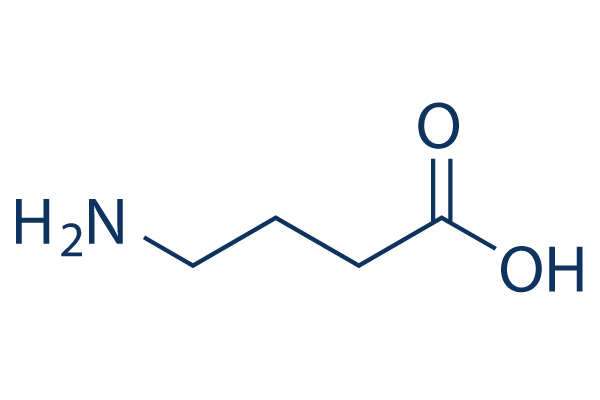
Chemical Structure
Molecular Weight: 103.12
Quality Control
| Related Targets | Adrenergic Receptor AChR 5-HT Receptor COX Calcium Channel Histamine Receptor Dopamine Receptor TRP Channel Cholinesterase (ChE) GluR |
|---|---|
| Other GABA Receptor Inhibitors | Dihydromyricetin CGP52432 Oxiracetam Ginkgolide A Pentylenetetrazol Emamectin Benzoate Nefiracetam Piracetam Bemegride 6-Hydroxyflavone (6-HF) |
Chemical Information, Storage & Stability
| Molecular Weight | 103.12 | Formula | C4H9NO2 |
Storage (From the date of receipt) | |
|---|---|---|---|---|---|
| CAS No. | 56-12-2 | Download SDF | Storage of Stock Solutions |
|
|
| Synonyms | 4-Aminobutanoic acid, GABA, Gamma-aminobutyric acid, Piperidic acid | Smiles | C(CC(=O)O)CN | ||
Solubility
|
In vitro |
Water : 21 mg/mL
DMSO
: Insoluble
Ethanol : Insoluble |
Molarity Calculator
|
In vivo |
|||||
In vivo Formulation Calculator (Clear solution)
Step 1: Enter information below (Recommended: An additional animal making an allowance for loss during the experiment)
Step 2: Enter the in vivo formulation (This is only the calculator, not formulation. Please contact us first if there is no in vivo formulation at the solubility Section.)
Calculation results:
Working concentration: mg/ml;
Method for preparing DMSO master liquid: mg drug pre-dissolved in μL DMSO ( Master liquid concentration mg/mL, Please contact us first if the concentration exceeds the DMSO solubility of the batch of drug. )
Method for preparing in vivo formulation: Take μL DMSO master liquid, next addμL PEG300, mix and clarify, next addμL Tween 80, mix and clarify, next add μL ddH2O, mix and clarify.
Method for preparing in vivo formulation: Take μL DMSO master liquid, next add μL Corn oil, mix and clarify.
Note: 1. Please make sure the liquid is clear before adding the next solvent.
2. Be sure to add the solvent(s) in order. You must ensure that the solution obtained, in the previous addition, is a clear solution before proceeding to add the next solvent. Physical methods such as vortex, ultrasound or hot water bath can be used to aid dissolving.
Mechanism of Action
| Targets/IC50/Ki |
GABA receptor
|
|---|---|
| In vitro |
γ-Aminobutyric acid (GABA) functions primarily as an inhibitory neurotransmitter in the mature central nervous system. The addition of this compound into the cell culture medium promoted the proliferation of GABRP-expressing PDAC cells, but not GABRP-negative cells, and GABAA receptor antagonists inhibited this growth-promoting effect by GABA. The HEK293 cells constitutively expressing exogenous GABRP revealed the growth-promoting effect of GABA treatment. GABA treatment in GABRP-positive cells increased intracellular Ca2+ levels and activated the mitogen-activated protein kinase/extracellular signal-regulated kinase (MAPK/Erk) cascade. It exerts antidiabetic effects by acting on both the islet β-cells and immune system. Unlike in adult brain or islet α-cells in which GABA exerts hyperpolarizing effects, in islet β-cells, it produces membrane depolarization and Ca2+ influx, leading to the activation of PI3K/Akt-dependent growth and survival pathways.
|
| In vivo |
4-Aminobutyric acid (GABA) is the principal inhibitory neurotransmitter in the adult brain that has a parallel inhibitory role in the immune system. GABAergic medications are used to treat anxiety, alcohol withdrawal, epilepsy, and to induce sedation, and anaesthesia. It is neuroprotective in animal models of stroke. This compound decreases inflammatory cytokine production in peripheral macrophages. It decreases T cell autoimmunity and the development of inflammatory responses in the nonobese diabetic mouse model of type 1 diabetes. In the adult brain, GABA induces a fast inhibition in neurons mainly through the GABAA receptor (GABAAR). It is produced by pancreatic β-cells. GABA released from β-cells can act on GABAAR in the α-cells, causing membrane hyperpolarization and hence suppressing glucagon secretion. GABA-treated mice showed higher circulating insulin, lower glucagon, nearly normal glycaemia, improved metabolic conditions, and maintained close to normal glucose tolerance during a period of 53 d after STZ injections.
|
References |
|
Clinical Trial Information
(data from https://clinicaltrials.gov, updated on 2024-05-22)
| NCT Number | Recruitment | Conditions | Sponsor/Collaborators | Start Date | Phases |
|---|---|---|---|---|---|
| NCT06261450 | Not yet recruiting | Fragile X Syndrome |
Université de Sherbrooke|Canadian Institutes of Health Research (CIHR)|Jazz Pharmaceuticals|Centre de recherche du Centre hospitalier universitaire de Sherbrooke |
April 1 2024 | Phase 2 |
| NCT06381479 | Recruiting | Stress|Sleep Disorder |
National Taiwan Sport University|Bened Biomedical Co. Ltd. |
April 19 2024 | Not Applicable |
| NCT06361368 | Not yet recruiting | Insomnia |
National Yang Ming University|Bened Biomedical Co. Ltd. |
April 2024 | Not Applicable |
| NCT06057233 | Not yet recruiting | Epilepsy Temporal Lobe |
University Hospital Grenoble|Université Grenoble-Alpes|Institut National de la Santé Et de la Recherche Médicale France |
March 2024 | -- |
Tech Support
Tel: +1-832-582-8158 Ext:3
If you have any other enquiries, please leave a message.

Products are for research use only. Not for human use. We do not sell to patients.
©Copyright 2013 Selleck Chemicals. All Rights Reserved.