
research use only
4μ8C IRE1 inhibitor
Cat.No.S7272
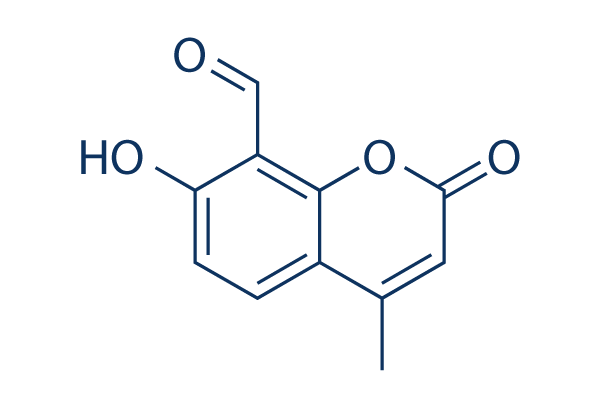
Chemical Structure
Molecular Weight: 204.18
Quality Control
Cell Culture, Treatment & Working Concentration
| Cell Lines | Assay Type | Concentration | Incubation Time | Formulation | Activity Description | PMID |
|---|---|---|---|---|---|---|
| SF21 cells | Function assay | 30 mins | Inhibition of human recombinant puritin-His-tagged IRE-1 RNase expressed in SF21 cells using XBP-1 RNA stem loop as substrate incubated for 30 mins prior to substrate addition measured after 2 hrs by FRET-suppression assay, IC50=0.206 μM | |||
| human Jeko cells | Function assay | 24 h | Inhibition of XBP-1s expression in human Jeko cells after 24 hrs by immunoblotting analysis, IC50=1.57 μM | |||
| human Mino cells | Function assay | 24 h | Inhibition of XBP-1s expression in human Mino cells after 24 hrs by immunoblotting analysis, IC50=1.62 μM | |||
| Click to View More Cell Line Experimental Data | ||||||
Chemical Information, Storage & Stability
| Molecular Weight | 204.18 | Formula | C11H8O4 |
Storage (From the date of receipt) | |
|---|---|---|---|---|---|
| CAS No. | 14003-96-4 | Download SDF | Storage of Stock Solutions |
|
|
| Synonyms | IRE1 Inhibitor III | Smiles | CC1=CC(=O)OC2=C1C=CC(=C2C=O)O | ||
Solubility
|
In vitro |
DMSO
: 71 mg/mL
(347.73 mM)
Water : Insoluble Ethanol : Insoluble |
Molarity Calculator
|
In vivo |
|||||
In vivo Formulation Calculator (Clear solution)
Step 1: Enter information below (Recommended: An additional animal making an allowance for loss during the experiment)
Step 2: Enter the in vivo formulation (This is only the calculator, not formulation. Please contact us first if there is no in vivo formulation at the solubility Section.)
Calculation results:
Working concentration: mg/ml;
Method for preparing DMSO master liquid: mg drug pre-dissolved in μL DMSO ( Master liquid concentration mg/mL, Please contact us first if the concentration exceeds the DMSO solubility of the batch of drug. )
Method for preparing in vivo formulation: Take μL DMSO master liquid, next addμL PEG300, mix and clarify, next addμL Tween 80, mix and clarify, next add μL ddH2O, mix and clarify.
Method for preparing in vivo formulation: Take μL DMSO master liquid, next add μL Corn oil, mix and clarify.
Note: 1. Please make sure the liquid is clear before adding the next solvent.
2. Be sure to add the solvent(s) in order. You must ensure that the solution obtained, in the previous addition, is a clear solution before proceeding to add the next solvent. Physical methods such as vortex, ultrasound or hot water bath can be used to aid dissolving.
Mechanism of Action
| Features |
IRE1 Rnase-selective inhibitor, used as a platform for developing new locally acting drugs.
|
|---|---|
| Targets/IC50/Ki |
IRE1 Rnase
(Cell-free assay) 76 nM
|
| In vitro |
4μ8C blocks substrate (RIDD) access to the active site of IRE1 and selectively inactivates both Xbp1 splicing and IRE1-mediated mRNA degradation. IRE1 inhibition subsequently induces ER stress without measurable acute toxicity. 4μ8C, as an IRE1 inhibitor, blocks IL-4, IL-5, and IL-13 production from CD4+ T cells. |
| Kinase Assay |
In Vitro IRE1 RNase and RIDD Assays
|
|
Analysis of radiolabelled Xbp1 substrate cleavage is performed as previously except that mammalian IRE1 reaction buffer is used. In vitro RIDD substrates are synthesised by in vitro transcription using the T7-MAXIscript Kit in the presence of 32P ATP or Cy5-UTP on templates isolated by RT-PCR from mouse Min6 cells (Ins2) or PCR from cloned XBP1 cDNA. The resulting products are gel purified to obtain full-length substrate. Reactions are then separated by 15% UREA-PAGE for analysis by phosphorimaging or by near-infrared imaging using the LI-COR Odyssey scanner.
|
|
| In vivo |
4μ8c is an IRE1 Inhibitor III that reduces atherosclerotic lesion and effectively mitigates plaque development in mice. |
References |
|
Tech Support
Tel: +1-832-582-8158 Ext:3
If you have any other enquiries, please leave a message.

Products are for research use only. Not for human use. We do not sell to patients.
©Copyright 2013 Selleck Chemicals. All Rights Reserved.