
research use only
Dabigatran Thrombin inhibitor
Cat.No.S2196
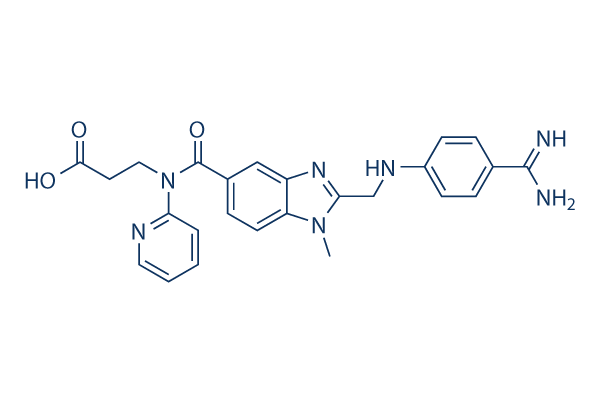
Chemical Structure
Molecular Weight: 471.51
Quality Control
Cell Culture, Treatment & Working Concentration
| Cell Lines | Assay Type | Concentration | Incubation Time | Formulation | Activity Description | PMID |
|---|---|---|---|---|---|---|
| HEK293 cells | Function assay | 3 mins | Inhibition of human OCT2-mediated ASP+ uptake expressed in HEK293 cells after 3 mins by fluorescence assay, IC50=4.7 μM | 23241029 | ||
| KB-3-1 | qHTS assay | P-glycoprotein substrates identified in KB-3-1 adenocarcinoma cell line, qHTS therapeutic library screen | 23241029 | |||
| HEK293 | Function assay | 1.5 mins | Inhibition of human MATE2K-mediated ASP+ uptake expressed in HEK293 cells after 1.5 mins by fluorescence assay, IC50=25.3μM | 23241029 | ||
| Click to View More Cell Line Experimental Data | ||||||
Chemical Information, Storage & Stability
| Molecular Weight | 471.51 | Formula | C25H25N7O3 |
Storage (From the date of receipt) | |
|---|---|---|---|---|---|
| CAS No. | 211914-51-1 | Download SDF | Storage of Stock Solutions |
|
|
| Synonyms | BIBR 953 | Smiles | CN1C2=C(C=C(C=C2)C(=O)N(CCC(=O)O)C3=CC=CC=N3)N=C1CNC4=CC=C(C=C4)C(=N)N | ||
Solubility
|
In vitro |
DMSO
: 0.5 mg/mL
(1.06 mM)
Ethanol : 0.01 mg/mL Water : Insoluble |
Molarity Calculator
|
In vivo |
|||||
In vivo Formulation Calculator (Clear solution)
Step 1: Enter information below (Recommended: An additional animal making an allowance for loss during the experiment)
Step 2: Enter the in vivo formulation (This is only the calculator, not formulation. Please contact us first if there is no in vivo formulation at the solubility Section.)
Calculation results:
Working concentration: mg/ml;
Method for preparing DMSO master liquid: mg drug pre-dissolved in μL DMSO ( Master liquid concentration mg/mL, Please contact us first if the concentration exceeds the DMSO solubility of the batch of drug. )
Method for preparing in vivo formulation: Take μL DMSO master liquid, next addμL PEG300, mix and clarify, next addμL Tween 80, mix and clarify, next add μL ddH2O, mix and clarify.
Method for preparing in vivo formulation: Take μL DMSO master liquid, next add μL Corn oil, mix and clarify.
Note: 1. Please make sure the liquid is clear before adding the next solvent.
2. Be sure to add the solvent(s) in order. You must ensure that the solution obtained, in the previous addition, is a clear solution before proceeding to add the next solvent. Physical methods such as vortex, ultrasound or hot water bath can be used to aid dissolving.
Mechanism of Action
| Features |
Dabigatran is a reversible, competitive, direct thrombin inhibitor.
|
|---|---|
| Targets/IC50/Ki |
Thrombin
(Cell-free assay) 9.3 nM
|
| In vitro |
BIBR 953 is a very potent anticoagulant. This compound shows that the terminal phenyl can be substituted by the more hydrophilic 2-pyridyl group without substantial loss of activity. It inhibits Thrombin, plasmin, factor Xa, trypsin, tPA and activated protein C with Ki of 4.5 nM, 1.7 μM, 3.8 μM, 50 nM, 45 μM and 20 μM, respectively. This chemical specifically and reversibly inhibits Thrombin.
|
| In vivo |
BIBR 953 exhibits the most favourable activity profile following i.v. administration to rats. The bioavailability of this compound after p.o. administration of dabigatran etexilate is 7.2%. It is predominantly excreted in the faeces after p.o. treatment and in the urine after i.v. treatment. The mean terminal half-life of this chemical is approximately 8 hours. Its acylglucuronides account for 0.4% and 4% of the dose in urine after p.o. and i.v. dosing, respectively.
|
References |
|
Clinical Trial Information
(data from https://clinicaltrials.gov, updated on 2024-05-22)
| NCT Number | Recruitment | Conditions | Sponsor/Collaborators | Start Date | Phases |
|---|---|---|---|---|---|
| NCT06360055 | Recruiting | Health |
Peking University Third Hospital |
April 1 2024 | Not Applicable |
| NCT05966740 | Recruiting | Venous Thromboembolism |
Boehringer Ingelheim|Children''s Hospital Acquired Thrombosis consortium |
October 31 2023 | -- |
| NCT05673889 | Completed | Healthy |
Pfizer|Arvinas Estrogen Receptor Inc. |
January 27 2023 | Phase 1 |
Tech Support
Tel: +1-832-582-8158 Ext:3
If you have any other enquiries, please leave a message.
Frequently Asked Questions
Question 1:
We want to use it for an in vivo study with rats. Do you have any suggestions?
Answer:
It has very low solubility in water or DMSO. We suggest that you dissolve this compound in aqueous acidic solution (The acids are preferably selected from among hydrochloric acid, hydrobromic acid, sulfuric acid, phosphoric acid, methansulphonic acid, acetic acid, fumaric acid, citric acid, tartaric acid, and maleic acid. Of particular interest is hydrochloric acid. ), with pH < 3, preferably < 2. Please refer to the following reference: http://www.sumobrain.com/patents/wipo/Lyophilised-dabigatran/WO2010086329.html.

Products are for research use only. Not for human use. We do not sell to patients.
©Copyright 2013 Selleck Chemicals. All Rights Reserved.