
research use only
BMS-536924 IGF-1R inhibitor
Cat.No.S1012
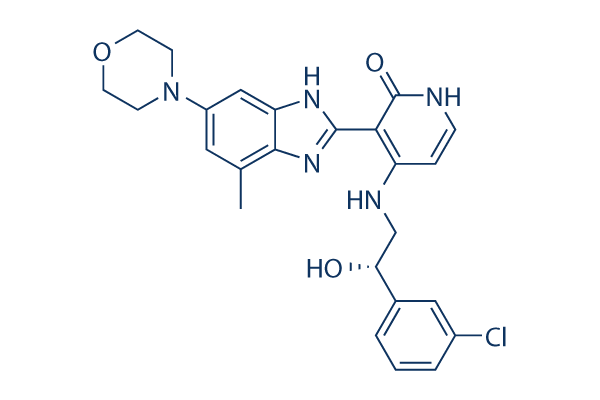
Chemical Structure
Molecular Weight: 479.96
Quality Control
| Related Targets | EGFR VEGFR PDGFR FGFR c-Met Src MEK CSF-1R FLT3 HER2 |
|---|---|
| Other IGF-1R Inhibitors | Linsitinib (OSI-906) NVP-AEW541 BMS-754807 Picropodophyllin (AXL1717) GSK1904529A AG-1024 NVP-ADW742 NT157 PQ 401 MSDC-0160 |
Chemical Information, Storage & Stability
| Molecular Weight | 479.96 | Formula | C25H26ClN5O3 |
Storage (From the date of receipt) | |
|---|---|---|---|---|---|
| CAS No. | 468740-43-4 | Download SDF | Storage of Stock Solutions |
|
|
| Synonyms | CS-0117 | Smiles | CC1=CC(=CC2=C1N=C(N2)C3=C(C=CNC3=O)NCC(C4=CC(=CC=C4)Cl)O)N5CCOCC5 | ||
Solubility
|
In vitro |
DMSO
: 96 mg/mL
(200.01 mM)
Water : Insoluble Ethanol : Insoluble |
Molarity Calculator
|
In vivo |
|||||
In vivo Formulation Calculator (Clear solution)
Step 1: Enter information below (Recommended: An additional animal making an allowance for loss during the experiment)
Step 2: Enter the in vivo formulation (This is only the calculator, not formulation. Please contact us first if there is no in vivo formulation at the solubility Section.)
Calculation results:
Working concentration: mg/ml;
Method for preparing DMSO master liquid: mg drug pre-dissolved in μL DMSO ( Master liquid concentration mg/mL, Please contact us first if the concentration exceeds the DMSO solubility of the batch of drug. )
Method for preparing in vivo formulation: Take μL DMSO master liquid, next addμL PEG300, mix and clarify, next addμL Tween 80, mix and clarify, next add μL ddH2O, mix and clarify.
Method for preparing in vivo formulation: Take μL DMSO master liquid, next add μL Corn oil, mix and clarify.
Note: 1. Please make sure the liquid is clear before adding the next solvent.
2. Be sure to add the solvent(s) in order. You must ensure that the solution obtained, in the previous addition, is a clear solution before proceeding to add the next solvent. Physical methods such as vortex, ultrasound or hot water bath can be used to aid dissolving.
Mechanism of Action
| Targets/IC50/Ki |
Insulin Receptor
73 nM
IGF-1R
100 nM
FAK
150 nM
MEK
182 nM
LCK
341 nM
VEGFR2
1.4 μM
EGF
1.6 μM
Met
4.87 μM
|
|---|---|
| In vitro |
BMS-536924 also inhibits FAK and Lck with IC50 of 150 nM and 341 nM, respectively. This compound inhibits cellular proliferation and disrupts Akt and MAPK phosphorylation. It inhibits IGF-I-stimulated IGF-1R signaling in MCF10A cells and blocks constitutive IGF-1R activity in CD8-IGF-1R-MCF10A. Preincubation of MCF10A cells with 1 μM of this chemical completely blocks the ability of IGF-I to stimulate IGF-1R phosphorylation. IGF-I stimulation results in increased phosphorylation of ERK1/2, GSK3β, and Akt. This compound inhibits this ligand-induced phosphorylation. Treatment of the CD8-IGF-1R-MCF10A cells with this inhibitor results in a dose-dependent inhibition of phosphorylation with partial inhibition at 0.01 μM and 0.1 μM, but complete receptor inhibition at a concentration of 1 μM. Maximal inhibition of phosphorylated IGF-1R is observed as early as 10 minutes following incubation. It retains its ability to inhibit IGF-1R phosphorylation for up to 48 hours. Addition of this agent time-dependently inhibits Akt phosphorylation starting at 1 hour. By 48 hours, Akt activation is completely blocked. Treatment with this compound shows antiproliferation activity in a panel of cancer cell lines including TC32, HT1080/S, SK-LMS-1, H513 and CTR cells. pIGF-1R/pIR is activated upon IGF-I/insulin stimulation and the activation is inhibited by this chemical at similar potencies in Rh41 and Rh36 cell lines. The expression of programmed cell death 4 (PDCD4), cleavage of poly(ADP-ribose) polymerase (PARP) and caspase-3 are up-regulated in Rh41 cells treated with this inhibitor.
|
| Kinase Assay |
IGF-I Pathway Activity
|
|
1 × 10⁶ pBabe-MCF10A cells are seeded onto 60-mm dishes. After 24 hours, the medium is changed to serum-free medium and incubated overnight at 37 °C for 24 hours. Cells are then pre-incubated with or without 1 uM BMS-536924 for 1 hour in serum free medium followed by stimulation with IGF-I (50 ng/mL) for 10 minutes. Cell monolayers are washed twice with PBS and harvested for immunoblot analysis
|
|
| In vivo |
Oral administration of BMS-536924 at 100-300 mpk strongly inhibits IGR-1R Sal tumour model. Efficacy is also observed in the nonengineered Colo205 human colon carcinoma model. Oral administration of this compound on a once a day schedule (100-300 mpk) or a twice a day schedule (50, 100 mpk) demonstrates antitumour activity in this tumour model. Oral glucose tolerance test (OGTT) shows 100 mpk (b.i.d.) causes a significant elevation in glucose levels after glucose challenge. The pharmacokinetic parameters of this chemical, administered orally in poly(ethylene glycol) 400 and water (80:20 v/v), are determined in mouse, rat, dog, and monkey. Good bioavailability is evident in all species. Significant nonlinear pharmacokinetics is observed in rodents at increasing p.o. dose. This compound reduces the tumour xenografts volume of CD8-IGF-1R-MCF10A cells after two weeks' treatment (100mg/kg) to 76%. Oral administration of 70 mg/kg this chemical significantly inhibits tumour growth (TGBC-1TKB cells) inoculated in nude mice. It up-regulates apoptosis in xenograft tumours. The treatment doesn't have adverse effects on the body weight of mice or the glucose levels at the time of death, suggesting tolerable toxicity.
|
References |
|
Tech Support
Tel: +1-832-582-8158 Ext:3
If you have any other enquiries, please leave a message.
Frequently Asked Questions
Question 1:
What are the differences between it and S1034?
Answer:
The most remarkable difference between these two IGF-IR inhibitors is that S1012 is an ATP-competitive inhibitor. You will get more information about the differences between IR inhibitors in this reference: http://www.sciencedirect.com/science/article/pii/S1359644605035129.

Products are for research use only. Not for human use. We do not sell to patients.
©Copyright 2013 Selleck Chemicals. All Rights Reserved.