
research use only
Enoxacin Topoisomerase inhibitor
Cat.No.S1756
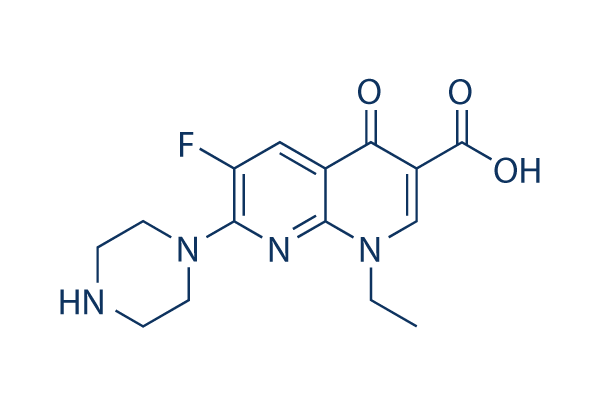
Chemical Structure
Molecular Weight: 320.32
Quality Control
| Related Targets | HDAC PARP ATM/ATR DNA-PK WRN DNA/RNA Synthesis PPAR Sirtuin Casein Kinase eIF |
|---|---|
| Other Topoisomerase Inhibitors | Camptothecin (CPT) Betulinic acid Beta-Lapachone (S)-10-Hydroxycamptothecin Amonafide Voreloxin (SNS-595) hydrochloride Ellagic acid Cu(II)-Elesclomol Hydroxy Camptothecine Rubitecan |
Chemical Information, Storage & Stability
| Molecular Weight | 320.32 | Formula | C15H17FN4O3 |
Storage (From the date of receipt) | |
|---|---|---|---|---|---|
| CAS No. | 74011-58-8 | Download SDF | Storage of Stock Solutions |
|
|
| Synonyms | AT-2266, CI919, Pd107779, NSC 629661 | Smiles | CCN1C=C(C(=O)C2=CC(=C(N=C21)N3CCNCC3)F)C(=O)O | ||
Solubility
|
In vitro |
DMSO
: 32 mg/mL
(99.9 mM)
Water : Insoluble Ethanol : Insoluble |
Molarity Calculator
|
In vivo |
|||||
In vivo Formulation Calculator (Clear solution)
Step 1: Enter information below (Recommended: An additional animal making an allowance for loss during the experiment)
Step 2: Enter the in vivo formulation (This is only the calculator, not formulation. Please contact us first if there is no in vivo formulation at the solubility Section.)
Calculation results:
Working concentration: mg/ml;
Method for preparing DMSO master liquid: mg drug pre-dissolved in μL DMSO ( Master liquid concentration mg/mL, Please contact us first if the concentration exceeds the DMSO solubility of the batch of drug. )
Method for preparing in vivo formulation: Take μL DMSO master liquid, next addμL PEG300, mix and clarify, next addμL Tween 80, mix and clarify, next add μL ddH2O, mix and clarify.
Method for preparing in vivo formulation: Take μL DMSO master liquid, next add μL Corn oil, mix and clarify.
Note: 1. Please make sure the liquid is clear before adding the next solvent.
2. Be sure to add the solvent(s) in order. You must ensure that the solution obtained, in the previous addition, is a clear solution before proceeding to add the next solvent. Physical methods such as vortex, ultrasound or hot water bath can be used to aid dissolving.
Mechanism of Action
| Targets/IC50/Ki |
Topoisomerase II
Topoisomerase IV
|
|---|---|
| In vitro |
Enoxacin, a fluoroquinolone used as an antibacterial compound, enhances the production of miRNAs with tumour suppressor functions by binding to the miRNA biosynthesis protein TAR RNA-binding protein 2 (TRBP). This compound binds to the DNA active site and alters the breakage/reunion activity of the enzyme. It stimulates cleavage of both relaxed and supercoiled forms of DNA in the absence of ATP, whereas CcdB induces cleavage only after many cycles of ATP-dependent breakage and reunion. This chemical dose dependently reduces the number of osteoclasts differentiating in mouse marrow cultures stimulated with 1,25-dihydroxyvitamin D(3), as well as markers of osteoclast activity, and the number of resorption lacunae formed on bone slices. It inhibits osteoclast formation at concentrations where osteoblast formation is not altered. This agent dose-dependently reduces the number of multinuclear cells expressing tartrate-resistant acid phosphatase (TRAP) activity produced by RANK-L-stimulated osteoclast precursors. It directly inhibits osteoclast formation without affecting cell viability by a novel mechanism that involves changes in posttranslational processing and trafficking of several proteins with known roles in osteoclast function. This compound is able to decrease cell viability, induce apoptosis, cause cell cycle arrest, and inhibit the invasiveness of prostate cancer (PCa) cell lines. It is also effective in restoring the global expression of miRNAs in prostate cancer (PCa) cell lines.
|
References |
|
Clinical Trial Information
(data from https://clinicaltrials.gov, updated on 2024-05-22)
| NCT Number | Recruitment | Conditions | Sponsor/Collaborators | Start Date | Phases |
|---|---|---|---|---|---|
| NCT04840823 | Completed | Amyotrophic Lateral Sclerosis |
McGill University|Weizmann Institute of Science|Apotex Inc. |
March 26 2021 | Phase 1|Phase 2 |
Tech Support
Tel: +1-832-582-8158 Ext:3
If you have any other enquiries, please leave a message.

Products are for research use only. Not for human use. We do not sell to patients.
©Copyright 2013 Selleck Chemicals. All Rights Reserved.