
research use only
Loratadine Histamine Receptor antagonist
Cat.No.S1358
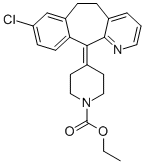
Chemical Structure
Molecular Weight: 382.88
Quality Control
| Related Targets | Adrenergic Receptor AChR 5-HT Receptor COX Calcium Channel Dopamine Receptor GABA Receptor TRP Channel Cholinesterase (ChE) GluR |
|---|---|
| Other Histamine Receptor Inhibitors | GSK2879552 Dihydrochloride JNJ-7777120 Ebastine Ciproxifan Maleate Mianserin HCl Astemizole Lafutidine Mizolastine Rupatadine Fumarate Betahistine 2HCl |
Chemical Information, Storage & Stability
| Molecular Weight | 382.88 | Formula | C22H23ClN2O2 |
Storage (From the date of receipt) | |
|---|---|---|---|---|---|
| CAS No. | 79794-75-5 | Download SDF | Storage of Stock Solutions |
|
|
| Synonyms | SCH29851 | Smiles | CCOC(=O)N1CCC(=C2C3=C(CCC4=C2N=CC=C4)C=C(C=C3)Cl)CC1 | ||
Solubility
|
In vitro |
Ethanol : 77 mg/mL
DMSO
: 17 mg/mL
(44.4 mM)
Water : Insoluble |
Molarity Calculator
|
In vivo |
|||||
In vivo Formulation Calculator (Clear solution)
Step 1: Enter information below (Recommended: An additional animal making an allowance for loss during the experiment)
Step 2: Enter the in vivo formulation (This is only the calculator, not formulation. Please contact us first if there is no in vivo formulation at the solubility Section.)
Calculation results:
Working concentration: mg/ml;
Method for preparing DMSO master liquid: mg drug pre-dissolved in μL DMSO ( Master liquid concentration mg/mL, Please contact us first if the concentration exceeds the DMSO solubility of the batch of drug. )
Method for preparing in vivo formulation: Take μL DMSO master liquid, next addμL PEG300, mix and clarify, next addμL Tween 80, mix and clarify, next add μL ddH2O, mix and clarify.
Method for preparing in vivo formulation: Take μL DMSO master liquid, next add μL Corn oil, mix and clarify.
Note: 1. Please make sure the liquid is clear before adding the next solvent.
2. Be sure to add the solvent(s) in order. You must ensure that the solution obtained, in the previous addition, is a clear solution before proceeding to add the next solvent. Physical methods such as vortex, ultrasound or hot water bath can be used to aid dissolving.
Mechanism of Action
| Targets/IC50/Ki |
H1 receptor
B(0)AT2
4 μM
|
|---|---|
| In vitro |
Loratadine is identified as a selective inhibitor of B(0)AT2 with an IC50 of 4 μM while being less active or inactive against several other members of the SLC6 family. This compound concentration-dependently inhibits the release of histamine and LTC4 when preincubating before Der p 1 antigen or anti-Fc epsilon RI challenge in human Fc epsilon RI+ cells. It also inhibits (10-40%) histamine, LTC4, and PGD2 release from purified HLMC (16-68%) activated by anti-Fc epsilon RI. This chemical causes concentration-dependent inhibition (10-40%) of histamine, tryptase, LTC4, and PGD2 release from purified HSMC (24-72%) immunologically challenged with anti-Fc epsilon RI. It inhibits significantly IL-6 and IL-8 secretion induced by histamine with a more powerful efficiency of the active metabolite in human umbilical vein endothelial cells (HUVEC). This compound blocks hKv1.5 channels in a concentration-, voltage-, time- and use-dependent manner but only at concentrations much higher than therapeutic plasma levels in man in Ltk- cells transfected with the gene encoding hKv1.5 channels. It inhibits rhinovirus-induced ICAM-1 upregulation in both primary bronchial or transformed (A549) respiratory epithelial cells. This chemical also inhibits ICAM-1 mRNA induction caused by rhinovirus infection in a dose-dependent manner, and they completely inhibits rhinovirus-induced ICAM-1 promoter activation. |
References |
|
Clinical Trial Information
(data from https://clinicaltrials.gov, updated on 2024-05-22)
| NCT Number | Recruitment | Conditions | Sponsor/Collaborators | Start Date | Phases |
|---|---|---|---|---|---|
| NCT05750875 | Completed | Pruritus|Uremia|Chronic Kidney Diseases |
King Edward Medical University |
May 1 2022 | Phase 4 |
| NCT05243706 | Unknown status | Vinca Alkaloid Adverse Reaction |
Ain Shams University |
March 1 2022 | Phase 3 |
| NCT04645979 | Completed | Rhinitis Allergic |
Bayer |
November 11 2020 | -- |
Tech Support
Tel: +1-832-582-8158 Ext:3
If you have any other enquiries, please leave a message.

Products are for research use only. Not for human use. We do not sell to patients.
©Copyright 2013 Selleck Chemicals. All Rights Reserved.