
research use only
PIK-90 PI3K inhibitor
Cat.No.S1187
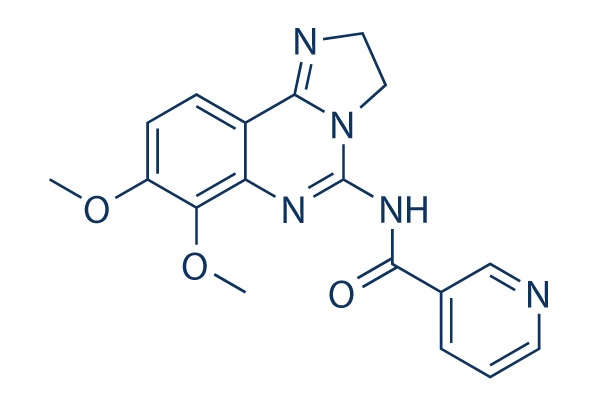
Chemical Structure
Molecular Weight: 351.36
Quality Control
| Related Targets | Akt mTOR GSK-3 ATM/ATR DNA-PK AMPK PDPK1 PTEN PP2A PDK |
|---|---|
| Other PI3K Inhibitors | GDC-0077 (Inavolisib) SAR405 Quercetin (Sophoretin) LY294002 XL147 analogue Tersolisib (STX-478) Buparlisib (BKM120) 740 Y-P (PDGFR 740Y-P) GO-203 TFA Eganelisib (IPI-549) |
Chemical Information, Storage & Stability
| Molecular Weight | 351.36 | Formula | C18H17N5O3 |
Storage (From the date of receipt) | |
|---|---|---|---|---|---|
| CAS No. | 677338-12-4 | Download SDF | Storage of Stock Solutions |
|
|
| Synonyms | N/A | Smiles | COC1=C(C2=NC(=NC(=O)C3=CN=CC=C3)N4CCNC4=C2C=C1)OC | ||
Solubility
|
In vitro |
DMSO
: 2 mg/mL
(5.69 mM)
Water : Insoluble Ethanol : Insoluble |
Molarity Calculator
|
In vivo |
|||||
In vivo Formulation Calculator (Clear solution)
Step 1: Enter information below (Recommended: An additional animal making an allowance for loss during the experiment)
Step 2: Enter the in vivo formulation (This is only the calculator, not formulation. Please contact us first if there is no in vivo formulation at the solubility Section.)
Calculation results:
Working concentration: mg/ml;
Method for preparing DMSO master liquid: mg drug pre-dissolved in μL DMSO ( Master liquid concentration mg/mL, Please contact us first if the concentration exceeds the DMSO solubility of the batch of drug. )
Method for preparing in vivo formulation: Take μL DMSO master liquid, next addμL PEG300, mix and clarify, next addμL Tween 80, mix and clarify, next add μL ddH2O, mix and clarify.
Method for preparing in vivo formulation: Take μL DMSO master liquid, next add μL Corn oil, mix and clarify.
Note: 1. Please make sure the liquid is clear before adding the next solvent.
2. Be sure to add the solvent(s) in order. You must ensure that the solution obtained, in the previous addition, is a clear solution before proceeding to add the next solvent. Physical methods such as vortex, ultrasound or hot water bath can be used to aid dissolving.
Mechanism of Action
| Targets/IC50/Ki |
PI3Kα
11 nM
PI3Kγ
18 nM
PI3Kδ
58 nM
PI3Kβ
350 nM
|
|---|---|
| In vitro |
PIK-90 shows distinct patterns of isoform selectivity to inhibit different subsets of four class I PI3K isoforms. In addition, this compound completely inhibits the fMLP-stimulated phosphorylation of Akt and impairs polarity and chemotaxis in dHL60 cells. It exhibits significantly antiproliferative activity by effectively blocking phosphorylation of Akt in six glioma cell lines varying in mutational status at PTEN or p53, including U87 MG, SF188, SF763, LN229, A1207 and LN-Z30 cells. Moreover, this chemical induces a modest G0G1 arrest at a concentration (0.5 μM) sufficient to inhibit phosphorylation of Akt substantially. In chronic lymphocytic leukemia (CLL) cells, it inhibits chemotaxis to levels that are 57.8% of controls at 1 μM and 56.8% of controls at 10 μM. Consistently, this inhibitor inhibits pseudoemperipolesis to levels that are 74.2% of controls at 1 μM and 57.9% of controls at 10 μM. In addition, it also leads to a significant reduction of CLL cell migration into the stromal cell layer and decreases CXCL12-induced actin polymerization.
|
| Kinase Assay |
Expression and Assay of p110α/p85α, p110β/p85α, p110δ/p85α, and p110γ
|
|
IC50 values are measured using either a standard TLC assay for lipid kinase activity or a high-throughput membrane capture assay. Kinase reactions are performed by preparing a reaction mixture containing kinase, inhibitor (2% DMSO final concentration), buffer (25 mM HEPES, pH 7.4, 10 mM MgCl2), and freshly sonicated phosphatidylinositol (100 μg/mL). Reactions are initiated by the addition of ATP containing 10 μCi of γ-32P-ATP to a final concentration 10 μM or 100 μM, and allowed to proceed for 20 minutes at room temperature. For TLC analysis, reactions are then terminated by the addition of 105 μL 1N HCl followed by 160 μL CHCl3:MeOH (1:1). The biphasic mixture is vortexed, briefly centrifuged, and the organic phase transferred to a new tube using a gel loading pipette tip precoated with CHCl3. This extract is spotted on TLC plates and developed for 3-4 hours in a 65:35 solution of n-propanol:1M acetic acid. The TLC plates are then dried, exposed to a phosphorimager screen, and quantitated. For each compound, kinase activity is typically measured at 10-12 inhibitor concentrations representing two-fold dilutions from the highest concentration tested (100 μM). For compounds showing significant activity, IC50 determinations are repeated two to four times, and the reported value is the average of these independent measurements.
|
|
| In vivo |
Immediately following insulin treatment, PIK-90 (10 mg/kg) completely protects animals from this insulin-stimulated decline in blood glucose.
|
References |
|
Tech Support
Tel: +1-832-582-8158 Ext:3
If you have any other enquiries, please leave a message.

Products are for research use only. Not for human use. We do not sell to patients.
©Copyright 2013 Selleck Chemicals. All Rights Reserved.