
research use only
Pramipexole Dopamine Receptor agonist
Cat.No.S2460
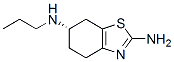
Chemical Structure
Molecular Weight: 211.33
Quality Control
| Related Targets | Adrenergic Receptor AChR 5-HT Receptor COX Calcium Channel Histamine Receptor GABA Receptor TRP Channel Cholinesterase (ChE) GluR |
|---|---|
| Other Dopamine Receptor Inhibitors | MPTP Hydrochloride Trifluoperazine Trifluoperazine 2HCl Penfluridol Sulpiride Levosulpiride SCH-23390 hydrochloride Domperidone Rotundine Azaperone |
Cell Culture, Treatment & Working Concentration
| Cell Lines | Assay Type | Concentration | Incubation Time | Formulation | Activity Description | PMID |
|---|---|---|---|---|---|---|
| CHO cells | Function assay | High inhibition constant against [3H]spiperone binding to human Dopamine receptor D3 expressed in CHO cells, Ki=0.88 nM | ||||
| Click to View More Cell Line Experimental Data | ||||||
Chemical Information, Storage & Stability
| Molecular Weight | 211.33 | Formula | C10H17N3S |
Storage (From the date of receipt) | |
|---|---|---|---|---|---|
| CAS No. | 104632-26-0 | Download SDF | Storage of Stock Solutions |
|
|
| Synonyms | SND 919,Mirapexin,Sifrol,Mirapex | Smiles | CCCNC1CCC2=C(C1)SC(=N2)N | ||
Solubility
|
In vitro |
DMSO
: 42 mg/mL
(198.74 mM)
Ethanol : 42 mg/mL Water : Insoluble |
Molarity Calculator
|
In vivo |
|||||
In vivo Formulation Calculator (Clear solution)
Step 1: Enter information below (Recommended: An additional animal making an allowance for loss during the experiment)
Step 2: Enter the in vivo formulation (This is only the calculator, not formulation. Please contact us first if there is no in vivo formulation at the solubility Section.)
Calculation results:
Working concentration: mg/ml;
Method for preparing DMSO master liquid: mg drug pre-dissolved in μL DMSO ( Master liquid concentration mg/mL, Please contact us first if the concentration exceeds the DMSO solubility of the batch of drug. )
Method for preparing in vivo formulation: Take μL DMSO master liquid, next addμL PEG300, mix and clarify, next addμL Tween 80, mix and clarify, next add μL ddH2O, mix and clarify.
Method for preparing in vivo formulation: Take μL DMSO master liquid, next add μL Corn oil, mix and clarify.
Note: 1. Please make sure the liquid is clear before adding the next solvent.
2. Be sure to add the solvent(s) in order. You must ensure that the solution obtained, in the previous addition, is a clear solution before proceeding to add the next solvent. Physical methods such as vortex, ultrasound or hot water bath can be used to aid dissolving.
Mechanism of Action
| Targets/IC50/Ki |
D3 receptor
0.5 nM(Ki)
D2L Receptor
2.2 nM(Ki)
D2S Receptor
3.9 nM(Ki)
D4 receptor
5.1 nM(Ki)
|
References |
|---|
Clinical Trial Information
(data from https://clinicaltrials.gov, updated on 2024-05-22)
| NCT Number | Recruitment | Conditions | Sponsor/Collaborators | Start Date | Phases |
|---|---|---|---|---|---|
| NCT06269146 | Not yet recruiting | Anxiety Disorders|Anxiety|Depression|Social Disconnection |
University of California San Diego|National Institute of Mental Health (NIMH)|New York State Psychiatric Institute |
February 2024 | Phase 2 |
| NCT03683225 | Active not recruiting | Idiopathic Parkinson Disease |
Chase Therapeutics Corporation |
April 1 2019 | Phase 2 |
| NCT03642964 | Active not recruiting | Major Depressive Disorder (MDD) |
Chase Therapeutics Corporation |
September 10 2018 | Phase 2 |
| NCT02101138 | Unknown status | Hypereosinophilic Syndrome |
National Institute of Allergy and Infectious Diseases (NIAID)|Knopp Biosciences|National Institutes of Health Clinical Center (CC) |
March 14 2014 | Phase 2 |
| NCT01733199 | Completed | Parkinson''s Disease|Secondary Behavioural Addiction |
Nantes University Hospital |
October 2012 | Phase 4 |
| NCT01607034 | Completed | Healthy Volunteers |
Knopp Biosciences |
June 2012 | Phase 1 |
Tech Support
Tel: +1-832-582-8158 Ext:3
If you have any other enquiries, please leave a message.

Products are for research use only. Not for human use. We do not sell to patients.
©Copyright 2013 Selleck Chemicals. All Rights Reserved.