
research use only
Rizatriptan Benzoate 5-HT Receptor agonist
Cat.No.S1607
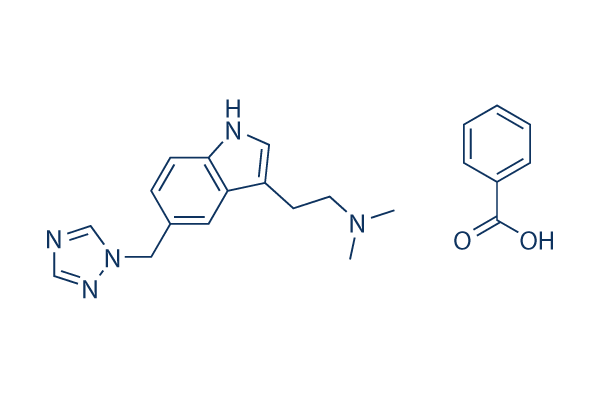
Chemical Structure
Molecular Weight: 391.47
Quality Control
| Related Targets | Adrenergic Receptor AChR COX Calcium Channel Histamine Receptor Dopamine Receptor GABA Receptor TRP Channel Cholinesterase (ChE) GluR |
|---|---|
| Other 5-HT Receptor Inhibitors | WAY-100635 Maleate Serotonin (5-HT) HCl Puerarin BRL-15572 Dihydrochloride SB269970 HCl Ketanserin RS-127445 Nuciferine Flopropione BRL-54443 |
Chemical Information, Storage & Stability
| Molecular Weight | 391.47 | Formula | C22H25N5O2 |
Storage (From the date of receipt) | |
|---|---|---|---|---|---|
| CAS No. | 145202-66-0 | Download SDF | Storage of Stock Solutions |
|
|
| Synonyms | MK-462 Benzoate | Smiles | CN(C)CCC1=CNC2=C1C=C(C=C2)CN3C=NC=N3.C1=CC=C(C=C1)C(=O)O | ||
Solubility
|
In vitro |
DMSO
: 78 mg/mL
(199.24 mM)
Water : 78 mg/mL Ethanol : Insoluble |
Molarity Calculator
|
In vivo |
|||||
In vivo Formulation Calculator (Clear solution)
Step 1: Enter information below (Recommended: An additional animal making an allowance for loss during the experiment)
Step 2: Enter the in vivo formulation (This is only the calculator, not formulation. Please contact us first if there is no in vivo formulation at the solubility Section.)
Calculation results:
Working concentration: mg/ml;
Method for preparing DMSO master liquid: mg drug pre-dissolved in μL DMSO ( Master liquid concentration mg/mL, Please contact us first if the concentration exceeds the DMSO solubility of the batch of drug. )
Method for preparing in vivo formulation: Take μL DMSO master liquid, next addμL PEG300, mix and clarify, next addμL Tween 80, mix and clarify, next add μL ddH2O, mix and clarify.
Method for preparing in vivo formulation: Take μL DMSO master liquid, next add μL Corn oil, mix and clarify.
Note: 1. Please make sure the liquid is clear before adding the next solvent.
2. Be sure to add the solvent(s) in order. You must ensure that the solution obtained, in the previous addition, is a clear solution before proceeding to add the next solvent. Physical methods such as vortex, ultrasound or hot water bath can be used to aid dissolving.
Mechanism of Action
| Targets/IC50/Ki |
5-HT1
|
|---|---|
| In vivo |
Rizatriptan Benzoate blocks neurogenic vasodilation via an action on 5-HT(1D) receptors located on perivascular trigeminal nerves to inhibit CGRP release in anaesthetized guinea-pigs. This compound evokes a transient reduction in dural blood vessel diameter which recovered to baseline values within 10 min in anaesthetized guinea-pigs. It significantly inhibits dural plasma protein extravasation produced by high intensity electrical stimulation of the trigeminal ganglion. This chemical significantly reduces electrically stimulated dural vasodilation in anaesthetised rats. It significantly reduced SP mRNA levels in the midbrains of normal and model group rats, indicating that this compound can downregulate SP gene expression in the rat midbrain. It significantly reduces midbrain PENK mRNA expression, decreasing the levels of midbrain met-enkephalin and leu-enkephalin, and thereby weakening the analgesic effects of the endogenous pain modulatory system in rat model of migraine. This chemical leads to the number of Fos-like immunoreactive neurons decreased in the spinal trigeminal nucleus caudal partand raphe magnus nucleus, increased the number of Fos-like immunoreactive neurons in the periaqueductal gray and remained unchanged in the ventromedial hypothalamic nucleus and mediodorsal thalamus nucleus in conscious rats. It markedly reduces the number of head-flicks in the rats. This compound also significantly reduces the duration of grooming behavior by nearly 2-fold when compared with that without treatment.
|
References |
|
Clinical Trial Information
(data from https://clinicaltrials.gov, updated on 2024-05-22)
| NCT Number | Recruitment | Conditions | Sponsor/Collaborators | Start Date | Phases |
|---|---|---|---|---|---|
| NCT00300924 | Completed | Migraine |
Diamond Headache Clinic|Merck Sharp & Dohme LLC |
March 2006 | Phase 3 |
Tech Support
Tel: +1-832-582-8158 Ext:3
If you have any other enquiries, please leave a message.

Products are for research use only. Not for human use. We do not sell to patients.
©Copyright 2013 Selleck Chemicals. All Rights Reserved.