
research use only
Rosuvastatin calcium HMG-CoA Reductase inhibitor
Cat.No.S2169
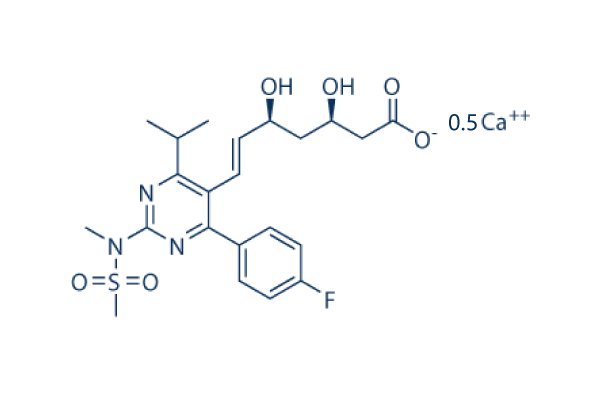
Chemical Structure
Molecular Weight: 500.57
Quality Control
| Related Targets | Dehydrogenase HSP Transferase P450 (e.g. CYP17) PDE phosphatase PPAR Vitamin Carbohydrate Metabolism Mitochondrial Metabolism |
|---|---|
| Other HMG-CoA Reductase Inhibitors | Mevastatin SR-12813 Clinofibrate Dihydrolanosterol 7-ketocholesterol Cerivastatin sodium |
Chemical Information, Storage & Stability
| Molecular Weight | 500.57 | Formula | C22H27FN3O6S.0.5Ca |
Storage (From the date of receipt) | |
|---|---|---|---|---|---|
| CAS No. | 147098-20-2 | Download SDF | Storage of Stock Solutions |
|
|
| Synonyms | ZD4522 calcium | Smiles | CC(C)C1=NC(=NC(=C1C=CC(CC(CC(=O)[O-])O)O)C2=CC=C(C=C2)F)N(C)S(=O)(=O)C.CC(C)C1=NC(=NC(=C1C=CC(CC(CC(=O)[O-])O)O)C2=CC=C(C=C2)F)N(C)S(=O)(=O)C.[Ca+2] | ||
Solubility
|
In vitro |
DMSO
: 100 mg/mL
(199.77 mM)
Water : Insoluble Ethanol : Insoluble |
Molarity Calculator
|
In vivo |
|||||
In vivo Formulation Calculator (Clear solution)
Step 1: Enter information below (Recommended: An additional animal making an allowance for loss during the experiment)
Step 2: Enter the in vivo formulation (This is only the calculator, not formulation. Please contact us first if there is no in vivo formulation at the solubility Section.)
Calculation results:
Working concentration: mg/ml;
Method for preparing DMSO master liquid: mg drug pre-dissolved in μL DMSO ( Master liquid concentration mg/mL, Please contact us first if the concentration exceeds the DMSO solubility of the batch of drug. )
Method for preparing in vivo formulation: Take μL DMSO master liquid, next addμL PEG300, mix and clarify, next addμL Tween 80, mix and clarify, next add μL ddH2O, mix and clarify.
Method for preparing in vivo formulation: Take μL DMSO master liquid, next add μL Corn oil, mix and clarify.
Note: 1. Please make sure the liquid is clear before adding the next solvent.
2. Be sure to add the solvent(s) in order. You must ensure that the solution obtained, in the previous addition, is a clear solution before proceeding to add the next solvent. Physical methods such as vortex, ultrasound or hot water bath can be used to aid dissolving.
Mechanism of Action
| Targets/IC50/Ki |
HMG-CoA reductase
(Cell-free assay) 11 nM
|
|---|---|
| In vitro |
Rosuvastatin is relatively hydrophilic and is highly selective for hepatic cells; its uptake is mediated by the liver-specific organic anion transporter OATP-C. Rosuvastatin is a high-affinity substrate for OATP-C with apparent association constant of 8.5 μM. Rosuvastatin inhibits cholesterol biosynthesis in rat liver isolated hepatocytes with IC50 of 1.12 nM. Rosuvastatin causes approximately 10 times greater increase of mRNA of LDL receptors than pravastatin. Rosuvastatin (100 μM) decreases the extent of U937 adhesion to TNF-α-stimulated HUVEC. Rosuvastatin inhibits the expressions of ICAM-1, MCP-1, IL-8, IL-6, and COX-2 mRNA and protein levels through inhibition of c-Jun N-terminal kinase and nuclear factor-kB in endothelial cells. |
| Kinase Assay |
HMG-CoA Reductase activity assay
|
|
The total volume of each assay is 95 μL and the reaction mixture contained 10 μL of the inhibiting compound to be tested and 85 μL of the incubating buffer containing 2 mg/mL liver microsomes, 0.1 M KH2PO4, pH 7.2, 5.7 mM dithiothreitol, 10 mM glucose-6-phosphate, 2 U/mL glucose-6-phosphate dehydrogenase, 1 mM NADP, 10 μM miconazole. Control experiments are done without NADPH generating system. All samples are incubated 10 min at 37℃ before addition of 5μL of substrate (unlabelled and 14C-HMG-3-hydroxy-3-methyl glutaryl CoA, final concentration 50 μM, 2.5 nCi/nmole). After 30 min at 37℃, the reaction is stopped by adding 27 μL 1N HCl and 20 μL of unlabelled mevalonolactone (200 μg/assay). The conversion of mevalonic acid to lactone is performed at room temperature for 60 min.
|
|
| In vivo |
Rosuvastatin is efficient at reducing plasma lipids. Rosuvastatin (3 mg/kg) daily administration for 14 days decreases plasma cholesterol levels by 26% in male beagle dogs with normal cholesterol levels. In cynomolgus monkeys, Rosuvastatin decreases plasma cholesterol levels by 22% Rosuvastatin (20 mg/kg/day) administration for 2 weeks significantly reduces very low-density lipoproteins (VLDL) in diabetes mellitus rats induced by Streptozocin. Rosuvastatin shows antiatherothrombotic effects in vivo. Rosuvastatin (1.25 mg/kg) significantly inhibits thrombin-induced transmigration of monocytes across mesenteric venules via inhibition of the endothelial cell surface expression of P-selectin, and increases the basal rate of nitric oxide in aortic segments by 2-fold times. Rosuvastatin (20 mg/kg) inhibits ROS production, normalises NO-dependent endothelial function and reduces platelet activation in diabetic rats induced by Streptozocin. Rosuvastatin displays cardioprotective effects in vivo. Rosuvastatin (80 mg) is shown to decrease infarct size and improve cardiac mechanical function after ischemia/reperfusion in an animal model. The cardioprotective properties of Rosuvastatin may be due to the improvement of coronary blood flow, decrease in resistance of coronary arteries mediated by enhanced eNOS expression, and the subsequent increase in the production of vascular endothelial NO. Rosuvastatin (2.0 mg/kg) attenuates left ventricular hypertrophy produced by transaortic constriction in mice through regulation of Rac1 protein and NADPH oxidase activities. |
References |
|
Clinical Trial Information
(data from https://clinicaltrials.gov, updated on 2024-05-22)
| NCT Number | Recruitment | Conditions | Sponsor/Collaborators | Start Date | Phases |
|---|---|---|---|---|---|
| NCT06160414 | Completed | Healthy |
Alexion Pharmaceuticals Inc. |
December 7 2023 | Phase 1 |
Tech Support
Tel: +1-832-582-8158 Ext:3
If you have any other enquiries, please leave a message.

Products are for research use only. Not for human use. We do not sell to patients.
©Copyright 2013 Selleck Chemicals. All Rights Reserved.