
research use only
S 38093 Histamine Receptor antagonist
Cat.No.S8598
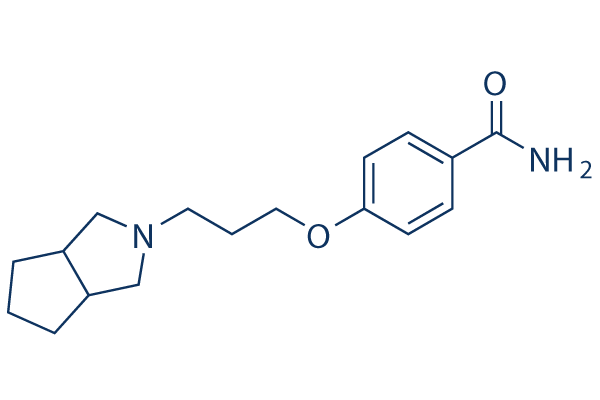
Chemical Structure
Molecular Weight: 288.38
Quality Control
| Related Targets | Adrenergic Receptor AChR 5-HT Receptor COX Calcium Channel Dopamine Receptor GABA Receptor TRP Channel Cholinesterase (ChE) GluR |
|---|---|
| Other Histamine Receptor Inhibitors | GSK2879552 Dihydrochloride JNJ-7777120 Ebastine Ciproxifan Maleate Mianserin HCl Astemizole Lafutidine Mizolastine Rupatadine Fumarate Betahistine 2HCl |
Chemical Information, Storage & Stability
| Molecular Weight | 288.38 | Formula | C17H24N2O2 |
Storage (From the date of receipt) | |
|---|---|---|---|---|---|
| CAS No. | 862896-30-8 | Download SDF | Storage of Stock Solutions |
|
|
| Synonyms | N/A | Smiles | C1CC2CN(CC2C1)CCCOC3=CC=C(C=C3)C(=O)N | ||
Solubility
|
In vitro |
DMSO
: 57 mg/mL
(197.65 mM)
Ethanol : 57 mg/mL Water : Insoluble |
Molarity Calculator
|
In vivo |
|||||
In vivo Formulation Calculator (Clear solution)
Step 1: Enter information below (Recommended: An additional animal making an allowance for loss during the experiment)
Step 2: Enter the in vivo formulation (This is only the calculator, not formulation. Please contact us first if there is no in vivo formulation at the solubility Section.)
Calculation results:
Working concentration: mg/ml;
Method for preparing DMSO master liquid: mg drug pre-dissolved in μL DMSO ( Master liquid concentration mg/mL, Please contact us first if the concentration exceeds the DMSO solubility of the batch of drug. )
Method for preparing in vivo formulation: Take μL DMSO master liquid, next addμL PEG300, mix and clarify, next addμL Tween 80, mix and clarify, next add μL ddH2O, mix and clarify.
Method for preparing in vivo formulation: Take μL DMSO master liquid, next add μL Corn oil, mix and clarify.
Note: 1. Please make sure the liquid is clear before adding the next solvent.
2. Be sure to add the solvent(s) in order. You must ensure that the solution obtained, in the previous addition, is a clear solution before proceeding to add the next solvent. Physical methods such as vortex, ultrasound or hot water bath can be used to aid dissolving.
Mechanism of Action
| Targets/IC50/Ki |
human H3 receptor
1.2 μM(Ki)
mouse H3 receptor
1.44 μM(Ki)
rat H3 receptor
8.8 μM(Ki)
|
|---|---|
| In vitro |
In cellular models, this compound was able to antagonise mice H3 receptors (KB = 0.65 μM) and to suppress cAMP decrease induced by an H3 agonist via human H3 receptors (KB = 0.11 μM). Among the four histaminergic receptor subtypes, it is selective for the H3 receptor, its binding affinity for H1, H2 and H4 receptors being negligible.
|
| In vivo |
S 38093, a novel brain-penetrant antagonist/inverse agonist of H3 receptors, on AHN (proliferation, maturation and survival) in 3-month-old and in aged 16-month-old mice. In aged animals, this compound induced a reversal of age-dependent effects on hippocampal brain-derived neurotrophic factor (BDNF) BDNF-IX, BDNF-IV and BDNF-I transcripts and increased vascular endothelial growth factor (VEGF) expression. The effects of chronic administration of this compound were assessed on a neurogenesis-dependent “context discrimination (CS) test” in aged mice. While ageing altered mouse CS, chronic treatment with this chemical significantly improved CS. Chronic treatment with this compound increases adult hippocampal neurogenesis and may provide an innovative strategy to improve age-associated cognitive deficits. This compound is found to be active at a mean pharmacological dose of 0.3–1 mg/kg p.o./i.p. in animal behavioural tests of working memory (Morris water maze in rats; spontaneous alternation and concurrent serial alternation tests in mice; delayed matching to sample in aged monkeys) and episodic-like memory (social and object recognition tests in rats; contextual discrimination task in mice). It also improves attention, executive functioning, and cognitive flexibility in MPTP-treated monkeys. Moreover, in line with its H3 antagonist/inverse agonist properties, this chemical dose-dependently increases extracellular histamine levels in the prefrontal cortex and facilitates cholinergic transmission in the prefrontal cortex and hippocampus of rats after both acute and chronic administrations. This compound was rapidly absorbed in mouse and rat (Tmax= 0.25-0.5h), slowly in monkey (2h), with a bioavailability ranging from 20 to 60% and t1/2 ranging from 1.5h to 7.4h. The compound was widely distributed with a moderate volume of distribution and low protein binding. The brain distribution of this chemical was rapid and high.
|
References |
|
Tech Support
Tel: +1-832-582-8158 Ext:3
If you have any other enquiries, please leave a message.

Products are for research use only. Not for human use. We do not sell to patients.
©Copyright 2013 Selleck Chemicals. All Rights Reserved.