
research use only
A-804598 P2 Receptor antagonist
Cat.No.S8725
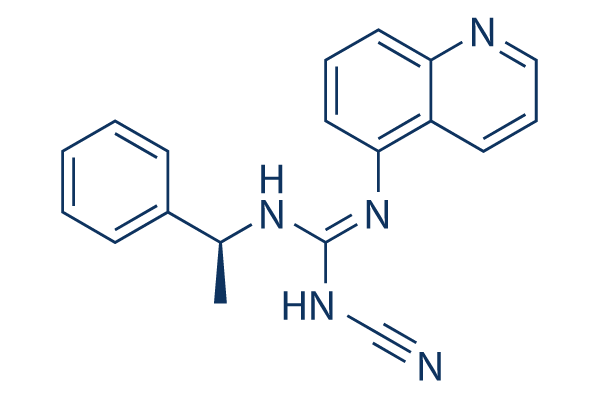
Chemical Structure
Molecular Weight: 315.37
Quality Control
| Related Targets | Adrenergic Receptor AChR 5-HT Receptor COX Calcium Channel Histamine Receptor Dopamine Receptor GABA Receptor TRP Channel Cholinesterase (ChE) |
|---|---|
| Other P2 Receptor Inhibitors | A-438079 Hydrochloride MRS 2578 A-740003 5-BDBD Gefapixant AF-353 A-317491 Minodronic acid Diquafosol Tetrasodium BX430 |
Chemical Information, Storage & Stability
| Molecular Weight | 315.37 | Formula | C19H17N5 |
Storage (From the date of receipt) | |
|---|---|---|---|---|---|
| CAS No. | 1125758-85-1 | -- | Storage of Stock Solutions |
|
|
| Synonyms | N/A | Smiles | CC(C1=CC=CC=C1)N=C(NC#N)NC2=CC=CC3=C2C=CC=N3 | ||
Solubility
|
In vitro |
DMSO
: 63 mg/mL
(199.76 mM)
Ethanol : 6 mg/mL Water : Insoluble |
Molarity Calculator
|
In vivo |
|||||
In vivo Formulation Calculator (Clear solution)
Step 1: Enter information below (Recommended: An additional animal making an allowance for loss during the experiment)
Step 2: Enter the in vivo formulation (This is only the calculator, not formulation. Please contact us first if there is no in vivo formulation at the solubility Section.)
Calculation results:
Working concentration: mg/ml;
Method for preparing DMSO master liquid: mg drug pre-dissolved in μL DMSO ( Master liquid concentration mg/mL, Please contact us first if the concentration exceeds the DMSO solubility of the batch of drug. )
Method for preparing in vivo formulation: Take μL DMSO master liquid, next addμL PEG300, mix and clarify, next addμL Tween 80, mix and clarify, next add μL ddH2O, mix and clarify.
Method for preparing in vivo formulation: Take μL DMSO master liquid, next add μL Corn oil, mix and clarify.
Note: 1. Please make sure the liquid is clear before adding the next solvent.
2. Be sure to add the solvent(s) in order. You must ensure that the solution obtained, in the previous addition, is a clear solution before proceeding to add the next solvent. Physical methods such as vortex, ultrasound or hot water bath can be used to aid dissolving.
Mechanism of Action
| Targets/IC50/Ki |
rat P2X7R
9 nM
rat P2X7R
10 nM
human P2X7R
11 nM
|
|---|---|
| In vitro |
A-804598 represents a structurally novel, competitive, and selective antagonist that has equivalent high affinity at rat (IC50 = 10 nM), mouse (IC50 = 9 nM) and human (IC50 = 11 nM) P2X7 receptors. This compound also potently blocks agonist stimulated release of IL-1β(IC50 of 8.5 nM) and Yo-Pro uptake (IC50 of 8.1 nM) from differentiated THP-1 cells that natively express human P2X7 receptors. Although this compound potently blocks P2X7 receptor activation, at concentrations up to 100 μM, it does not significantly reduce agonist-evoked changes in intracellular calcium concentrations mediated by a variety of other P2X and P2Y receptors. This chemical shows weak or no activity for interating with a large array of G-protein-coupled receptors, enzymes, transporters, and ion channels (CEREP, Poitiers, France)(IC50 > 5-10 μM).
|
| In vivo |
Inhibition of P2X7 through the antagonist A-804598 in SOD1-G93A mice suppresses SQSTM1/p62 up-regulation in lumbar spinal cord.
|
References |
|
Tech Support
Tel: +1-832-582-8158 Ext:3
If you have any other enquiries, please leave a message.

Products are for research use only. Not for human use. We do not sell to patients.
©Copyright 2013 Selleck Chemicals. All Rights Reserved.