
research use only
A66 PI3K inhibitor
Cat.No.S2636
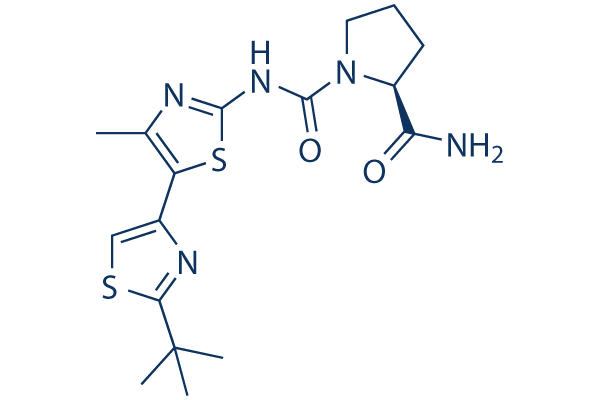
Chemical Structure
Molecular Weight: 393.53
Quality Control
| Related Targets | Akt mTOR GSK-3 ATM/ATR DNA-PK AMPK PDPK1 PTEN PP2A PDK |
|---|---|
| Other PI3K Inhibitors | GDC-0077 (Inavolisib) SAR405 Quercetin (Sophoretin) LY294002 XL147 analogue Tersolisib (STX-478) Buparlisib (BKM120) 740 Y-P (PDGFR 740Y-P) GO-203 TFA Eganelisib (IPI-549) |
Chemical Information, Storage & Stability
| Molecular Weight | 393.53 | Formula | C17H23N5O2S2 |
Storage (From the date of receipt) | |
|---|---|---|---|---|---|
| CAS No. | 1166227-08-2 | Download SDF | Storage of Stock Solutions |
|
|
| Synonyms | N/A | Smiles | CC1=C(SC(=N1)NC(=O)N2CCCC2C(=O)N)C3=CSC(=N3)C(C)(C)C | ||
Solubility
|
In vitro |
DMSO
: 79 mg/mL
(200.74 mM)
Ethanol : 1 mg/mL Water : Insoluble |
Molarity Calculator
|
In vivo |
|||||
In vivo Formulation Calculator (Clear solution)
Step 1: Enter information below (Recommended: An additional animal making an allowance for loss during the experiment)
Step 2: Enter the in vivo formulation (This is only the calculator, not formulation. Please contact us first if there is no in vivo formulation at the solubility Section.)
Calculation results:
Working concentration: mg/ml;
Method for preparing DMSO master liquid: mg drug pre-dissolved in μL DMSO ( Master liquid concentration mg/mL, Please contact us first if the concentration exceeds the DMSO solubility of the batch of drug. )
Method for preparing in vivo formulation: Take μL DMSO master liquid, next addμL PEG300, mix and clarify, next addμL Tween 80, mix and clarify, next add μL ddH2O, mix and clarify.
Method for preparing in vivo formulation: Take μL DMSO master liquid, next add μL Corn oil, mix and clarify.
Note: 1. Please make sure the liquid is clear before adding the next solvent.
2. Be sure to add the solvent(s) in order. You must ensure that the solution obtained, in the previous addition, is a clear solution before proceeding to add the next solvent. Physical methods such as vortex, ultrasound or hot water bath can be used to aid dissolving.
Mechanism of Action
| Features |
Highly selective for the p110α isoform.
|
|---|---|
| Targets/IC50/Ki |
p110α
(Cell-free assay) 32 nM
PI4Kβ
(Cell-free assay) 236 nM
C2β
(Cell-free assay) 462 nM
p110δ
(Cell-free assay) >1.25 μM
|
| In vitro |
In addition to the wild-type p110α, A66 also potently inhibits the oncogenic forms of p110α such as p110α E545K and p110α H1047R with IC50 of 30 nM and 43 nM, respectively. Unlike PIK-75, this compound displays >100 fold selectivity for p110α over other class-I PI3K isoforms. Among the class-II PI3Ks, class-III PI3K and PI4Ks, it only exhibits limited cross-reactivity with the class-II PI3K PI3KC2β and the PI4Kβ isoform of PI4K with IC50 of 462 nM and 236 nM, respectively. This chemical exhibits no inhibitory activity against other lipid kinases or the related kinases DNA-PK and mTOR. It has a higher degree of specificity compared with PIK-75 when tested at 10 μM against two large panels of 110 protein kinases and 318 kinases. Inhibition of p110α alone by this compound treatment is sufficient to block insulin signalling to Akt/PKB in certain cell lines that harbour H1047R mutations in PIK3CA and have high levels of p110α and class-Ia PI3K activity. Its treatment at 0.7 μM induces a 75-80% reduction in focus formation by the highly transforming p85α iSH2 mutants KS459delN, DKRMN-S560del, and K379E, and reduces the phosphorylation of Akt on T308 by all p85 mutants.
|
| In vivo |
A single dose of A66 at 100 mg/kg induces a profound reduction in the phosphorylation of Akt/PKB and p70 S6 kinase, but not of ERK, in SK-OV-3 tumour tissue in vivo at both 1 hour and 6 hours after dosing. This compound dosed at 100 mg/kg once daily (QD) for 21 days or 75 mg/kg twice daily (BID) for 16 days induces a significant delay in growth of SK-OV-3 xenografted tumours with average TGI of 45.9% and 29.9%, respectively, which is even greater than that induced by the well-established pan-PI3K inhibitor BEZ-235. QD dosing of this chemical in the HCT-116 xenograft model also induces a significant reduction in tumour volume with TGI of 77.2%, but causes a non-significant reduction in tumour volume in the U87MG xenograft model. Administration of this agent at 10 mg/kg in male CD1 mice induces significant impairments in the ITT (insulin tolerance test) and GTT (glucose tolerance test), and an increase in glucose production during a PTT (pyruvate tolerance test), almost to the same level as the pan-PI3K inhibitors.
|
References |
|
Clinical Trial Information
(data from https://clinicaltrials.gov, updated on 2024-05-22)
| NCT Number | Recruitment | Conditions | Sponsor/Collaborators | Start Date | Phases |
|---|---|---|---|---|---|
| NCT01046383 | Terminated | NON-SMALL CELL LUNG CANCER |
Immunotec Inc. |
June 2010 | Phase 3 |
Tech Support
Tel: +1-832-582-8158 Ext:3
If you have any other enquiries, please leave a message.

Products are for research use only. Not for human use. We do not sell to patients.
©Copyright 2013 Selleck Chemicals. All Rights Reserved.