
research use only
AMG319 PI3K inhibitor
Cat.No.S7813
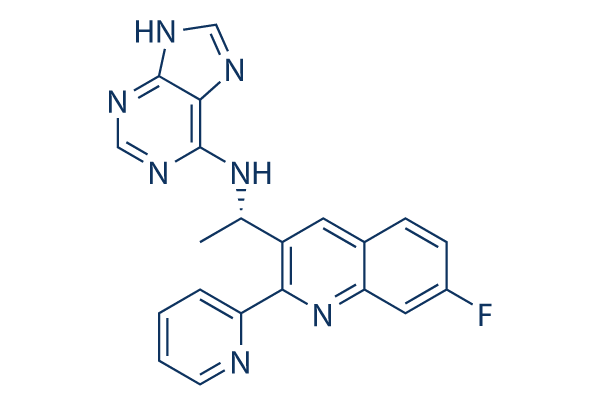
Chemical Structure
Molecular Weight: 385.4
Quality Control
| Related Targets | Akt mTOR GSK-3 ATM/ATR DNA-PK AMPK PDPK1 PTEN PP2A PDK |
|---|---|
| Other PI3K Inhibitors | GDC-0077 (Inavolisib) SAR405 Quercetin (Sophoretin) LY294002 XL147 analogue Tersolisib (STX-478) Buparlisib (BKM120) 740 Y-P (PDGFR 740Y-P) GO-203 TFA Eganelisib (IPI-549) |
Chemical Information, Storage & Stability
| Molecular Weight | 385.4 | Formula | C21H16FN7 |
Storage (From the date of receipt) | |
|---|---|---|---|---|---|
| CAS No. | 1608125-21-8 | Download SDF | Storage of Stock Solutions |
|
|
| Synonyms | N/A | Smiles | CC(C1=C(N=C2C=C(C=CC2=C1)F)C3=CC=CC=N3)NC4=NC=NC5=C4NC=N5 | ||
Solubility
|
In vitro |
DMSO
: 77 mg/mL
(199.79 mM)
Ethanol : 77 mg/mL Water : Insoluble |
Molarity Calculator
|
In vivo |
|||||
In vivo Formulation Calculator (Clear solution)
Step 1: Enter information below (Recommended: An additional animal making an allowance for loss during the experiment)
Step 2: Enter the in vivo formulation (This is only the calculator, not formulation. Please contact us first if there is no in vivo formulation at the solubility Section.)
Calculation results:
Working concentration: mg/ml;
Method for preparing DMSO master liquid: mg drug pre-dissolved in μL DMSO ( Master liquid concentration mg/mL, Please contact us first if the concentration exceeds the DMSO solubility of the batch of drug. )
Method for preparing in vivo formulation: Take μL DMSO master liquid, next addμL PEG300, mix and clarify, next addμL Tween 80, mix and clarify, next add μL ddH2O, mix and clarify.
Method for preparing in vivo formulation: Take μL DMSO master liquid, next add μL Corn oil, mix and clarify.
Note: 1. Please make sure the liquid is clear before adding the next solvent.
2. Be sure to add the solvent(s) in order. You must ensure that the solution obtained, in the previous addition, is a clear solution before proceeding to add the next solvent. Physical methods such as vortex, ultrasound or hot water bath can be used to aid dissolving.
Mechanism of Action
| Targets/IC50/Ki |
PI3Kδ
18 nM
PI3Kγ
850 nM
|
|---|---|
| In vitro |
AMG319 inhibits anti-IgM/CD40L-induced B cell proliferation with IC50 of 8.6 nM and reduces pAkt level with IC50 of 1.5 nM. This compound also inhibits anti-IgD-induced CD-69 expression in HWB.
|
| Kinase Assay |
PI3K Enzyme Assays
|
|
A PI3K Alphascreen assay is used to measure the activity of a panel of four phosphoinositide 3-kinases: PI3Kα, PI3Kβ, PI3Kγ, and PI3Kδ. Enzyme reaction buffer is prepared using sterile water and 50 mM Tris-HCl, pH 7, 14 mM MgCl2, 2 mM sodium cholate, and 100 mM NaCl. 2 mM DTT is added fresh on the day of the experiment. The Alphascreen buffer is made using sterile water and 10 mM Tris-HCl, pH 7.5, 150 mM NaCl, 0.10% Tween 20, and 30 mM EDTA. Then 1 mM DTT is added fresh on the day of the experiment. Compound source plates used for this assay are 384-well Greiner clear polypropylene plates containing test compounds at 5 mM and diluted 1:2 over 22 concentrations. Columns 23 and 24 contained only DMSO, as these wells comprised the positive and negative controls, respectively. Source plates are replicated by transferring 0.5 μL per well into 384-well Optiplates. Each PI3K isoform is diluted in enzyme reaction buffer to 2× working stocks. PI3Kα is diluted to 1.6 nM, PI3Kβ is diluted to 0.8 nM, PI3Kγ is diluted to 15 nM, and PI3Kδ is diluted to 1.6 nM. PI(4,5)P2 is diluted to 10 μM, and ATP was diluted to 20 μM. This 2× stock is used in the assays for PI3Kα and PI3Kβ. For assay of PI3Kγ and PI3Kδ, PI(4,5)P2 is diluted to 10 μM and ATP was diluted to 8 μM to prepare a similar 2× working stock. Alphascreen reaction solutions are made using beads from the anti-GST Alphascreen kit. Two 4× working stocks of the Alphascreen reagents are made in Alphascreen reaction buffer. In one stock, biotinylated-IP4 is diluted to 40 nM and streptavidin-donor beads are diluted to 80 μg/mL. In the second stock, PIP3-binding protein is diluted to 40 nM and anti-GST-acceptor beads were diluted to 80 μg/mL. As a negative control, a reference inhibitor at a concentration ≫Ki (40 μM) is included in column 24 as a negative (100% inhibition) control. Using a 384-well Multidrop, 10 μL/well of 2× enzyme stock is added to columns 1–24 of the assay plates for each isoform. An amount of 10 μL/well of the appropriate substrate 2× stock (containing 20 μM ATP for the PI3Kα and -β assays and containing 8 μM ATP for the PI3Kγ and -δ assays) is then added to columns 1–24 of all plates. Plates are then incubated at room temperature for 20 min. In the dark, 10 μL/well of the donor bead solution is added to columns 1–24 of the plates to quench the enzyme reaction. The plates are incubated at room temperature for 30 min. Still in the dark, 10 μL/well of the acceptor bead solution is added to columns 1–24 of the plates. The plates are then incubated in the dark for 1.5 h. The plates are read on an Envision multimode plate reader using a 680 nm excitation filter and a 520–620 nm emission filter.
|
|
| In vivo |
In female Lewis rats, AMG319 (3 mg/kg, p.o.) inhibits the KLH-induced inflammatory response by 88%. In the transgenic (IgMm) mice, this compound (, p.o.) inhibits in vivo pAKT with an IC50 of 1.9 nM.
|
References |
Clinical Trial Information
(data from https://clinicaltrials.gov, updated on 2024-05-22)
| NCT Number | Recruitment | Conditions | Sponsor/Collaborators | Start Date | Phases |
|---|---|---|---|---|---|
| NCT02540928 | Terminated | Human Papillomavirus (HPV)|Positive or Negative Head and Neck Squamous Cell Carcinoma (HNSCC) of the Hypopharynx Oropharynx Oral Cavity Supraglottis or Larynx |
Cancer Research UK |
October 2015 | Phase 2 |
Tech Support
Tel: +1-832-582-8158 Ext:3
If you have any other enquiries, please leave a message.

Products are for research use only. Not for human use. We do not sell to patients.
©Copyright 2013 Selleck Chemicals. All Rights Reserved.