
research use only
Amoxapine GlyT inhibitor
Cat.No.S4218
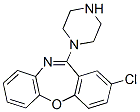
Chemical Structure
Molecular Weight: 313.78
Quality Control
| Related Targets | Adrenergic Receptor AChR 5-HT Receptor COX Calcium Channel Histamine Receptor Dopamine Receptor GABA Receptor TRP Channel Cholinesterase (ChE) |
|---|---|
| Other GlyT Inhibitors | Bitopertin Iclepertin |
Chemical Information, Storage & Stability
| Molecular Weight | 313.78 | Formula | C17H16ClN3O |
Storage (From the date of receipt) | |
|---|---|---|---|---|---|
| CAS No. | 14028-44-5 | Download SDF | Storage of Stock Solutions |
|
|
| Synonyms | CL 67772,Asendin | Smiles | C1CN(CCN1)C2=NC3=CC=CC=C3OC4=C2C=C(C=C4)Cl | ||
Solubility
|
In vitro |
DMSO
: 3.1 mg/mL
(9.87 mM)
Water : Insoluble Ethanol : Insoluble |
Molarity Calculator
|
In vivo |
|||||
In vivo Formulation Calculator (Clear solution)
Step 1: Enter information below (Recommended: An additional animal making an allowance for loss during the experiment)
Step 2: Enter the in vivo formulation (This is only the calculator, not formulation. Please contact us first if there is no in vivo formulation at the solubility Section.)
Calculation results:
Working concentration: mg/ml;
Method for preparing DMSO master liquid: mg drug pre-dissolved in μL DMSO ( Master liquid concentration mg/mL, Please contact us first if the concentration exceeds the DMSO solubility of the batch of drug. )
Method for preparing in vivo formulation: Take μL DMSO master liquid, next addμL PEG300, mix and clarify, next addμL Tween 80, mix and clarify, next add μL ddH2O, mix and clarify.
Method for preparing in vivo formulation: Take μL DMSO master liquid, next add μL Corn oil, mix and clarify.
Note: 1. Please make sure the liquid is clear before adding the next solvent.
2. Be sure to add the solvent(s) in order. You must ensure that the solution obtained, in the previous addition, is a clear solution before proceeding to add the next solvent. Physical methods such as vortex, ultrasound or hot water bath can be used to aid dissolving.
Mechanism of Action
| Targets/IC50/Ki |
GlyT2a
92 μM
GlyT1b
1 mM
|
|---|---|
| In vitro |
Amoxapine displays a selective inhibition of GLYT2a behaving as a 10 fold more efficient inhibitor of this isoform than of GLYT1b in human embryonic kidney 293 cells. This compound behaves as a competitive inhibitor of both glycine and chloride and a mixed-type inhibitor with respect to sodium. It causes acute hERG blockade in oocytes with IC50 of 21.6 mM and in HEK 293 cells with IC50 of 5.1 mM. This chemical block is reverse frequency-dependent and causes accelerated and leftward-shifted inactivation. Its application results in chronic reduction of hERG trafficking into the cell surface membrane with IC50 of 15.3 mM in HEK 293 cells. |
| In vivo |
Amoxapine (10 mg/kg i.p., daily) does not affect the levels of dynorphin, substance P and cholecystokinin, but markedly enhances the levels of leu-enkephalin in spinal cord, cerebral cortex and hypothalamus of rats. This compound (10 mg/kg i.p., daily) results in no changes in opioid receptors in the cerebral cortex, but the densities of delta and mu opioid binding sites are increased in the spinal cord, and decreased in the hypothalamus of rats. This chemical (1 mg/kg, 5 mg/kg and 10 mg/kg; i.p.) decreases paradoxical sleep and increases deep slow wave sleep especially when it is given at a low dose. It (10 mg/kg; i.p.) induces a sustained decrease of paradoxical sleep during the whole treatment, while some tolerance is observed with regard to the inhibitory effect of cericlamine on this state of sleep. It decreases locomotor activity, induce ptosis and catalepsy, inhibits apomorphine gnawing and amphetamine stereotyped behavior and by characteristic changes in monkey discriminated avoidance behavior. |
References |
|
Tech Support
Tel: +1-832-582-8158 Ext:3
If you have any other enquiries, please leave a message.

Products are for research use only. Not for human use. We do not sell to patients.
©Copyright 2013 Selleck Chemicals. All Rights Reserved.