
research use only
Astilbin Immunology & Inflammation related chemical
Cat.No.S3932
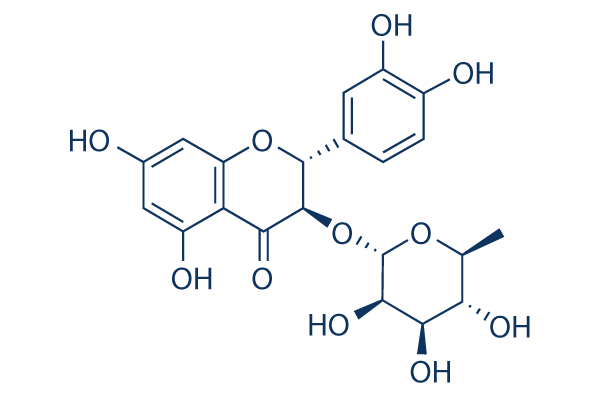
Chemical Structure
Molecular Weight: 450.39
Quality Control
| Related Targets | PD-1/PD-L1 CXCR STING AhR CD markers Interleukins Anti-infection Antioxidant COX Histamine Receptor |
|---|---|
| Other Immunology & Inflammation related Inhibitors | Cl-amidine Bestatin (Ubenimex) Bindarit (AF 2838) Tranilast Tempol Sinomenine GI254023X (GI4023) ATP Geniposidic acid CORM-3 |
Chemical Information, Storage & Stability
| Molecular Weight | 450.39 | Formula | C21H22O11 |
Storage (From the date of receipt) | |
|---|---|---|---|---|---|
| CAS No. | 29838-67-3 | Download SDF | Storage of Stock Solutions |
|
|
| Synonyms | Isoastilbin, Neoastilbin, Neoisoastilbin, Taxifolin 3-O-rhamnoside, Taxifolin 3-rhamnoside | Smiles | CC1C(C(C(C(O1)OC2C(OC3=CC(=CC(=C3C2=O)O)O)C4=CC(=C(C=C4)O)O)O)O)O | ||
Solubility
|
In vitro |
DMSO
: 90 mg/mL
(199.82 mM)
|
Molarity Calculator
|
In vivo |
|||||
In vivo Formulation Calculator (Clear solution)
Step 1: Enter information below (Recommended: An additional animal making an allowance for loss during the experiment)
Step 2: Enter the in vivo formulation (This is only the calculator, not formulation. Please contact us first if there is no in vivo formulation at the solubility Section.)
Calculation results:
Working concentration: mg/ml;
Method for preparing DMSO master liquid: mg drug pre-dissolved in μL DMSO ( Master liquid concentration mg/mL, Please contact us first if the concentration exceeds the DMSO solubility of the batch of drug. )
Method for preparing in vivo formulation: Take μL DMSO master liquid, next addμL PEG300, mix and clarify, next addμL Tween 80, mix and clarify, next add μL ddH2O, mix and clarify.
Method for preparing in vivo formulation: Take μL DMSO master liquid, next add μL Corn oil, mix and clarify.
Note: 1. Please make sure the liquid is clear before adding the next solvent.
2. Be sure to add the solvent(s) in order. You must ensure that the solution obtained, in the previous addition, is a clear solution before proceeding to add the next solvent. Physical methods such as vortex, ultrasound or hot water bath can be used to aid dissolving.
Mechanism of Action
| In vitro |
In vitro, Astilbin inhibits Th17 cell differentiation and IL-17 secretion of isolated T cells, and inhibits Jak/Stat3 signalling in Th17 cells, while up-regulating Stat3 inhibitor SCOSE3 expression in psoriatic lesions. This compound has been reported to possess multiple clinically relevant bioactivities, including antioxidant, anti-inflammatory, anti-arthritic, and anti-diabetic nephropathy properties. Nevertheless, the molecular mechanisms by which this chemical interacts with inflammatory processes are poorly understood. It not only inhibits T lymphocyte function in acute heart allograft rejection, but also inhibits migration and antigen presenting of dendritic cells (DCs).
|
|---|---|
| In vivo |
Astilbin is reported to reduce activation of both T and B cells in lupus-prone mice. It significantly inhibits inflammatory responses and keratinocyte over-proliferation in a mouse model of imiquimod (IMQ)-induced psoriasis. This compound undergoes extensive biotransformation specifically due to enzyme catechol-O-methyl transferase. It gives rise to 3′-O-methylastilbin, a major metabolite of this chemical, which plays important role against the inhibition activated T lymphocytes. The pharmacokinetic parameters of this compound followed by intragastric administration Astilbin (40 mg/kg): Cmax=37.7±14.7 ng/mL, Tmax=25.8±34.3 min, t1/2=161.6±44.1 min.
|
References |
|
Tech Support
Tel: +1-832-582-8158 Ext:3
If you have any other enquiries, please leave a message.

Products are for research use only. Not for human use. We do not sell to patients.
©Copyright 2013 Selleck Chemicals. All Rights Reserved.