
research use only
AZD2858 GSK-3 inhibitor
Cat.No.S7253
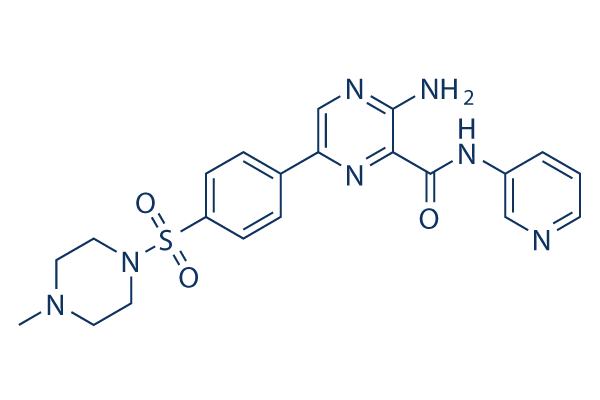
Chemical Structure
Molecular Weight: 453.52
Quality Control
| Related Targets | PI3K Akt mTOR ATM/ATR DNA-PK AMPK PDPK1 PTEN PP2A PDK |
|---|---|
| Other GSK-3 Inhibitors | CHIR-99021 (Laduviglusib) Laduviglusib (CHIR-99021) Hydrochloride SB216763 CHIR-98014 TWS119 GSK-3 Inhibitor IX (BIO) LY2090314 Tideglusib SB415286 AR-A014418 |
Chemical Information, Storage & Stability
| Molecular Weight | 453.52 | Formula | C21H23N7O3S |
Storage (From the date of receipt) | |
|---|---|---|---|---|---|
| CAS No. | 486424-20-8 | Download SDF | Storage of Stock Solutions |
|
|
| Synonyms | N/A | Smiles | CN1CCN(CC1)S(=O)(=O)C2=CC=C(C=C2)C3=CN=C(C(=N3)C(=O)NC4=CN=CC=C4)N | ||
Solubility
|
In vitro |
DMSO
: 7 mg/mL
(15.43 mM)
Water : Insoluble Ethanol : Insoluble |
Molarity Calculator
|
In vivo |
|||||
In vivo Formulation Calculator (Clear solution)
Step 1: Enter information below (Recommended: An additional animal making an allowance for loss during the experiment)
Step 2: Enter the in vivo formulation (This is only the calculator, not formulation. Please contact us first if there is no in vivo formulation at the solubility Section.)
Calculation results:
Working concentration: mg/ml;
Method for preparing DMSO master liquid: mg drug pre-dissolved in μL DMSO ( Master liquid concentration mg/mL, Please contact us first if the concentration exceeds the DMSO solubility of the batch of drug. )
Method for preparing in vivo formulation: Take μL DMSO master liquid, next addμL PEG300, mix and clarify, next addμL Tween 80, mix and clarify, next add μL ddH2O, mix and clarify.
Method for preparing in vivo formulation: Take μL DMSO master liquid, next add μL Corn oil, mix and clarify.
Note: 1. Please make sure the liquid is clear before adding the next solvent.
2. Be sure to add the solvent(s) in order. You must ensure that the solution obtained, in the previous addition, is a clear solution before proceeding to add the next solvent. Physical methods such as vortex, ultrasound or hot water bath can be used to aid dissolving.
Mechanism of Action
| Targets/IC50/Ki |
GSK-3
68 nM
|
|---|---|
| In vitro |
AZD2858 is a selective GSK-3 inhibitor with an IC50 of 68 nM, inhibits tau phosphorylation at the S396 site, activates Wnt signaling pathway. This compound treatment (1 μM, 12 h) on primary isolated human osteoblast-like cells results in a 3-fold increase of β-catenin levels. It causes β-catenin stabilisation in human and rat mesenchymal stem cells, stimulates hADSC commitment towards osteoblasts and osteogenic mineralisation in vitro.
|
| Kinase Assay |
Tau phosphorylation assay
|
|
NIH-3T3 cells expressing 4-repeat Tau are used to assess functional activity of AZD2858 in vitro. The cells are grown in DMEM media and 2 mM L-glut, and 10% HiFCS, and plated at a concentration of 6×10⁵ cells/well in 6-well plates. In each experiment, this compound is dosed in triplicates at a concentration of 1, 10, 100, 500, 1000, 2000 and 10,000 nM. Cells are treated for 4 h prior to cell lysis using 100 μL ice cold lysis buffer (0.5% NP-40, 10 mM Tris, pH 7.2, 150 mM NaCl, 2 mM EDTA). A suspension is made with addition of protease and phosphatase inhibitors: 50 mM NaF, 0.2 mM NaVO4 and Cocktail Protease inhibitors. The solution is then snap frozen at −80 °C for at least 1 h, before thawing on ice and lysate clarification by centrifugation, followed by Western blot according to standard protocols. After blocking, the blots are exposed to the primary antibody, Phospho-Ser396-tau (1:1000) over night, washed and incubated with the secondary antibody (donkey anti-rabbit, 1:5000), followed by a final wash. For re-probing, the primary antibody Tau5 (1:200) and the secondary horseradish peroxidase linked antibody (sheep anti-mouse, 1:10000) are used. All blots are developed using ECL Western blot detection reagents, Kodak X-ray films, quantified using densitometric analysis, and the ratio of S396 tau to total tau (tau5) is calculated.
|
|
| In vivo |
In rats, oral AZD2858 treatment causes a dose-dependent increase in trabecular bone mass compared to control after a two-week treatment with a maximum effect at a dose of 20 mg/kg once daily (total BMC: 172% of control). A small but significant effect is also seen at cortical sites (total BMC: 111% of control). This compound (30 μmol/kg) on rats daily for up to 3 weeks shows an increase in both mineral density (of 28% at 2 weeks and 38% at 3 weeks) and mineral content (of 81% at 2 weeks and 93% at 3 weeks) in the calluses. This treatment makes the fractures heals more rapidly, with a bony callus without an obvious endochondral component. It produces time-dependent changes in serum bone turnover biomarkers and increases bone mass over 28 days exposure in rats. After 7 days, this compound increases the bone formation biomarker P1NP, and reduces the resorption biomarker TRAcP-5b, indicating increased bone anabolism and reduced resorption in rats.
|
References |
|
Tech Support
Tel: +1-832-582-8158 Ext:3
If you have any other enquiries, please leave a message.

Products are for research use only. Not for human use. We do not sell to patients.
©Copyright 2013 Selleck Chemicals. All Rights Reserved.