
research use only
C646 Histone Acetyltransferase p300 Inhibitor
Cat.No.S7152
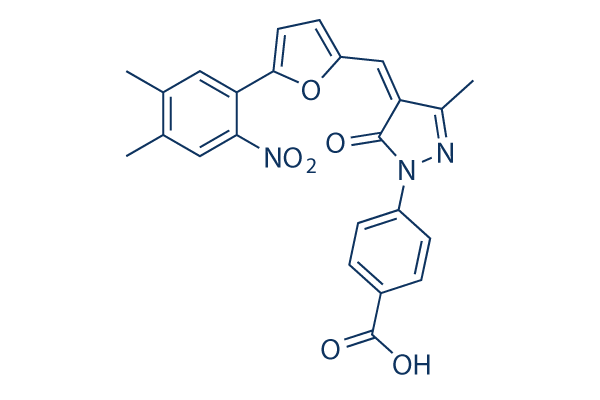
Chemical Structure
Molecular Weight: 445.42
Quality Control
Cell Culture, Treatment & Working Concentration
| Cell Lines | Assay Type | Concentration | Incubation Time | Formulation | Activity Description | PMID |
|---|---|---|---|---|---|---|
| NE-4C cells | Function assay | 0-5 μM | high glucose induced increases of H4K5ac and H4K5/8/12/16ac levels in NE-4C cells are inhibited by addition of a selective CBP/p300 inhibitor C646 in a dose-dependent way (from 0 to 5 μM) | 30114346 | ||
| SH-SY5Y | Function assay | 20 μM | 24 h | Co-treatment with 20 µM C646 suppressed the effect of TSA treatment on Alox15 mRNA expression by 65.7% | 29235036 | |
| GES-1 | Function assay | 10 μM | 6 h | C646 treatment significantly reduced the levels of histone H3 acetylation in both GC cells and normal gastric epithelial cells (P<0.05) | 29075795 | |
| SGC-7901 | Function assay | 10 μM | 6 h | C646 treatment significantly reduced the levels of histone H3 acetylation in both GC cells and normal gastric epithelial cells (P<0.05) | 29075795 | |
| MKN45 | Function assay | 10 μM | 6 h | C646 treatment significantly reduced the levels of histone H3 acetylation in both GC cells and normal gastric epithelial cells (P<0.05) | 29075795 | |
| MGC-803 | Function assay | 10 μM | 6 h | C646 treatment significantly reduced the levels of histone H3 acetylation in both GC cells and normal gastric epithelial cells (P<0.05) | 29075795 | |
| BGC-823 | Function assay | 10 μM | 6 h | C646 treatment significantly reduced the levels of histone H3 acetylation in both GC cells and normal gastric epithelial cells (P<0.05) | 29075795 | |
| KATO III | Function assay | 10 μM | 6 h | C646 treatment significantly reduced the levels of histone H3 acetylation in both GC cells and normal gastric epithelial cells (P<0.05) | 29075795 | |
| Raw246.7 | Function assay | 1, 5, 10, 15, 20, 25, or 30 μM | 16 h | results in significant inhibition of LPS and IFNγ induced NF-κB promoter activity at 15 μM or higher concentrations | 26718586 | |
| WM35 | Function assay | 10 μM and 20 μM | 24 h | a dose-dependent decrease in the protein levels of cyclins A and E, accompanied by an increased expression of p53 and its downstream effector p21 | 23698071 | |
| 1205Lu | Function assay | 10 μM and 20 μM | 24 h | a dose-dependent decrease in the protein levels of cyclins A and E, accompanied by an increased expression of p53 and its downstream effector p21 | 23698071 | |
| WM983B | Function assay | 10 μM and 20 μM | 24 h | a dose-dependent decrease in the protein levels of cyclins A and E, accompanied by an increased expression of p53 and its downstream effector p21 | 23698071 | |
| Kasumi-1 | Growth inhibition assay | 10, 25 and 50 μM | 0, 24, 48, 72 h | cellular growth and colony formation were dramatically suppressed upon C646 treatment. | 23390536 | |
| SKNO-1 | Growth inhibition assay | 10, 25 and 50 μM | 0, 24, 48, 72 h | cellular growth and colony formation were dramatically suppressed upon C646 treatment. | 23390536 | |
| BL21(RIL)-DE3 | Function assay | 10 mins | Inhibition of synthetic VMA-tagged p300 (1287 to 1652 residues) (unknown origin) expressed in Escherichia coli BL21(RIL)-DE3 cells using H4-15 peptide substrate incubated for 10 mins by radiometric filter binding assay in presence of [14C]acetyl-CoA, Ki = 0.4 μM. | 26701186 | ||
| BL21(RIL)-DE3 | Function assay | 10 mins | Inhibition of synthetic VMA-tagged p300 (1287 to 1652 residues) (unknown origin) expressed in Escherichia coli BL21(RIL)-DE3 cells using H4-15 peptide substrate incubated for 10 mins by radiometric filter binding assay in presence of [14C]acetyl-CoA, IC50 = 1.6 μM. | 26701186 | ||
| BL21-CodonPlus(DE3)-RIL | Function assay | 10 mins | Inhibition of FLAG-tagged p300 (1195 to 1673 residues) (unknown origin) expressed in competent Escherichia coli BL21-CodonPlus(DE3)-RIL cells using histone H4 substrate incubated for 10 mins by scintillation counting method in presence of [14C]acetyl-CoA, IC50 = 9 μM. | 26701186 | ||
| Click to View More Cell Line Experimental Data | ||||||
Chemical Information, Storage & Stability
| Molecular Weight | 445.42 | Formula | C24H19N3O6 |
Storage (From the date of receipt) | |
|---|---|---|---|---|---|
| CAS No. | 328968-36-1 | Download SDF | Storage of Stock Solutions |
|
|
| Synonyms | N/A | Smiles | CC1=CC(=C(C=C1C)[N+](=O)[O-])C2=CC=C(O2)C=C3C(=NN(C3=O)C4=CC=C(C=C4)C(=O)O)C | ||
Solubility
|
In vitro |
DMSO
: 11 mg/mL
(24.69 mM)
Water : Insoluble Ethanol : Insoluble |
Molarity Calculator
|
In vivo |
|||||
In vivo Formulation Calculator (Clear solution)
Step 1: Enter information below (Recommended: An additional animal making an allowance for loss during the experiment)
Step 2: Enter the in vivo formulation (This is only the calculator, not formulation. Please contact us first if there is no in vivo formulation at the solubility Section.)
Calculation results:
Working concentration: mg/ml;
Method for preparing DMSO master liquid: mg drug pre-dissolved in μL DMSO ( Master liquid concentration mg/mL, Please contact us first if the concentration exceeds the DMSO solubility of the batch of drug. )
Method for preparing in vivo formulation: Take μL DMSO master liquid, next addμL PEG300, mix and clarify, next addμL Tween 80, mix and clarify, next add μL ddH2O, mix and clarify.
Method for preparing in vivo formulation: Take μL DMSO master liquid, next add μL Corn oil, mix and clarify.
Note: 1. Please make sure the liquid is clear before adding the next solvent.
2. Be sure to add the solvent(s) in order. You must ensure that the solution obtained, in the previous addition, is a clear solution before proceeding to add the next solvent. Physical methods such as vortex, ultrasound or hot water bath can be used to aid dissolving.
Mechanism of Action
| Features |
Extensively used as a pharmacologic probe in cancer cells. Potential use for prostate and lung cancers.
|
|---|---|
| Targets/IC50/Ki |
p300/CBP
(Cell-free assay) 400 nM(Ki)
|
| In vitro |
C646 is an inhibitor for histone acetyltransferase, inhibits p300 with a Ki of 400 nM and is selective versus other acetyltransferases. This compound produces 86% inhibition of p300 in vitro at 10 μM. It is a classical reversible p300 inhibitor. This chemical treatment (25μM) reduces histone H3 and H4 acetylation levels and abrogates TSA-induced acetylation in cells. It (20μM) induces apoptosis in androgen-sensitive and castration-resistant prostate cancer cell lines by interfering with AR and NF-kB pathways. This compound blocks dynamic acetylation of H3K4me3 globally in mouse and fly cells, and locally across the promoter and start-site of inducible genes in the mouse, thereby disrupting RNA polymerase II association and the activation of these genes.
|
| Kinase Assay |
Radioactive assay
|
|
IC50 values for the putative p300 HAT inhibitors are determined using the direct radioactive assay described above. Reactions are performed in 20 mM HEPES (pH 7.9), and contained 5 mM DTT, 80μM EDTA, 40μg/ml BSA, 100μM H4-15, and 5 nM p300. Putative inhibitors are added over a range of concentrations, with DMSO concentration kept constant (<5%). Reactions are incubated at 30°C for 10 min, then initiated with addition of a 1:1 mixture of 12C-acetyl-CoA and 14C-acetyl-CoA to 20 mM. After 10 min at 30°C, reactions are quenched with 14% SDS (w/v). All concentrations are screened in duplicate. Gels are run, washed, dried, and exposed to a PhosphorImager plate, and production of Ac-H4-15 quantified to obtain IC50s.
|
|
| In vivo |
C646 infused into the ILPFC immediately after weak extinction training enhances the consolidation of fear extinction memory. This compound attenuates mechanical allodynia and thermal hyperalgesia, accompanied by a suppressed COX-2 expression, in the spinal cord.
|
References |
|
Applications
| Methods | Biomarkers | Images | PMID |
|---|---|---|---|
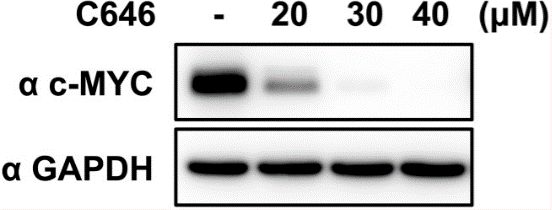
| Western blot | α-c-Myc Cyclin A1/2 / Cyclin E2 / p53 / p21 H3K27Ac |
|
28630312 |
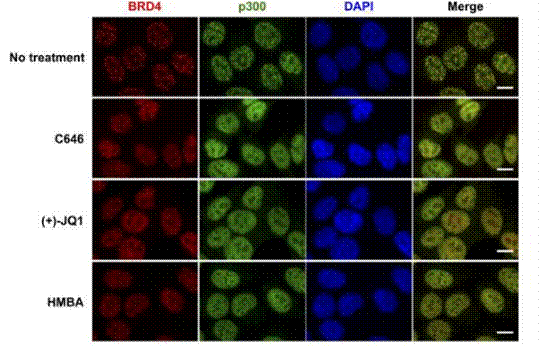
| Immunofluorescence | BRD4 / p300 |
|
28630312 |
Tech Support
Tel: +1-832-582-8158 Ext:3
If you have any other enquiries, please leave a message.
Frequently Asked Questions
Question 1:
I am planning to conduct IP studies in mice with it, any specific vehicle that you can recommend to me?
Answer:
It can be dissolved in 5% DMSO+30% PEG 300+ddH2O at 1 mg/ml as a clear solution, and should be ok for i.p. injection.

Products are for research use only. Not for human use. We do not sell to patients.
©Copyright 2013 Selleck Chemicals. All Rights Reserved.