
research use only
Diammonium Glycyrrhizinate Immunology & Inflammation related inhibitor
Cat.No.S3622
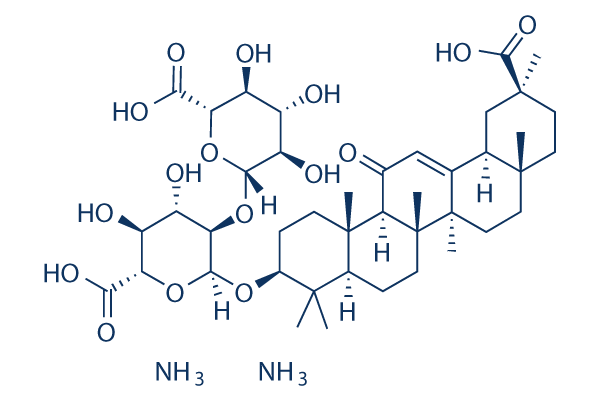
Chemical Structure
Molecular Weight: 856.99
Quality Control
| Related Targets | PD-1/PD-L1 CXCR STING AhR CD markers Interleukins Anti-infection Antioxidant COX Histamine Receptor |
|---|---|
| Other Immunology & Inflammation related Inhibitors | Cl-amidine Bestatin (Ubenimex) Bindarit (AF 2838) Tranilast Tempol Sinomenine GI254023X (GI4023) ATP Geniposidic acid CORM-3 |
Chemical Information, Storage & Stability
| Molecular Weight | 856.99 | Formula | C42H62O16. 2H3N |
Storage (From the date of receipt) | |
|---|---|---|---|---|---|
| CAS No. | 79165-06-3 | Download SDF | Storage of Stock Solutions |
|
|
| Synonyms | N/A | Smiles | CC1(C2CCC3(C(C2(CCC1OC4C(C(C(C(O4)C(=O)O)O)O)OC5C(C(C(C(O5)C(=O)O)O)O)O)C)C(=O)C=C6C3(CCC7(C6CC(CC7)(C)C(=O)O)C)C)C)C.N.N | ||
Solubility
|
In vitro |
DMSO
: 100 mg/mL
(116.68 mM)
Water : 100 mg/mL Ethanol : Insoluble |
Molarity Calculator
|
In vivo |
|||||
In vivo Formulation Calculator (Clear solution)
Step 1: Enter information below (Recommended: An additional animal making an allowance for loss during the experiment)
Step 2: Enter the in vivo formulation (This is only the calculator, not formulation. Please contact us first if there is no in vivo formulation at the solubility Section.)
Calculation results:
Working concentration: mg/ml;
Method for preparing DMSO master liquid: mg drug pre-dissolved in μL DMSO ( Master liquid concentration mg/mL, Please contact us first if the concentration exceeds the DMSO solubility of the batch of drug. )
Method for preparing in vivo formulation: Take μL DMSO master liquid, next addμL PEG300, mix and clarify, next addμL Tween 80, mix and clarify, next add μL ddH2O, mix and clarify.
Method for preparing in vivo formulation: Take μL DMSO master liquid, next add μL Corn oil, mix and clarify.
Note: 1. Please make sure the liquid is clear before adding the next solvent.
2. Be sure to add the solvent(s) in order. You must ensure that the solution obtained, in the previous addition, is a clear solution before proceeding to add the next solvent. Physical methods such as vortex, ultrasound or hot water bath can be used to aid dissolving.
Mechanism of Action
| In vivo |
Intraperitoneal administration of DG protects mice against ConA-induced elevation of serum ALT levels and apoptosis of hepatocytes; at the same time, the absolute amount of hepatic NKT cells and T cells is significantly decreased, indicating that DG can inhibit the recruitment of lymphocytes into the liver. In addition, the production of IL-6 and IL-10 is improved by DG pretreatment, suggesting that DG may possibly protect the liver from injury via two pathways: direct protection of hepatocytes from apoptosis through an IL-6-dependent way and indirect inhibition of T-cell-mediated inflammation through an IL-10-dependent way. DG is able to reduce inflammatory injury via suppression of nuclear factor κ-light-chain-enhancer of activated B cells (NF-κB), tumor necrosis factor-α and intercellular adhesion molecule 1, which are thought to promote inflammatory injury. DG has neuroprotective potential against ischemia-reperfusion injury in a model of focal cerebral ischemic-reperfusion injury.
|
References |
|
|---|
Clinical Trial Information
(data from https://clinicaltrials.gov, updated on 2024-05-22)
| NCT Number | Recruitment | Conditions | Sponsor/Collaborators | Start Date | Phases |
|---|---|---|---|---|---|
| NCT06375772 | Recruiting | Acute Nasopharyngitis |
G.ST Antivirals GmbH |
April 2 2024 | Phase 2 |
| NCT05408091 | Recruiting | Healthy Volunteers |
Trellis Bioscience LLC|National Institute of Allergy and Infectious Diseases (NIAID) |
September 14 2023 | Phase 1 |
| NCT06030817 | Recruiting | Malignant Tumor |
Peking Union Medical College Hospital |
August 11 2023 | Not Applicable |
Tech Support
Tel: +1-832-582-8158 Ext:3
If you have any other enquiries, please leave a message.

Products are for research use only. Not for human use. We do not sell to patients.
©Copyright 2013 Selleck Chemicals. All Rights Reserved.