
research use only
Roblitinib (FGF401) FGFR inhibitor
Cat.No.S8548
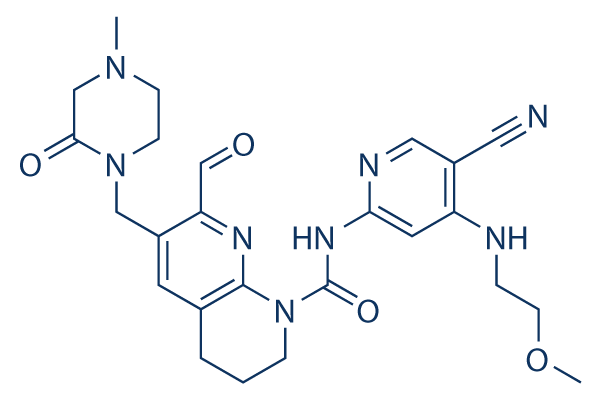
Chemical Structure
Molecular Weight: 506.56
Quality Control
| Related Targets | EGFR VEGFR PDGFR c-Met Src MEK CSF-1R FLT3 HER2 c-Kit |
|---|---|
| Other FGFR Inhibitors | PD173074 AZD4547 (Fexagratinib) BLU9931 Futibatinib (TAS-120) LY2874455 PD-166866 Zoligratinib (Debio-1347) H3B-6527 Fisogatinib (BLU-554) SSR128129E |
Chemical Information, Storage & Stability
| Molecular Weight | 506.56 | Formula | C25H30N8O4 |
Storage (From the date of receipt) | |
|---|---|---|---|---|---|
| CAS No. | 1708971-55-4 | -- | Storage of Stock Solutions |
|
|
| Synonyms | N/A | Smiles | CN1CCN(C(=O)C1)CC2=C(N=C3C(=C2)CCCN3C(=O)NC4=NC=C(C(=C4)NCCOC)C#N)C=O | ||
Solubility
|
In vitro |
DMSO
: 6 mg/mL
(11.84 mM)
Water : Insoluble Ethanol : Insoluble |
Molarity Calculator
|
In vivo |
|||||
In vivo Formulation Calculator (Clear solution)
Step 1: Enter information below (Recommended: An additional animal making an allowance for loss during the experiment)
Step 2: Enter the in vivo formulation (This is only the calculator, not formulation. Please contact us first if there is no in vivo formulation at the solubility Section.)
Calculation results:
Working concentration: mg/ml;
Method for preparing DMSO master liquid: mg drug pre-dissolved in μL DMSO ( Master liquid concentration mg/mL, Please contact us first if the concentration exceeds the DMSO solubility of the batch of drug. )
Method for preparing in vivo formulation: Take μL DMSO master liquid, next addμL PEG300, mix and clarify, next addμL Tween 80, mix and clarify, next add μL ddH2O, mix and clarify.
Method for preparing in vivo formulation: Take μL DMSO master liquid, next add μL Corn oil, mix and clarify.
Note: 1. Please make sure the liquid is clear before adding the next solvent.
2. Be sure to add the solvent(s) in order. You must ensure that the solution obtained, in the previous addition, is a clear solution before proceeding to add the next solvent. Physical methods such as vortex, ultrasound or hot water bath can be used to aid dissolving.
Mechanism of Action
| Targets/IC50/Ki |
FGFR4
(Cell-free assay) 1.9 nM
|
|---|---|
| In vitro |
Roblitinib (FGF401) binds in a reversible covalent manner to the FGFR4 kinase domain and inhibits it with an IC50 of 1.9 nM. In biochemical assays, this compound shows at least 1,000 fold selectivity against a panel of 65 kinases, and in a kinome wide scan consisting of 456 kinases, FGFR4 was its only target. It also inhibits growth of HCC and gastric cancer cell lines expressing FG19, FGFR4 and βklotho. |
| In vivo |
In xenograft animal models in vivo, Roblitinib (FGF401) showed a consistent pharmacokinetic/pharmacodynamic (PK/PD) relationship with phospho-FGFR4 over total FGFR4 (p/tFGFR4) levels in tumour robustly inhibited in a dose dependent manner. It has good oral PK properties and remarkable anti-tumour activity in mice bearing HCC tumour xenografts and PDX models that are positive for FGF19, FGFR4 and KLB. |
References |
|
Clinical Trial Information
(data from https://clinicaltrials.gov, updated on 2024-05-22)
| NCT Number | Recruitment | Conditions | Sponsor/Collaborators | Start Date | Phases |
|---|---|---|---|---|---|
| NCT02325739 | Completed | Hepatocellular Carcinoma (HCC)|Solid Malignancies |
Novartis Pharmaceuticals|Novartis |
December 29 2014 | Phase 1|Phase 2 |
Tech Support
Tel: +1-832-582-8158 Ext:3
If you have any other enquiries, please leave a message.

Products are for research use only. Not for human use. We do not sell to patients.
©Copyright 2013 Selleck Chemicals. All Rights Reserved.