
research use only
Taselisib (GDC 0032) PI3K inhibitor
Cat.No.S7103
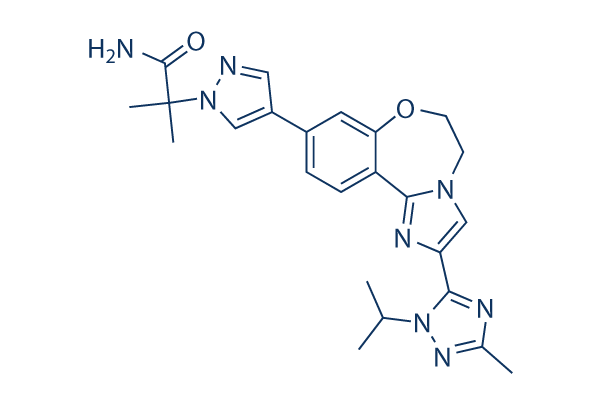
Chemical Structure
Molecular Weight: 460.53
Quality Control
| Related Targets | Akt mTOR GSK-3 ATM/ATR DNA-PK AMPK PDPK1 PTEN PP2A PDK |
|---|---|
| Other PI3K Inhibitors | GDC-0077 (Inavolisib) SAR405 Quercetin (Sophoretin) LY294002 XL147 analogue Tersolisib (STX-478) Buparlisib (BKM120) 740 Y-P (PDGFR 740Y-P) GO-203 TFA Eganelisib (IPI-549) |
Cell Culture, Treatment & Working Concentration
| Cell Lines | Assay Type | Concentration | Incubation Time | Formulation | Activity Description | PMID |
|---|---|---|---|---|---|---|
| human MOLM16 cells | Proliferation assay | 72 h | Antiproliferative activity against human MOLM16 cells after 72 hrs by Cell Titer-Blue assay | |||
| Click to View More Cell Line Experimental Data | ||||||
Chemical Information, Storage & Stability
| Molecular Weight | 460.53 | Formula | C24H28N8O2 |
Storage (From the date of receipt) | |
|---|---|---|---|---|---|
| CAS No. | 1282512-48-4 | Download SDF | Storage of Stock Solutions |
|
|
| Synonyms | RG7604 | Smiles | CC1=NN(C(=N1)C2=CN3CCOC4=C(C3=N2)C=CC(=C4)C5=CN(N=C5)C(C)(C)C(=O)N)C(C)C | ||
Solubility
|
In vitro |
DMSO
: 70 mg/mL
(151.99 mM)
Ethanol : 7 mg/mL Water : Insoluble |
Molarity Calculator
|
In vivo |
|||||
In vivo Formulation Calculator (Clear solution)
Step 1: Enter information below (Recommended: An additional animal making an allowance for loss during the experiment)
Step 2: Enter the in vivo formulation (This is only the calculator, not formulation. Please contact us first if there is no in vivo formulation at the solubility Section.)
Calculation results:
Working concentration: mg/ml;
Method for preparing DMSO master liquid: mg drug pre-dissolved in μL DMSO ( Master liquid concentration mg/mL, Please contact us first if the concentration exceeds the DMSO solubility of the batch of drug. )
Method for preparing in vivo formulation: Take μL DMSO master liquid, next addμL PEG300, mix and clarify, next addμL Tween 80, mix and clarify, next add μL ddH2O, mix and clarify.
Method for preparing in vivo formulation: Take μL DMSO master liquid, next add μL Corn oil, mix and clarify.
Note: 1. Please make sure the liquid is clear before adding the next solvent.
2. Be sure to add the solvent(s) in order. You must ensure that the solution obtained, in the previous addition, is a clear solution before proceeding to add the next solvent. Physical methods such as vortex, ultrasound or hot water bath can be used to aid dissolving.
Mechanism of Action
| Features |
A beta isoform-sparing PI3K inhibitor.
|
|---|---|
| Targets/IC50/Ki |
PI3Kδ
(Cell-free assay) 0.12 nM(Ki)
PI3Kα
(Cell-free assay) 0.29 nM(Ki)
PI3Kγ
(Cell-free assay) 0.97 nM(Ki)
PI3Kβ
(Cell-free assay) 9.1 nM(Ki)
C2β
(Cell-free assay) 292 nM
hVps34
(Cell-free assay) 374 nM
|
| In vitro |
GDC-0032 is an orally bioavailable, potent, and selective inhibitor of Class I PI3Kα, δ, and γ isoforms, with 30 fold less inhibition of the PI3K β isoform relative to the PI3Kα isoform. Preclinical data show that GDC-0032 has increased activity against PI3Kα isoform (PIK3CA) mutant and HER2-amplified cancer cell lines. GDC-0032 inhibits MCF7-neo/HER2 cells proliferation with IC50 of 2.5 nM. |
| Kinase Assay |
Characterisation of Biochemical and Cellular Activity In Vitro
|
|
Enzymatic activity of the class I PI3K isoforms is measured using a fluorescence polarisation assay that monitors formation of the product 3,4,5-inositoltriphosphate molecule as it competes with fluorescently labelled PIP3 for binding to the GRP-1 pleckstrin homology domain protein. An increase in phosphatidyl inositide-3-phosphate product results in a decrease in fluorescence polarisation signal as the labelled fluorophore is displaced from the GRP-1 protein binding site. Class I PI3K isoforms are expressed and purified as heterodimeric recombinant proteins. Tetramethylrhodamine-labelled PIP3 (TAMRA-PIP3), di-C8-PIP2, and PIP3 detection reagents are purchased from Echelon Biosciences. PI3Kα is assayed under initial rate conditions in the presence of 10 mM Tris (pH 7.5), 25 μM ATP, 9.75 μM PIP2, 5% glycerol, 4 mM MgCl2, 50 mM NaCl, 0.05% (v/v) Chaps, 1 mM dithiothreitol, and 2% (v/v) DMSO at 60 ng/mL. After assay for 30 min at 25 °C, reactions are terminated with a final concentration of 9 mM EDTA, 4.5 nM TAMRA-PIP3, and 4.2 μg/mL GRP-1 detector protein before reading fluorescence polarisation on an Envision plate reader. IC50 values are calculated from the fit of the dose-response curves to a 4-parameter equation. Each reported value is an average of three experiments, and all have a standard deviation less than one geometric mean.
|
|
| In vivo |
GDC-0032 pharmacokinetics is approximately dose proportional and time independent with a mean t1/2 of 40 hours. The combination of GDC-0032 enhances activity resulting in tumour regressions and tumour growth delay (91% tumour growth inhibition (TGI)). In addition, the combination of GDC-0032 enhances the efficacy in vivo (102%TGI for GDC-0032). |
References |
Applications
| Methods | Biomarkers | Images | PMID |
|---|---|---|---|
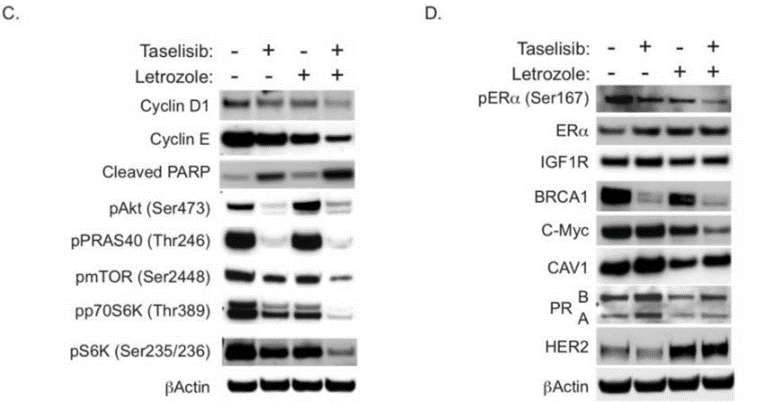
| Western blot | Cyclin D1 / Cyclin E / Cleaved PARP / p-AKT / pPRAS40 / p-mTOR / pp70S6K / BRCA1 / c-Myc |
|
27382432 |
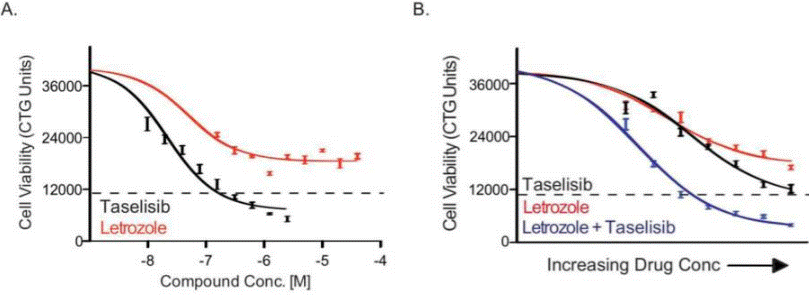
| Growth inhibition assay | Cell viability |
|
27382432 |
Clinical Trial Information
(data from https://clinicaltrials.gov, updated on 2024-05-22)
| NCT Number | Recruitment | Conditions | Sponsor/Collaborators | Start Date | Phases |
|---|---|---|---|---|---|
| NCT02785913 | Completed | Recurrent Squamous Cell Lung Carcinoma|Stage IV Squamous Cell Lung Carcinoma |
SWOG Cancer Research Network|National Cancer Institute (NCI) |
November 2014 | Phase 2 |
| NCT01967966 | Completed | Healthy Volunteer |
Genentech Inc. |
November 2013 | Phase 1 |
| NCT01814709 | Completed | Healthy Volunteer |
Genentech Inc. |
April 2013 | Phase 1 |
Tech Support
Tel: +1-832-582-8158 Ext:3
If you have any other enquiries, please leave a message.

Products are for research use only. Not for human use. We do not sell to patients.
©Copyright 2013 Selleck Chemicals. All Rights Reserved.