
research use only
Ginsenoside Rd COX inhibitor
Cat.No.S3931
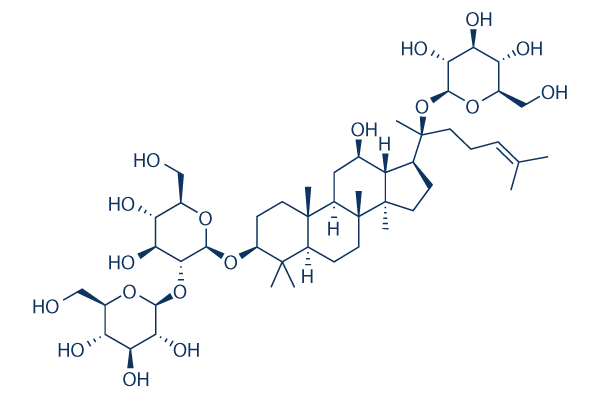
Chemical Structure
Molecular Weight: 947.15
Quality Control
Chemical Information, Storage & Stability
| Molecular Weight | 947.15 | Formula | C48H82O18 |
Storage (From the date of receipt) | |
|---|---|---|---|---|---|
| CAS No. | 52705-93-8 | Download SDF | Storage of Stock Solutions |
|
|
| Synonyms | Panaxoside Rd, Sanchinoside Rd | Smiles | CC(C)=CCCC(C)(OC1OC(CO)C(O)C(O)C1O)C2CCC3(C)C2C(O)CC4C5(C)CCC(OC6OC(CO)C(O)C(O)C6OC7OC(CO)C(O)C(O)C7O)C(C)(C)C5CCC34C | ||
Solubility
|
In vitro |
DMSO
: 90 mg/mL
(95.02 mM)
Ethanol : 90 mg/mL Water : Insoluble |
Molarity Calculator
|
In vivo |
|||||
In vivo Formulation Calculator (Clear solution)
Step 1: Enter information below (Recommended: An additional animal making an allowance for loss during the experiment)
Step 2: Enter the in vivo formulation (This is only the calculator, not formulation. Please contact us first if there is no in vivo formulation at the solubility Section.)
Calculation results:
Working concentration: mg/ml;
Method for preparing DMSO master liquid: mg drug pre-dissolved in μL DMSO ( Master liquid concentration mg/mL, Please contact us first if the concentration exceeds the DMSO solubility of the batch of drug. )
Method for preparing in vivo formulation: Take μL DMSO master liquid, next addμL PEG300, mix and clarify, next addμL Tween 80, mix and clarify, next add μL ddH2O, mix and clarify.
Method for preparing in vivo formulation: Take μL DMSO master liquid, next add μL Corn oil, mix and clarify.
Note: 1. Please make sure the liquid is clear before adding the next solvent.
2. Be sure to add the solvent(s) in order. You must ensure that the solution obtained, in the previous addition, is a clear solution before proceeding to add the next solvent. Physical methods such as vortex, ultrasound or hot water bath can be used to aid dissolving.
Mechanism of Action
| Targets/IC50/Ki |
COX-2
iNOS
Ca2+ influx
NF-κB
(in HepG2 cells) 12.05 μM
CYP2D6
(Cell-free assay) 58.0 μM
CYP1A2
(Cell-free assay) 78.4 μM
CYP3A4
(Cell-free assay) 81.7 μM
CYP2C9
(Cell-free assay) 85.1 μM
|
|---|---|
| In vitro |
Ginsenoside Rd is a selective and competitive Ca2+ receptor antagonist and herefore, can suppress calcium influx after cytotoxic injuries. This compound administration dose-dependently suppresses glutamate-induced DNA laddering and apoptosis through the suppression of glutamate-induced caspase-3 activation and Ca2+ entry. Exposure to this chemical can also protect mitochondria against calcium-induced damages through downregulation of reactive oxygen species generation, suppression of mitochondrial membrane potential hyperpolarization, and amelioration of mitochondrial swelling. It is a potent in vitro inhibitor on the chymotrypsin-like activity of 26S proteasome. |
| In vivo |
Ginsenoside Rd treatment prior to and/or following an ischemic stroke can reduce infarct volume, increase neuronal survival, and enhance cognitive and neurological functions. Administration of this compound to a Sprague-Dawley rat has been shown to downregulate ischemic stroke-induced tau protein phosphorylation at Ser199/202 and PHF-1 sites through the downregulation of glycogen synthase kinase-3β and to enhance ischemia-induced cognitive impairment. This compound administration has also been shown to upregulate the protein kinase B/AKT pathway and, from this, suppress glycogen synthase kinase-3β activity. Its administration after tMCAO upregulates glial glutamate transporter-1 (GLT-1) expression and promotes glutamate clearance in rats. Pretreatment with this chemical (10 mg/kg) inhibits poly(ADP-ribose) polymerase-1 and consequently downregulates apoptosis-inducing factor translocation and nuclear factor-kappa B p65 subunit nuclear accumulation in Dawley rats suffering from right middle cerebral artery occlusion. |
References |
|
Tech Support
Tel: +1-832-582-8158 Ext:3
If you have any other enquiries, please leave a message.

Products are for research use only. Not for human use. We do not sell to patients.
©Copyright 2013 Selleck Chemicals. All Rights Reserved.