
research use only
Lurasidone HCl Dopamine Receptor antagonist
Cat.No.S3044
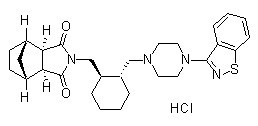
Chemical Structure
Molecular Weight: 529.14
Quality Control
| Related Targets | Adrenergic Receptor AChR 5-HT Receptor COX Calcium Channel Histamine Receptor GABA Receptor TRP Channel Cholinesterase (ChE) GluR |
|---|---|
| Other Dopamine Receptor Inhibitors | MPTP Hydrochloride Trifluoperazine Trifluoperazine 2HCl Penfluridol Sulpiride Levosulpiride SCH-23390 hydrochloride Domperidone Rotundine Azaperone |
Chemical Information, Storage & Stability
| Molecular Weight | 529.14 | Formula | C28H36N4O2S.HCl |
Storage (From the date of receipt) | |
|---|---|---|---|---|---|
| CAS No. | 367514-88-3 | Download SDF | Storage of Stock Solutions |
|
|
| Synonyms | SM-13496 | Smiles | C1CCC(C(C1)CN2CCN(CC2)C3=NSC4=CC=CC=C43)CN5C(=O)C6C7CCC(C7)C6C5=O.Cl | ||
Solubility
|
In vitro |
4-Methylpyridine : 15 mg/mL
DMSO
: 1 mg/mL
(1.88 mM)
Water : Insoluble |
Molarity Calculator
|
In vivo |
|||||
In vivo Formulation Calculator (Clear solution)
Step 1: Enter information below (Recommended: An additional animal making an allowance for loss during the experiment)
Step 2: Enter the in vivo formulation (This is only the calculator, not formulation. Please contact us first if there is no in vivo formulation at the solubility Section.)
Calculation results:
Working concentration: mg/ml;
Method for preparing DMSO master liquid: mg drug pre-dissolved in μL DMSO ( Master liquid concentration mg/mL, Please contact us first if the concentration exceeds the DMSO solubility of the batch of drug. )
Method for preparing in vivo formulation: Take μL DMSO master liquid, next addμL PEG300, mix and clarify, next addμL Tween 80, mix and clarify, next add μL ddH2O, mix and clarify.
Method for preparing in vivo formulation: Take μL DMSO master liquid, next add μL Corn oil, mix and clarify.
Note: 1. Please make sure the liquid is clear before adding the next solvent.
2. Be sure to add the solvent(s) in order. You must ensure that the solution obtained, in the previous addition, is a clear solution before proceeding to add the next solvent. Physical methods such as vortex, ultrasound or hot water bath can be used to aid dissolving.
Mechanism of Action
| Targets/IC50/Ki |
5-HT7
0.495 nM
D2 receptor
1.68 nM
5-HT2A
2.03 nM
5-HT1A
6.75 nM
noradrenaline α2C
10.8 nM
|
|---|---|
| In vitro |
Lurasidone antagonises dopamine-stimulated [35S]GTPγS binding at human Dopamine D2L receptor in a concentration-dependent manner with a KB value of 2.8 nM. Lurasidone antagonises 5-HT-stimulated cAMP accumulation in the CHO/h5-HT7 cells with a KB value of 2.6 nM. Lurasidone partially stimulates [35S]GTPγS binding to the membrane preparation for human 5-HT1A receptors with a maximum effect of 33%. Lurasidone dose-dependently increases the ratio of DOPAC/dopamine in rat frontal cortex and striatum.
|
| In vivo |
The inhibitory actions of Lurasidone on MAP-induced hyperactivity persist for more than 8 hours, and the ED50 values of the action at 1 hour, 2 hours, 4 hours, and 8 hours after the treatment are 2.3 mg/kg, 0.87 mg/kg, 1.6 mg/kg, and 5.0 mg/kg, respectively. Lurasidone (1 mg/kg–10 mg/kg) dose-dependently inhibits conditioned avoidance response in rats with ED50 of 6.3 mg/kg. Lurasidone dose-dependently inhibits TRY-induced forepaw clonic seizure and p-CAMP-induced hyperthermia in rats with ED50 of 5.6 mg/kg and 3.0 mg/kg, respectively. Lurasidone (0.3 mg/kg–30 mg/kg) dose-dependently and significantly increases the number of shocks received by rats in the Vogel's conflict test with MED of 10 mg/kg. Lurasidone (3 mg/kg, 2 weeks) significantly suppresses hyperactivity behaviour in olfactory bulbectomy model rats. Lurasidone (700 mg/kg–1000 mg/kg) slightly prolongs the duration of loss of righting reflexes elicited by hexobarbital (anaesthesia) in mice in a dose-dependent manner. Lurasidone (30 mg/kg, p.o.) significantly and dose-dependently reverses the MK-801-induced impairment of the passive-avoidance response of rats. Lurasidone (3 mg/kg p.o.) potently reverses MK-801-induced learning impairment in the Morris water maze test in rats. Lurasidone (3 mg/kg p.o.) potently reverses MK-801-induced reference memory impairment and moderately but not significantly attenuates MK-801-induced working memory impairment in the radial-arm maze test. Lurasidone (10 mg/kg) treatment increases total BDNF mRNA levels in rat prefrontal cortex and, to a lesser extent, in hippocampus. Lurasidone (10 mg/kg) significantly increases the levels of mature BDNF protein in rat prefrontal cortex, without affecting the protein levels of the neurotrophin (both precursor and mature forms) in hippocampal extracts.
|
References |
|
Clinical Trial Information
(data from https://clinicaltrials.gov, updated on 2024-05-22)
| NCT Number | Recruitment | Conditions | Sponsor/Collaborators | Start Date | Phases |
|---|---|---|---|---|---|
| NCT03627195 | Completed | Schizophrenia |
Sumitomo Pharma America Inc. |
June 7 2018 | Phase 1 |
| NCT02731612 | Recruiting | Bipolar Disorder |
Nazlin Walji|University of British Columbia |
May 8 2017 | Phase 3 |
| NCT02147379 | Completed | Bipolar I Disorder |
University of British Columbia |
May 2014 | Phase 3 |
| NCT02174523 | Completed | Schizophrenia |
Sumitomo Pharma (Suzhou) Co. Ltd.|Xuhui Central Hospital Shanghai |
April 2014 | Phase 1 |
Tech Support
Tel: +1-832-582-8158 Ext:3
If you have any other enquiries, please leave a message.

Products are for research use only. Not for human use. We do not sell to patients.
©Copyright 2013 Selleck Chemicals. All Rights Reserved.