
research use only
MK-8245 SCD inhibitor
Cat.No.S1158
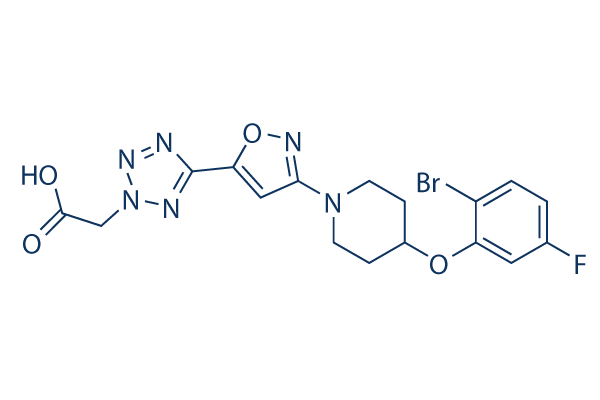
Chemical Structure
Molecular Weight: 467.25
Quality Control
| Related Targets | Dehydrogenase HSP Transferase P450 (e.g. CYP17) PDE phosphatase PPAR Vitamin Carbohydrate Metabolism Mitochondrial Metabolism |
|---|---|
| Other SCD Inhibitors | PluriSIn #1 (NSC 14613) A939572 MF-438 CVT-11127 Aramchol CAY10566 |
Chemical Information, Storage & Stability
| Molecular Weight | 467.25 | Formula | C17H16BrFN6O4 |
Storage (From the date of receipt) | |
|---|---|---|---|---|---|
| CAS No. | 1030612-90-8 | Download SDF | Storage of Stock Solutions |
|
|
| Synonyms | N/A | Smiles | C1CN(CCC1OC2=C(C=CC(=C2)F)Br)C3=NOC(=C3)C4=NN(N=N4)CC(=O)O | ||
Solubility
|
In vitro |
DMSO
: 93 mg/mL
(199.03 mM)
Water : Insoluble Ethanol : Insoluble |
Molarity Calculator
|
In vivo |
|||||
In vivo Formulation Calculator (Clear solution)
Step 1: Enter information below (Recommended: An additional animal making an allowance for loss during the experiment)
Step 2: Enter the in vivo formulation (This is only the calculator, not formulation. Please contact us first if there is no in vivo formulation at the solubility Section.)
Calculation results:
Working concentration: mg/ml;
Method for preparing DMSO master liquid: mg drug pre-dissolved in μL DMSO ( Master liquid concentration mg/mL, Please contact us first if the concentration exceeds the DMSO solubility of the batch of drug. )
Method for preparing in vivo formulation: Take μL DMSO master liquid, next addμL PEG300, mix and clarify, next addμL Tween 80, mix and clarify, next add μL ddH2O, mix and clarify.
Method for preparing in vivo formulation: Take μL DMSO master liquid, next add μL Corn oil, mix and clarify.
Note: 1. Please make sure the liquid is clear before adding the next solvent.
2. Be sure to add the solvent(s) in order. You must ensure that the solution obtained, in the previous addition, is a clear solution before proceeding to add the next solvent. Physical methods such as vortex, ultrasound or hot water bath can be used to aid dissolving.
Mechanism of Action
| Features |
A potent hepatic SCD inhibitor, and does not affect SCD enzyme in skin and eye tissues like other systemically distributed SCD inhibitors.
|
|---|---|
| Targets/IC50/Ki |
SCD1 (human)
1 nM
SCD1 (rat)
3 nM
SCD1 (mouse)
3 nM
|
| In vitro |
MK-8245, a phenoxy piperidine isoxazole derivative, has been identified as a potent and liver-specific SCD inhibitor. It contains a tetrazole acetic acid moiety, which is the key molecule for OATPs recognition and liver-targeting. This compound displays similar potencies against human, rat and mouse SCD1 with IC50 values of 1 nM for human SCD1 and 3 nM for both rat SCD1 and mouse SCD1. It exhibits significant SCD inhibition in the rat hepatocyte assay which contains functional, active OATPs with IC50 of 68 nM, while being only weakly active in the HepG2 cell assay which is devoid of active OATPs with IC50 of ~1 μM. It displays highly selective activity for the
-5 and
-6 desaturases (i.e., >100000 μM vs rat and human
5D and
6D as assessed in the HepG assay.
|
| In vivo |
Administration of MK-8245 at 10 mg/kg in mice exhibits a tissue distribution profile concentrated in the liver. It shows a liver-to-Harderian gland ratio of 21, suggesting a high degree of liver-targeting compared to a systemically distributed compound with a liver-to-Harderian gland ratio of 1.5. Oral dosing of this compound in mice, rats, dogs, and rhesus monkeys demonstrates that it is distributed mainly to the liver, with low exposure in tissues associated with potential adverse events. The liver-to-skin ratios are >30:1 in all four species. Administration of this chemical to eDIO mice before the glucose challenge improves glucose clearance in a dose-dependent manner with an ED50 of 7 mg/kg.
|
References |
Tech Support
Tel: +1-832-582-8158 Ext:3
If you have any other enquiries, please leave a message.

Products are for research use only. Not for human use. We do not sell to patients.
©Copyright 2013 Selleck Chemicals. All Rights Reserved.