
research use only
Pentamidine isethionate phosphatase inhibitor
Cat.No.S4007
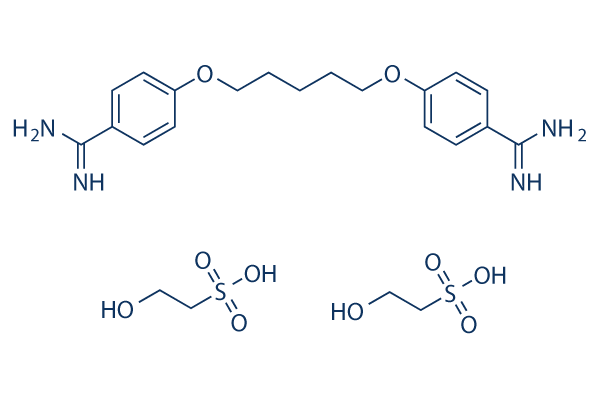
Chemical Structure
Molecular Weight: 592.68
Quality Control
Cell Culture, Treatment & Working Concentration
| Cell Lines | Assay Type | Concentration | Incubation Time | Formulation | Activity Description | PMID |
|---|---|---|---|---|---|---|
| A549 | Cytotoxicity assay | Cytotoxicity against A549 cell line, IC50=24 μM | ||||
| rat L6 cell | Cytotoxicity assay | Cytotoxicity against rat L6 cells, IC50=2.1 μM | ||||
| J774A1 | Cytotoxicity assay | 72 h | Cytotoxicity against mouse J774A1 cells after 72 hrs by MTT assay, CC50=1 μM | |||
| HepG2 | Cytotoxicity assay | 72 h | Cytotoxicity against human HepG2 cells after 72 hrs by MTT assay, CC50=2.3 μM | |||
| HeLa | Cytotoxicity assay | 96 h | Cytotoxicity against human HeLa cells after 96 hrs by resazurin-based spectrofluorimetric method, IC50=15 μM | |||
| WM115 | Cytotoxicity assay | Cytotoxicity against human WM115 cells assessed as growth inhibition measured after 72 hrs by crystal violet assay, IC50=4.8 μM | ||||
| Click to View More Cell Line Experimental Data | ||||||
Chemical Information, Storage & Stability
| Molecular Weight | 592.68 | Formula | C19H24N4O2.2C2H6O4S |
Storage (From the date of receipt) | |
|---|---|---|---|---|---|
| CAS No. | 140-64-7 | Download SDF | Storage of Stock Solutions |
|
|
| Synonyms | N/A | Smiles | C1=CC(=CC=C1C(=N)N)OCCCCCOC2=CC=C(C=C2)C(=N)N.C(CS(=O)(=O)O)O.C(CS(=O)(=O)O)O | ||
Solubility
|
In vitro |
DMSO
: 100 mg/mL
(168.72 mM)
Water : 100 mg/mL Ethanol : Insoluble |
Molarity Calculator
|
In vivo |
|||||
In vivo Formulation Calculator (Clear solution)
Step 1: Enter information below (Recommended: An additional animal making an allowance for loss during the experiment)
Step 2: Enter the in vivo formulation (This is only the calculator, not formulation. Please contact us first if there is no in vivo formulation at the solubility Section.)
Calculation results:
Working concentration: mg/ml;
Method for preparing DMSO master liquid: mg drug pre-dissolved in μL DMSO ( Master liquid concentration mg/mL, Please contact us first if the concentration exceeds the DMSO solubility of the batch of drug. )
Method for preparing in vivo formulation: Take μL DMSO master liquid, next addμL PEG300, mix and clarify, next addμL Tween 80, mix and clarify, next add μL ddH2O, mix and clarify.
Method for preparing in vivo formulation: Take μL DMSO master liquid, next add μL Corn oil, mix and clarify.
Note: 1. Please make sure the liquid is clear before adding the next solvent.
2. Be sure to add the solvent(s) in order. You must ensure that the solution obtained, in the previous addition, is a clear solution before proceeding to add the next solvent. Physical methods such as vortex, ultrasound or hot water bath can be used to aid dissolving.
Mechanism of Action
| Targets/IC50/Ki |
PRL Phosphatases
|
|---|---|
| In vitro |
Pentamidine is known experimentally to interfere with numerous cellular processes. Specifically, Pentamidine has been shown to bind to DNA in a nonintercalative manner and appears to preferentially bind to kinetoplast DNA in trypanosomes. Additionally, Pentamidine may inhibit RNA polymerase and ribosomal function, as well as nucleic acid, protein, phospholipid, and polyamine synthesis. Pentamidine also inhibits certain proteases, including trypsin, and impairs cellular oxygen consumption.
Pentamidine has a potent in vitro antiprotozoal activity. Pentamidine displays cytotoxic activity against L. infantum promastigotes with IC50 of 2.5 μM. 2.5 μM Pentamidine induces early programmed cell death in 49.6% of L. infantum promastigotes. 2.5 μM Pentamidine induces a notorious decrease in promastigotes in both G1 and S phases relative to the control-untreated samples (G1:77.0 vs 15.0%; S:11.0 vs 2.4% for control- and pentamidine-treated promastigotes, resp). Pentamidine is able to bind with calf-thymus DNA (CT-DNA) and induces conformational changes in the DNA double helix. Pentamidine also binds with ubiquitin to modifiy the β-cluster of ubiquitin.
Pentamidine is an inhibitor of phosphatase of regenerating liver (PRLs). 1 μg/mL of Pentamidine complete inhibits the activity of recombinant PTP1B in dephosphorylating a phos-photyrosine peptide. 10 μg/mL of Pentamidine completely inhibits the activities of recombinant PRL-1, PRL-2 and PRL-3 in dephosphorylating a phosphotyrosine peptide substrate. Incubation with Pentamidine (1 μg/mL) for 48 h reduces the activity of intracellular PRL phosphatases in transfected NIH3T3 cells by more than 85%. 10 μg/mL Pentamidine completely inhibits the growth of melanoma cell line (WM9), prostate carcinoma cell line (DU145 and C4–2), ovarian carcinoma cell line (Hey), colon carcinoma cell line (WM480), and lung carcinoma cell line (A549) which all express endogenous PRLs.
|
| Kinase Assay |
In vitro PTPase assays
|
|
Individual PTPases (0.01 μg/reaction) in 50 μL of PTPase buffer [50 mM Tris (pH 7.4)] are incubated at 22 ℃ for 10 min or as indicated in the absence or presence of inhibitory compounds. Substrates (0.2 mM phosphotyrosine peptide) are then added and allows to react at 22 ℃ for 18 hr. PTPase activity of individual reactions is measured by adding 100 μL of malachite green solution (UBI) and then quantifying the amounts of free phosphate cleaved by the PTPase from the peptide substrate by spectrometry (A660 nm). Relative PTPase activities are calculated based on the formula [(PTPase activity in the presence of an inhibitory compound)/(PTPase activity in the absence of the compound) × 100%]. Reactions performed under comparable conditions in the absence of recombinant PTPases only are used as controls and shows no detectable PTPase activity.
|
|
| In vivo |
Pentamidine has a potent antiprotozoal activity in animal models. Pentamidine (0.3-9 mg/L) decreased the viability of P. carinii in experimental models in chick embryo lung epithelial cells and lung cells of rats with pneumonia. 5 mg/kg Pentamidine treatment for 2 weeks eradicates Pneumocystis carinii pneumonia in 75% of the animals.
Pentamidine inhibits the growth of WM9 human melanoma tumours in nude mice. During the 16-week study period, the tumours in 250 μg pentamidine-treated mice stay at sizes similar to those at the treatment initiation point, whereas the tumours in the control mice grow so rapidly that humane sacrifice of the animals is required at the 4th week. Pentamidine induces significant necrosis that accounts for more than 50% of the tumour mass.
|
References |
|
Clinical Trial Information
(data from https://clinicaltrials.gov, updated on 2024-05-22)
| NCT Number | Recruitment | Conditions | Sponsor/Collaborators | Start Date | Phases |
|---|---|---|---|---|---|
| NCT05458752 | Completed | Pneumocystis Jirovecii Infection |
Central Hospital Nancy France |
April 1 2020 | -- |
| NCT02669706 | Completed | Hematologic Malignancy |
University of Illinois at Chicago |
March 2015 | -- |
| NCT00729807 | Terminated | Melanoma (Skin) |
University of Maryland Baltimore|National Cancer Institute (NCI) |
July 2008 | Phase 2 |
| NCT00802594 | Completed | Trypanosomiasis African |
Immtech Pharmaceuticals Inc|Bill and Melinda Gates Foundation |
August 2001 | Phase 2 |
Tech Support
Tel: +1-832-582-8158 Ext:3
If you have any other enquiries, please leave a message.

Products are for research use only. Not for human use. We do not sell to patients.
©Copyright 2013 Selleck Chemicals. All Rights Reserved.