
research use only
Prucalopride 5-HT Receptor agonist
Cat.No.S2875
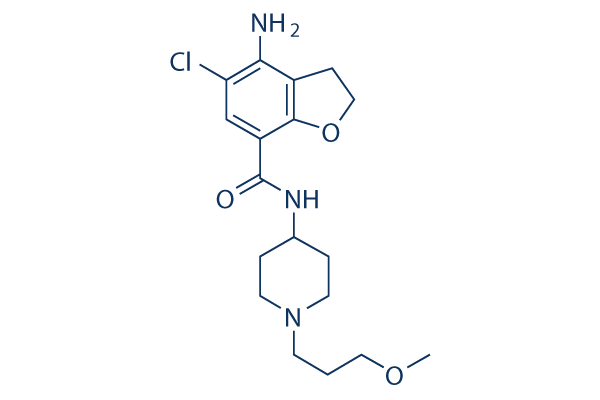
Chemical Structure
Molecular Weight: 367.87
Quality Control
| Related Targets | Adrenergic Receptor AChR COX Calcium Channel Histamine Receptor Dopamine Receptor GABA Receptor TRP Channel Cholinesterase (ChE) GluR |
|---|---|
| Other 5-HT Receptor Inhibitors | WAY-100635 Maleate Serotonin (5-HT) HCl Puerarin BRL-15572 Dihydrochloride SB269970 HCl Ketanserin RS-127445 Nuciferine Flopropione BRL-54443 |
Chemical Information, Storage & Stability
| Molecular Weight | 367.87 | Formula | C18H26ClN3O3 |
Storage (From the date of receipt) | |
|---|---|---|---|---|---|
| CAS No. | 179474-81-8 | Download SDF | Storage of Stock Solutions |
|
|
| Synonyms | R-93877 | Smiles | COCCCN1CCC(CC1)NC(=O)C2=CC(=C(C3=C2OCC3)N)Cl | ||
Solubility
|
In vitro |
DMSO
: 74 mg/mL
(201.15 mM)
Ethanol : 74 mg/mL Water : Insoluble |
Molarity Calculator
|
In vivo |
|||||
In vivo Formulation Calculator (Clear solution)
Step 1: Enter information below (Recommended: An additional animal making an allowance for loss during the experiment)
Step 2: Enter the in vivo formulation (This is only the calculator, not formulation. Please contact us first if there is no in vivo formulation at the solubility Section.)
Calculation results:
Working concentration: mg/ml;
Method for preparing DMSO master liquid: mg drug pre-dissolved in μL DMSO ( Master liquid concentration mg/mL, Please contact us first if the concentration exceeds the DMSO solubility of the batch of drug. )
Method for preparing in vivo formulation: Take μL DMSO master liquid, next addμL PEG300, mix and clarify, next addμL Tween 80, mix and clarify, next add μL ddH2O, mix and clarify.
Method for preparing in vivo formulation: Take μL DMSO master liquid, next add μL Corn oil, mix and clarify.
Note: 1. Please make sure the liquid is clear before adding the next solvent.
2. Be sure to add the solvent(s) in order. You must ensure that the solution obtained, in the previous addition, is a clear solution before proceeding to add the next solvent. Physical methods such as vortex, ultrasound or hot water bath can be used to aid dissolving.
Mechanism of Action
| Targets/IC50/Ki |
5-HT4A
2.5 nM(Ki)
5-HT4B
8 nM(Ki)
|
|---|---|
| In vitro |
Prucalopride induces contractions in a concentration-dependent manner with pEC50 of 7.5. This compound (1 mM) significantly amplifies the rebound contraction of the guinea-pig proximal colon after electrical field stimulation. It induces relaxation of the rat oesophagus preparation of rat oesophagus tunica muscularis mucosae with pEC50 of 7.8, yielding a monophasic concentration–response curve.
|
| In vivo |
Complete bowel movements per week are 30.9% of those receiving 2 mg of Prucalopride and 28.4% of those receiving 4 mg of this compound, as compared with 12.0% in the placebo group. 47.3% of patients receiving 2 mg of this compound and 46.6% of those receiving 4 mg of it have an increase in the number of spontaneous, complete bowel movements of one or more per week, on average, as compared with 25.8% in the placebo group. This compound (2 mg or 4 mg) significantly improves all other secondary efficacy end points, including patients' satisfaction with their bowel function and treatment and their perception of the severity of their constipation symptoms. It (4 mg daily) accelerates overall gastric emptying and small bowel transit in patients with constipation without a rectal evacuation disorder. This chemical (4 mg daily) tends to accelerate overall colonic transit with significantly faster overall colonic transit and ascending colon emptying. Higher proportions of patients on this compound 2 mg (19.5%), 4 mg (23.6%) have three or more spontaneous complete bowel movements (SCBM)/week compared with placebo (9.6%). It also significantly improves secondary efficacy and quality of life endpoints, including the proportion of patients with an increase of one or more SCBM/week, evacuation completeness, perceived disease severity and treatment effectiveness and quality of life. This compound alters colonic contractile motility patterns in a dose-dependent fashion by stimulating high-amplitude clustered contractions in the proximal colon and by inhibiting contractile activity in the distal colon of fasted dogs. It also causes a dose-dependent decrease in the time to the first giant migrating contraction (GMC); at higher doses of this chemical, the first GMC generally occurs within the first half-hour after treatment.
|
References |
|
Clinical Trial Information
(data from https://clinicaltrials.gov, updated on 2024-05-22)
| NCT Number | Recruitment | Conditions | Sponsor/Collaborators | Start Date | Phases |
|---|---|---|---|---|---|
| NCT04838522 | Recruiting | Chronic Constipation |
Takeda|UC San Diego Human Milk Research Biorepository |
March 2 2022 | -- |
| NCT04429802 | Completed | Gastrointestinal Motility Disorder|Dyspepsia |
Universitaire Ziekenhuizen KU Leuven |
September 26 2013 | Not Applicable |
| NCT01807000 | Completed | Healthy |
Shire|Takeda |
March 18 2013 | Phase 1 |
| NCT01692132 | Withdrawn | Chronic Constipation |
Janssen Pharmaceutica |
February 2013 | -- |
| NCT03279341 | Completed | Chronic Constipation |
University Hospital Gasthuisberg |
December 3 2012 | Phase 4 |
| NCT01117051 | Terminated | Non-cancer Pain|Opioid Induced Constipation |
Shire|Takeda |
May 19 2010 | Phase 3 |
Tech Support
Tel: +1-832-582-8158 Ext:3
If you have any other enquiries, please leave a message.

Products are for research use only. Not for human use. We do not sell to patients.
©Copyright 2013 Selleck Chemicals. All Rights Reserved.