
research use only
Pyrilamine Maleate Histamine Receptor agonist
Cat.No.S4382
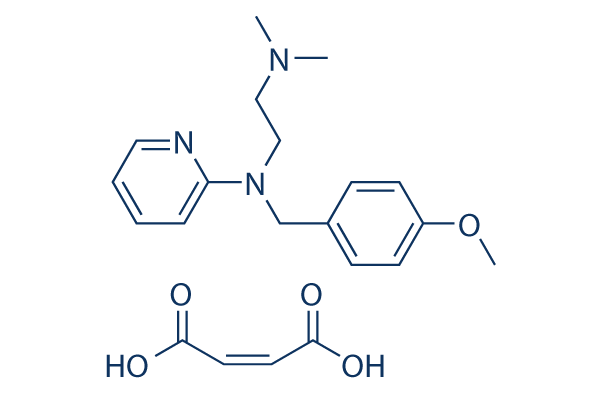
Chemical Structure
Molecular Weight: 401.46
Quality Control
| Related Targets | Adrenergic Receptor AChR 5-HT Receptor COX Calcium Channel Dopamine Receptor GABA Receptor TRP Channel Cholinesterase (ChE) GluR |
|---|---|
| Other Histamine Receptor Inhibitors | GSK2879552 Dihydrochloride JNJ-7777120 Ebastine Ciproxifan Maleate Mianserin HCl Astemizole Lafutidine Mizolastine Rupatadine Fumarate Betahistine 2HCl |
Chemical Information, Storage & Stability
| Molecular Weight | 401.46 | Formula | C17H23N3O1.C4H4O4 |
Storage (From the date of receipt) | |
|---|---|---|---|---|---|
| CAS No. | 59-33-6 | Download SDF | Storage of Stock Solutions |
|
|
| Synonyms | Mepyramine Maleate | Smiles | CN(C)CCN(CC1=CC=C(C=C1)OC)C2=CC=CC=N2.C(=CC(=O)O)C(=O)O | ||
Solubility
|
In vitro |
DMSO
: 80 mg/mL
(199.27 mM)
Water : 80 mg/mL Ethanol : 80 mg/mL |
Molarity Calculator
|
In vivo |
|||||
In vivo Formulation Calculator (Clear solution)
Step 1: Enter information below (Recommended: An additional animal making an allowance for loss during the experiment)
Step 2: Enter the in vivo formulation (This is only the calculator, not formulation. Please contact us first if there is no in vivo formulation at the solubility Section.)
Calculation results:
Working concentration: mg/ml;
Method for preparing DMSO master liquid: mg drug pre-dissolved in μL DMSO ( Master liquid concentration mg/mL, Please contact us first if the concentration exceeds the DMSO solubility of the batch of drug. )
Method for preparing in vivo formulation: Take μL DMSO master liquid, next addμL PEG300, mix and clarify, next addμL Tween 80, mix and clarify, next add μL ddH2O, mix and clarify.
Method for preparing in vivo formulation: Take μL DMSO master liquid, next add μL Corn oil, mix and clarify.
Note: 1. Please make sure the liquid is clear before adding the next solvent.
2. Be sure to add the solvent(s) in order. You must ensure that the solution obtained, in the previous addition, is a clear solution before proceeding to add the next solvent. Physical methods such as vortex, ultrasound or hot water bath can be used to aid dissolving.
Mechanism of Action
| In vitro |
Pyrilamine blocks the rapidly activating component of the delayed rectifier, IKr, with IC50 of 1.1 μM. Pyrilamine (10 μM) blocks the slowly activating component of the delayed rectifier, IKs and the inward rectifier, IK1 less than 20%.
|
|---|---|
| In vivo |
Pyrilamine (15 mg/kg/day) significantly decreases the movement time and velocity, as well as the total food consumption and completely abolishes the circadian rhythmicity of locomotion in sham-operated rats. Pyrilamine (15 mg/kg/day) leads to the complete blockade of H(1) receptors in both sham- and portacaval anastomosis-operated rats. Pyrilamine decreases the number of flinches in a dose dependent manner and decreases c-fos mRNA expression in lumbar spinal cord of rats. Pyrilamine is mainly metabolised into the O-glucuronic acid conjugate of O-demethyl pyrilamine in the rats. The terminal plasma elimination half-life of Pyrilamine does not increase with increasing doses (2.3 hours, 0.7 mg/kg; 1.5 hours, 7.0 mg/kg) and thus pyrilamine does not exhibit dose-dependent elimination. Pyrilamine is slightly less mutagenic than Methapyrilene over a comparable range of concentrations, and also induces predominantly small-colony mutants in the L5178Y/TK +/- mouse lymphoma assay.
|
References |
|
Tech Support
Tel: +1-832-582-8158 Ext:3
If you have any other enquiries, please leave a message.

Products are for research use only. Not for human use. We do not sell to patients.
©Copyright 2013 Selleck Chemicals. All Rights Reserved.