
research use only
Reparixin (Repertaxin) CXCR inhibitor
Cat.No.S8640
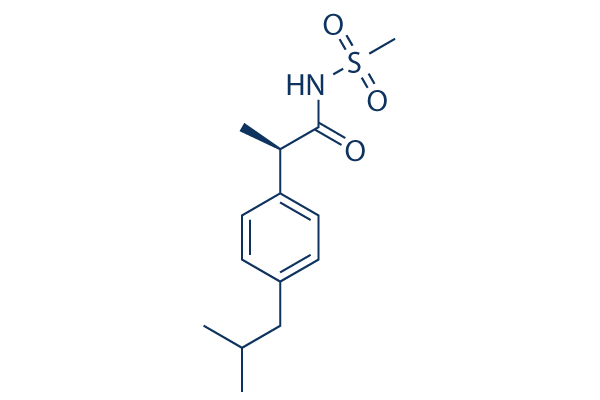
Chemical Structure
Molecular Weight: 283.39
Quality Control
| Related Targets | PD-1/PD-L1 STING AhR Immunology & Inflammation related CD markers Interleukins Anti-infection Antioxidant COX Histamine Receptor |
|---|---|
| Other CXCR Inhibitors | AZD5069 SB 225002 WZ811 Navarixin (SCH-527123) LIT-927 AMG 487 SX-682 LY2510924 Danirixin (GSK1325756) SB 265610 |
Cell Culture, Treatment & Working Concentration
| Cell Lines | Assay Type | Concentration | Incubation Time | Formulation | Activity Description | PMID |
|---|---|---|---|---|---|---|
| polymorphonuclear cells | Function assay | Inhibition of CXCL8-induced chemotaxis in human polymorphonuclear cells, IC50=0.0053μM | 15974585 | |||
| L1.2 | Function assay | Inhibition of CXCL8-induced cell migration in L1.2 cells expressing CXCR1 by chemotaxis assay, IC50=0.0056μM | 17665889 | |||
| L1.2 | Function assay | Inhibition of CXCL8-induced cell migration in L1.2 cells expressing Ile43Val CXCR1 mutant by chemotaxis assay, IC50=0.08μM | 17665889 | |||
| L1.2 | Function assay | up to 1000 nM | Inhibition of CXCL8-induced cell migration in L1.2 cells expressing wild type CXCR1 at up to 1000 nM by chemotaxis assay | 17665889 | ||
| Click to View More Cell Line Experimental Data | ||||||
Chemical Information, Storage & Stability
| Molecular Weight | 283.39 | Formula | C14H21NO3S |
Storage (From the date of receipt) | |
|---|---|---|---|---|---|
| CAS No. | 266359-83-5 | Download SDF | Storage of Stock Solutions |
|
|
| Synonyms | DF 1681Y | Smiles | CC(C)CC1=CC=C(C=C1)C(C)C(=O)NS(=O)(=O)C | ||
Solubility
|
In vitro |
DMSO
: 100 mg/mL
(352.87 mM)
Ethanol : 57 mg/mL Water : Insoluble |
Molarity Calculator
|
In vivo |
|||||
In vivo Formulation Calculator (Clear solution)
Step 1: Enter information below (Recommended: An additional animal making an allowance for loss during the experiment)
Step 2: Enter the in vivo formulation (This is only the calculator, not formulation. Please contact us first if there is no in vivo formulation at the solubility Section.)
Calculation results:
Working concentration: mg/ml;
Method for preparing DMSO master liquid: mg drug pre-dissolved in μL DMSO ( Master liquid concentration mg/mL, Please contact us first if the concentration exceeds the DMSO solubility of the batch of drug. )
Method for preparing in vivo formulation: Take μL DMSO master liquid, next addμL PEG300, mix and clarify, next addμL Tween 80, mix and clarify, next add μL ddH2O, mix and clarify.
Method for preparing in vivo formulation: Take μL DMSO master liquid, next add μL Corn oil, mix and clarify.
Note: 1. Please make sure the liquid is clear before adding the next solvent.
2. Be sure to add the solvent(s) in order. You must ensure that the solution obtained, in the previous addition, is a clear solution before proceeding to add the next solvent. Physical methods such as vortex, ultrasound or hot water bath can be used to aid dissolving.
Mechanism of Action
| Targets/IC50/Ki |
CXCR1
(Cell-free assay) 1 nM
CXCL8
(Cell-free assay) 1 nM
CXCR2
(Cell-free assay) 400 nM
|
|---|---|
| In vitro |
Reparixin (Repertaxin) is a non-competitive allosteric blocker of CXCR1 and CXCR2 receptor activation, which inhibits intracellular signal pathways without affecting receptor bindings. It potently and selectively inhibits a wide range of biological activities that are induced by CXCL8 such as leukocytes recruitment and functional inflammatory reactions. However, this compound does not affect CXCR1/CXCR2 activation induced by other chemotactic factors, C5a, fMLP, CXCL12 or several other agonists of GPCRs. It can regulate the production of angiotensin II receptors, which may influence Ang II-induced hypertension. Reparixin specifically blocks CXCR1/2-mediated mouse and human neutrophil migration in vitro without affecting other receptors. The compound inhibits CXCL8-induced neutrophil activation through human CXCR1 and human CXCR2 and blocks phosphorylation of downstream signalling molecules. It prevents the increase of intracellular free calcium, elastase release and production of reactive oxygen intermediates, but leaves phagocytosis of Escherichia coli bacteria unaffected. |
| In vivo |
Reparixin (Repertaxin), an inhibitor of CXCL8 receptor CXCR1 and CXCR2 activation, attenuates inflammatory responses in various injury models. It effectively decreases systolic blood pressure and increases the blood flow. The thoracic aorta wall thickness is significantly decreased in SHR-R (the reparixin-treated group) compared to SHR-N (normal saline-treated SHR). (SHR: Spontaneously hypertensive rats) |
References |
|
Applications
| Methods | Biomarkers | Images | PMID |
|---|---|---|---|
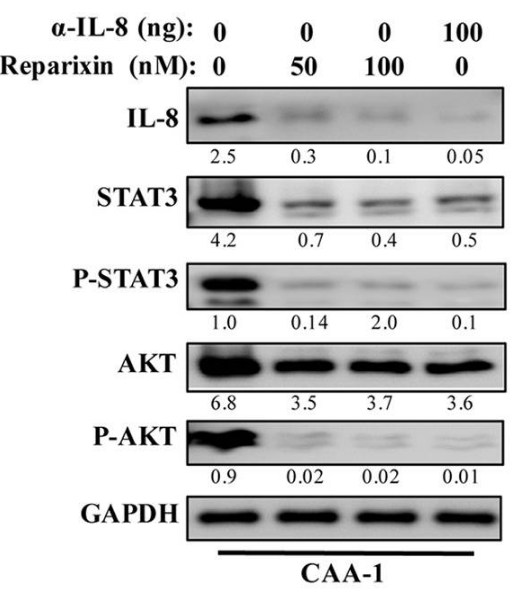
| Western blot | IL-8 / STAT3 / p-STAT3 / AKT / p-AKT CXCR1 / CACR2 / Bcl-2 / Bax / Cyclin D1 / VEGF / MMP-2 / MMP-9 / TIMP-2 / E-cadherin / p-ERK / ERK |
|
30397072 |
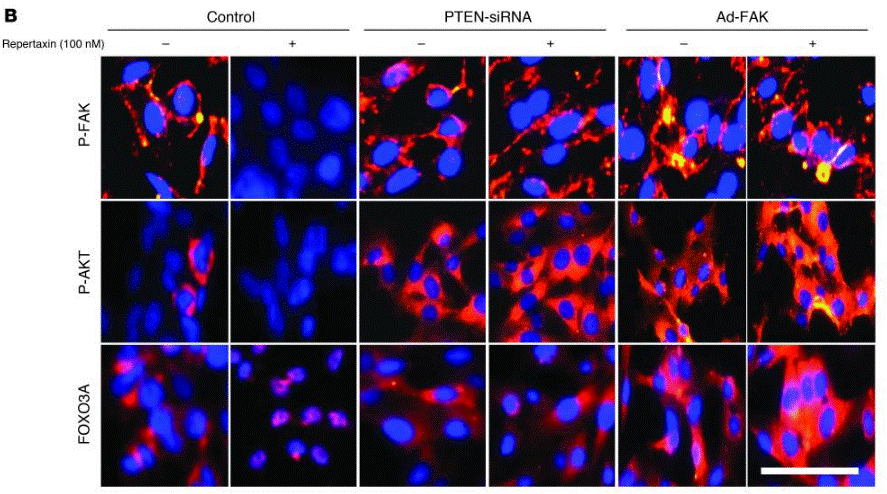
| Immunofluorescence | p-FAK / p-AKT / FOXO3A |
|
20051626 |
Clinical Trial Information
(data from https://clinicaltrials.gov, updated on 2024-05-22)
| NCT Number | Recruitment | Conditions | Sponsor/Collaborators | Start Date | Phases |
|---|---|---|---|---|---|
| NCT05835466 | Recruiting | Myelofibrosis (PMF)|Post Essential Thrombocythemia Myelofibrosis (ET-MF)|Post Polycythemia Vera Related Myelofibrosis (PV-MF) |
Icahn School of Medicine at Mount Sinai|Dompé Farmaceutici S.p.A |
June 27 2023 | Phase 2 |
| NCT05496868 | Recruiting | Acute Respiratory Distress Syndrome Adult |
Dompé Farmaceutici S.p.A |
February 7 2023 | Phase 2 |
| NCT01861054 | Terminated | Breast Cancer |
Dompé Farmaceutici S.p.A |
February 2013 | Phase 2 |
Tech Support
Tel: +1-832-582-8158 Ext:3
If you have any other enquiries, please leave a message.
Frequently Asked Questions
Question 1:
Do you have the information of the half life time of it Catalog No.S8640 in rats?
Answer:
The following paper indicated that its half-life in rats is 0.5h (http://jpet.aspetjournals.org/content/322/3/973).

Products are for research use only. Not for human use. We do not sell to patients.
©Copyright 2013 Selleck Chemicals. All Rights Reserved.