
research use only
Reversine Adenosine Receptor antagonist
Cat.No.S7588
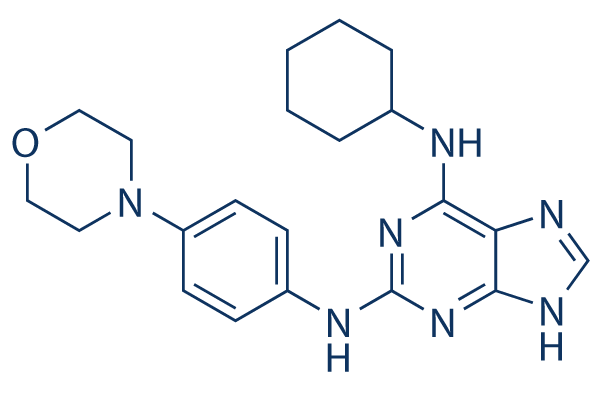
Chemical Structure
Molecular Weight: 393.23
Quality Control
| Related Targets | CXCR Hedgehog/Smoothened PKA Adrenergic Receptor AChR 5-HT Receptor Histamine Receptor Dopamine Receptor Ras KRas |
|---|---|
| Other Adenosine Receptor Inhibitors | CGS 21680 HCl ZM241385 SCH58261 Etrumadenant (AB928) A2AR antagonist 1 Ciforadenant (CPI-444) Imaradenant (AZD4635) DPCPX Proxyphylline Alloxazine |
Chemical Information, Storage & Stability
| Molecular Weight | 393.23 | Formula | C21H27N7O |
Storage (From the date of receipt) | |
|---|---|---|---|---|---|
| CAS No. | 656820-32-5 | Download SDF | Storage of Stock Solutions |
|
|
| Synonyms | N/A | Smiles | C1CCC(CC1)NC2=NC(=NC3=C2NC=N3)NC4=CC=C(C=C4)N5CCOCC5 | ||
Solubility
|
In vitro |
DMSO
: 5 mg/mL
(12.71 mM)
Water : Insoluble Ethanol : Insoluble |
Molarity Calculator
|
In vivo |
|||||
In vivo Formulation Calculator (Clear solution)
Step 1: Enter information below (Recommended: An additional animal making an allowance for loss during the experiment)
Step 2: Enter the in vivo formulation (This is only the calculator, not formulation. Please contact us first if there is no in vivo formulation at the solubility Section.)
Calculation results:
Working concentration: mg/ml;
Method for preparing DMSO master liquid: mg drug pre-dissolved in μL DMSO ( Master liquid concentration mg/mL, Please contact us first if the concentration exceeds the DMSO solubility of the batch of drug. )
Method for preparing in vivo formulation: Take μL DMSO master liquid, next addμL PEG300, mix and clarify, next addμL Tween 80, mix and clarify, next add μL ddH2O, mix and clarify.
Method for preparing in vivo formulation: Take μL DMSO master liquid, next add μL Corn oil, mix and clarify.
Note: 1. Please make sure the liquid is clear before adding the next solvent.
2. Be sure to add the solvent(s) in order. You must ensure that the solution obtained, in the previous addition, is a clear solution before proceeding to add the next solvent. Physical methods such as vortex, ultrasound or hot water bath can be used to aid dissolving.
Mechanism of Action
| Targets/IC50/Ki |
Aurora A
400 nM
Aurora C
400 nM
Aurora B
500 nM
human A3 adenosine receptor
0.66 μM(Ki)
|
|---|---|
| In vitro |
Reversine induces myogenic lineage-committed cells to become multipotent mesenchymal progenitor cells, which proliferates and redifferentiates into bone and fat cells. This compound, as an A3 adenosine receptor antagonist, competitively inhibits forskolin-stimulated cAMP production in stably transfected Chinese hamster ovary (CHO) cells. It inhibits the phosphorylation of a well-known Aurora target, histone H3 in HCT116 cells. Moreover, this chemical potently blocks proliferation of multiple tumour cell types, and induces cell death. In primary human tumour samples, it also inhibits colony formation of leukaemic cells. When treated in combination, this compound and aspirin synergistically inhibit growth of cervical cancer cells and induce cell apoptosis.
|
| Kinase Assay |
Radioligand Binding Assays
|
|
Each tube in the A3 AR competitive binding assay contains 100 μL of membrane suspension (20 μg of protein), 50 μL of [125I]4-amino-3-iodobenzyl)adenosine-5′-N-methyluronamide (0.5 nM), and 50 μL of increasing concentrations of the test ligands in Tris-HCl buffer (50 mM, pH 7.4) containing 10 mM MgCl2 and 1 mM EDTA. Nonspecific binding is determined using 10 mM 5′-N-ethylcarboxamidoadenosine in the buffer. The mixtures are incubated at 25°C for 60 min. Binding reactions are terminated by filtration through Whatman GF/B filters under reduced pressure using a MT-24 cell harvester. Filters are washed three times with 9 mL of ice-cold buffer. Radioactivity is determined using a Beckman γ-counter, and the percent inhibition is calculated.
|
|
| In vivo |
In mice inoculated with U14 tumours, Reversine (10 mg/kg i.p.) and aspirin cause more reduced tumour weight and tumour volume when compared with the control agents.
|
References |
|
Tech Support
Tel: +1-832-582-8158 Ext:3
If you have any other enquiries, please leave a message.

Products are for research use only. Not for human use. We do not sell to patients.
©Copyright 2013 Selleck Chemicals. All Rights Reserved.