
research use only
Salermide Sirtuin inhibitor
Cat.No.S8460
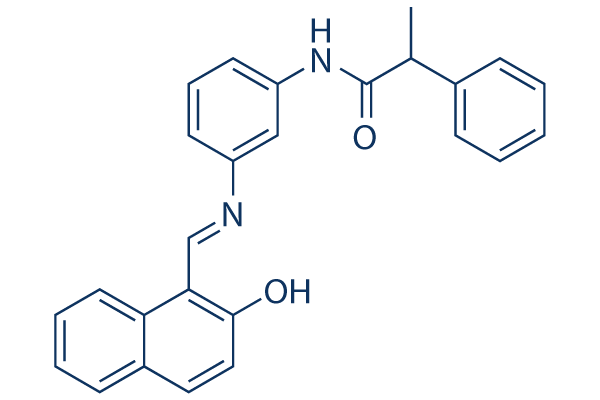
Chemical Structure
Molecular Weight: 394.47
Quality Control
| Related Targets | HDAC PARP ATM/ATR DNA-PK WRN DNA/RNA Synthesis Topoisomerase PPAR Casein Kinase eIF |
|---|---|
| Other Sirtuin Inhibitors | SRT 1720 Hydrochloride Selisistat (EX-527) Sirtinol Fisetin 3-TYP AGK2 SRT2104 (GSK2245840) OSS_128167 SirReal2 Thiomyristoyl |
Cell Culture, Treatment & Working Concentration
| Cell Lines | Assay Type | Concentration | Incubation Time | Formulation | Activity Description | PMID |
|---|---|---|---|---|---|---|
| CRO cells | Cytotoxicity assay | 72 h | Cytotoxicity against human CRO cells after 72 hrs by celltiter-glo luminescent assay, CC50=6.7 μM | |||
| CRC 1.1 cells | Cytotoxicity assay | 72 h | Cytotoxicity against human CRC 1.1 cells after 72 hrs by celltiter-glo luminescent assay, CC50=9.7 μM | |||
| 30PT cells | Cytotoxicity assay | 72 h | Cytotoxicity against human 30PT cells after 72 hrs by celltiter-glo luminescent assay, CC50=36.5 μM | |||
| 30P cells | Cytotoxicity assay | 72 h | Cytotoxicity against human 30P cells after 72 hrs by celltiter-glo luminescent assay, CC50=41 μM | |||
| MCF7 cells | Proliferation assay | 30 μM | 24-72 h | Antiproliferative activity against human MCF7 cells at 30 uM after 24 to 72 hrs | ||
| U937 cells | Function assay | 50 μM | 45 h | Induction of apoptosis in human U937 cells at 50 uM after 45 hrs by flow cytometry | ||
| MOLT4 cells | Proliferation assay | 25 μM | 24-72 h | Antiproliferative activity against human MOLT4 cells at 25 uM after 24 to 72 hrs by MTT assay | ||
| MDA-MB-231 cells | Proliferation assay | 25 μM | 24-72 h | Antiproliferative activity against human MDA-MB-231 cells at 25 uM after 24 to 72 hrs by MTT assay | ||
| RKO cells | Proliferation assay | 25 μM | 24-72 h | Antiproliferative activity against human RKO cells at 25 uM after 24 to 72 hrs by MTT assay | ||
| Click to View More Cell Line Experimental Data | ||||||
Chemical Information, Storage & Stability
| Molecular Weight | 394.47 | Formula | C26H22N2O2 |
Storage (From the date of receipt) | |
|---|---|---|---|---|---|
| CAS No. | 1105698-15-4 | Download SDF | Storage of Stock Solutions |
|
|
| Synonyms | N/A | Smiles | CC(C1=CC=CC=C1)C(=O)NC2=CC(=CC=C2)N=CC3=C(C=CC4=CC=CC=C43)O | ||
Solubility
|
In vitro |
DMSO
: 78 mg/mL
(197.73 mM)
Ethanol : 8 mg/mL Water : Insoluble |
Molarity Calculator
|
In vivo |
|||||
In vivo Formulation Calculator (Clear solution)
Step 1: Enter information below (Recommended: An additional animal making an allowance for loss during the experiment)
Step 2: Enter the in vivo formulation (This is only the calculator, not formulation. Please contact us first if there is no in vivo formulation at the solubility Section.)
Calculation results:
Working concentration: mg/ml;
Method for preparing DMSO master liquid: mg drug pre-dissolved in μL DMSO ( Master liquid concentration mg/mL, Please contact us first if the concentration exceeds the DMSO solubility of the batch of drug. )
Method for preparing in vivo formulation: Take μL DMSO master liquid, next addμL PEG300, mix and clarify, next addμL Tween 80, mix and clarify, next add μL ddH2O, mix and clarify.
Method for preparing in vivo formulation: Take μL DMSO master liquid, next add μL Corn oil, mix and clarify.
Note: 1. Please make sure the liquid is clear before adding the next solvent.
2. Be sure to add the solvent(s) in order. You must ensure that the solution obtained, in the previous addition, is a clear solution before proceeding to add the next solvent. Physical methods such as vortex, ultrasound or hot water bath can be used to aid dissolving.
Mechanism of Action
| Targets/IC50/Ki |
SIRT1
SIRT2
|
|---|---|
| In vitro |
Salermide prompts tumour-specific cell death in a wide range of human cancer cell lines. The antitumour activity of this compound is primarily because of a massive induction of apoptosis. It induces apoptosis in cancer but not in normal cells. This chemical induces strong apoptosis without any evident effect on the cell cycle in all the cancer cell lines analysed except in non-tumorigenic MRC5 cells. The induction of apoptosis is cell-type-specific and dose-dependent.
|
| In vivo |
Salermide is well tolerated by mice at concentrations up to 100 μM. Its feeding does not produce any adverse health effects in mice as monitored by diet consumption, body-weight gain, and postural and behavioural changes.
|
References |
Tech Support
Tel: +1-832-582-8158 Ext:3
If you have any other enquiries, please leave a message.

Products are for research use only. Not for human use. We do not sell to patients.
©Copyright 2013 Selleck Chemicals. All Rights Reserved.