
research use only
Salvianolic acid B Sirtuin activator
Cat.No.S4735
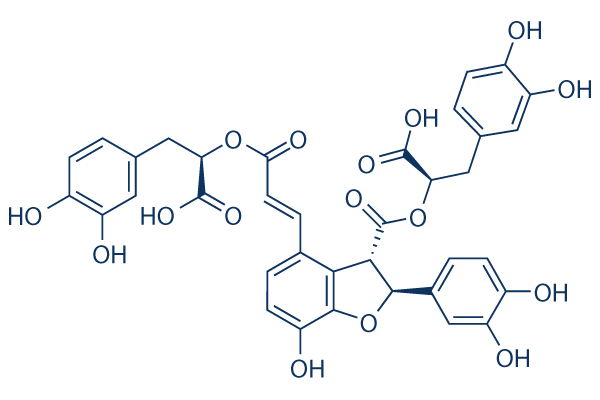
Chemical Structure
Molecular Weight: 718.61
Quality Control
| Related Targets | HDAC JAK BET Histone Methyltransferase PKC PARP HIF PRMT EZH2 AMPK |
|---|---|
| Other Sirtuin Inhibitors | SRT 1720 Hydrochloride Selisistat (EX-527) Sirtinol Fisetin 3-TYP AGK2 SRT2104 (GSK2245840) OSS_128167 SirReal2 Thiomyristoyl |
Chemical Information, Storage & Stability
| Molecular Weight | 718.61 | Formula | C36H30O16 |
Storage (From the date of receipt) | 3 years -20°C powder (seal) |
|---|---|---|---|---|---|
| CAS No. | 121521-90-2 | Download SDF | Storage of Stock Solutions |
|
|
| Synonyms | Sal B, Lithospermate B, Lithospermic acid B | Smiles | C1=CC(=C(C=C1CC(C(=O)O)OC(=O)C=CC2=C3C(C(OC3=C(C=C2)O)C4=CC(=C(C=C4)O)O)C(=O)OC(CC5=CC(=C(C=C5)O)O)C(=O)O)O)O | ||
Solubility
|
In vitro |
DMSO
: 100 mg/mL
(139.15 mM)
Water : 100 mg/mL Ethanol : 100 mg/mL |
Molarity Calculator
|
In vivo |
|||||
In vivo Formulation Calculator (Clear solution)
Step 1: Enter information below (Recommended: An additional animal making an allowance for loss during the experiment)
Step 2: Enter the in vivo formulation (This is only the calculator, not formulation. Please contact us first if there is no in vivo formulation at the solubility Section.)
Calculation results:
Working concentration: mg/ml;
Method for preparing DMSO master liquid: mg drug pre-dissolved in μL DMSO ( Master liquid concentration mg/mL, Please contact us first if the concentration exceeds the DMSO solubility of the batch of drug. )
Method for preparing in vivo formulation: Take μL DMSO master liquid, next addμL PEG300, mix and clarify, next addμL Tween 80, mix and clarify, next add μL ddH2O, mix and clarify.
Method for preparing in vivo formulation: Take μL DMSO master liquid, next add μL Corn oil, mix and clarify.
Note: 1. Please make sure the liquid is clear before adding the next solvent.
2. Be sure to add the solvent(s) in order. You must ensure that the solution obtained, in the previous addition, is a clear solution before proceeding to add the next solvent. Physical methods such as vortex, ultrasound or hot water bath can be used to aid dissolving.
Mechanism of Action
| Targets/IC50/Ki |
SIRT
|
|---|---|
| In vitro |
Salvianolic acid B, also known as satanic acid B or lithospermic acid B, is a new generation of natural antioxidants. It can influence Ca2+ aggregation and endothelial cell NO release of hypoxia/reoxygenation-induced cell. When this compound concentration is 2.5, 5, and 10 mg/l, cell viability and superoxide dismutase (SOD) activity are enhanced, and the formation of malondialdehyde (MDA) in human umbilical vein endothelial cells (ECV304) is inhibited. SalB inhibits HG-induced oxidative stress and reduces the generation of ROS and 8-hydroxy-2-deoxyguanosine (8-OHDG) and mitochondrial depolarisation and apoptosis in a dose-dependent manner. It can downregulate the expression of Bax and AIF nuclear translocation and cytochrome c release mediated by HG, but upregulate the expression of Bcl-2 induced by HG. Besides, this chemical attenuates HG-induced caspase of the enzyme 3, 9 and minimises PARP cleavage of Schwann cells (SCs). It inhibits angiotensin II or H2O2 and TNF-α-induced gelatinolytic activity in human aortic smooth muscle cells (HASMCs) in a concentration-dependent manner. This compound can inhibit platelet aggregation and adhesion. It can promote cardiac angiogenesis effect. SalB can enhance cell activity and reduce the number of sub-G1 and apoptotic nuclei of ischaemic cell model in order to show its antiapoptotic effects. It inhibits ischaemia and hypoxia of myocardial injury. This chemical inhibits the synthesis of type I collagen of non-TGF-1 stimulated human hepatic stellate cell line (LX-2). SalB activates mammalian Sirtuins 1 (SIRT1), an NAD-dependent class III histone deacetylase (HDAC) that plays important roles in several physiological processes, including gene transcription, senescence, energy metabolism, oxidative stress and inflammation. (HG: High glucose)
|
| In vivo |
Salvianolic acid B can significantly reduce the myocardial infarct size and blood lactate dehydrogenase level of model rats with acute myocardial infarction, improve cardiac function and myocardial tissue structure, thus inhibiting ischaemia and hypoxia of myocardial injury. This compound can improve blood haemorheology, reduce oxidative damage, improve the vascular endothelial cell function, and prevent the development of coronary artery disease. It could selectively inhibit the activity of MMP-9 in a rat model of myocardial infarction. This chemical can also effectively increase the thickness of the left ventricular wall in the myocardial infarction rats to improve the contraction of the heart, and reduce cardiac fibrosis. SalB treatment ameliorates ethanol-induced hepatic inflammation by decreasing the levels of hepatotoxic cytokines such as tumour necrosis factor-α (TNF-α) and interleukin-6 (IL-6). It has beneficial effects against hepatic fibrosis in animal models and has been shown to possess cardioprotective and neuroprotective activity via anti-oxidative and anti-inflammatory actions.
|
References |
|
Clinical Trial Information
(data from https://clinicaltrials.gov, updated on 2024-05-22)
| NCT Number | Recruitment | Conditions | Sponsor/Collaborators | Start Date | Phases |
|---|---|---|---|---|---|
| NCT02694848 | Unknown status | Angina |
China Academy of Chinese Medical Sciences|Xiyuan Hospital of China Academy of Chinese Medical Sciences|Guang''anmen Hospital of China Academy of Chinese Medical Sciences|General Hospital of Beijing PLA Military Region|Guangdong Provincial Hospital of Traditional Chinese Medicine |
February 2016 | Phase 4 |
Tech Support
Tel: +1-832-582-8158 Ext:3
If you have any other enquiries, please leave a message.

Products are for research use only. Not for human use. We do not sell to patients.
©Copyright 2013 Selleck Chemicals. All Rights Reserved.