
research use only
SF2523 PI3K inhibitor
Cat.No.S8589
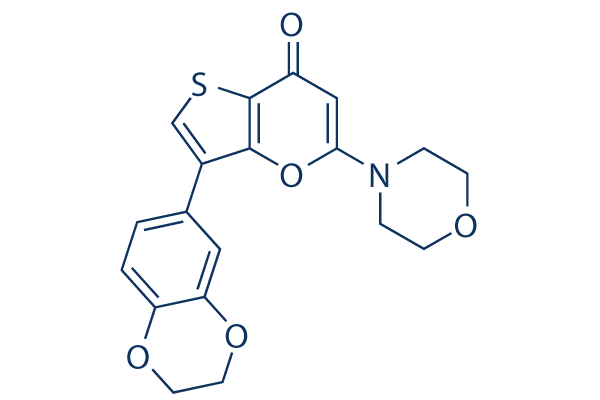
Chemical Structure
Molecular Weight: 371.41
Quality Control
| Related Targets | Akt mTOR GSK-3 ATM/ATR DNA-PK AMPK PDPK1 PTEN PP2A PDK |
|---|---|
| Other PI3K Inhibitors | GDC-0077 (Inavolisib) SAR405 Quercetin (Sophoretin) LY294002 XL147 analogue Tersolisib (STX-478) Buparlisib (BKM120) 740 Y-P (PDGFR 740Y-P) GO-203 TFA Eganelisib (IPI-549) |
Chemical Information, Storage & Stability
| Molecular Weight | 371.41 | Formula | C19H17NO5S |
Storage (From the date of receipt) | |
|---|---|---|---|---|---|
| CAS No. | 1174428-47-7 | Download SDF | Storage of Stock Solutions |
|
|
| Synonyms | N/A | Smiles | C1COCCN1C2=CC(=O)C3=C(O2)C(=CS3)C4=CC5=C(C=C4)OCCO5 | ||
Solubility
|
In vitro |
DMSO
: 29 mg/mL
(78.08 mM)
Ethanol : 7 mg/mL Water : Insoluble |
Molarity Calculator
|
In vivo |
|||||
In vivo Formulation Calculator (Clear solution)
Step 1: Enter information below (Recommended: An additional animal making an allowance for loss during the experiment)
Step 2: Enter the in vivo formulation (This is only the calculator, not formulation. Please contact us first if there is no in vivo formulation at the solubility Section.)
Calculation results:
Working concentration: mg/ml;
Method for preparing DMSO master liquid: mg drug pre-dissolved in μL DMSO ( Master liquid concentration mg/mL, Please contact us first if the concentration exceeds the DMSO solubility of the batch of drug. )
Method for preparing in vivo formulation: Take μL DMSO master liquid, next addμL PEG300, mix and clarify, next addμL Tween 80, mix and clarify, next add μL ddH2O, mix and clarify.
Method for preparing in vivo formulation: Take μL DMSO master liquid, next add μL Corn oil, mix and clarify.
Note: 1. Please make sure the liquid is clear before adding the next solvent.
2. Be sure to add the solvent(s) in order. You must ensure that the solution obtained, in the previous addition, is a clear solution before proceeding to add the next solvent. Physical methods such as vortex, ultrasound or hot water bath can be used to aid dissolving.
Mechanism of Action
| Targets/IC50/Ki |
DNA-PK
(Cell-free assay) 9 nM
PI3Kα
(Cell-free assay) 34 nM
PI3Kγ
(Cell-free assay) 158 nM
BRD4
(Cell-free assay) 241 nM
mTOR
(Cell-free assay) 280 nM
|
|---|---|
| In vitro |
SF2523 blocks BRD4 binding to MYCN promoter PS1/PS2. It blocks M1-M2 transition and decreases levels of p-AKT, N-MYC in several neuroblastoma cell lines. This compound treatment decreases protein levels of MYCN and Cyclin D1, the MYCN target, and inhibits AKT activation by blocking phosphorylation of AKT at Ser473. It interacts robustly with the full-length BRD4 (Kd = 140 nM) and exhibits comparable affinity to the BRD4 first BD (BD1) (Kd = 150 nM), however it binds more weakly to the second BD (BD2) of BRD4 (Kd = 710 nM). Comparison of binding affinities of this chemical for BDs of other proteins reveals that it binds equally well to BDs of BRD4, BRD2, and BRD3; shows moderate binding to BDs of CECR2 and BRDT; but associates much weaker with other BDs.
|
| In vivo |
SF2523 blocks spontaneous metastasis and tumour growth. This compound has demonstrated animal efficacy results without toxicity in the following 4 animal models: orthotopic pancreatic model, multiple myeloma model, renal cell carcinoma model, neuroblastoma xenograft model. It targets PI3K-driven and BRD4-driven oncogenic pathways in vivo. It is less toxic to the host organism in vivo than a combination of an equipotent PI3K inhibitor and BRD4 inhibitor.
|
References |
|
Tech Support
Tel: +1-832-582-8158 Ext:3
If you have any other enquiries, please leave a message.

Products are for research use only. Not for human use. We do not sell to patients.
©Copyright 2013 Selleck Chemicals. All Rights Reserved.