
research use only
Sodium Monofluorophosphate phosphatase inhibitor
Cat.No.S4013
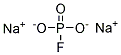
Chemical Structure
Molecular Weight: 143.95
Quality Control
- content >98%
- Cited in Nature Medicine for its top-tier quality
- COA
- Datasheet
- SDS
Chemical Information, Storage & Stability
| Molecular Weight | 143.95 | Formula | FNa2O3P |
Storage (From the date of receipt) | |
|---|---|---|---|---|---|
| CAS No. | 10163-15-2 | Download SDF | Storage of Stock Solutions |
|
|
| Synonyms | NSC248 | Smiles | [O-]P(=O)([O-])F.[Na+].[Na+] | ||
Molarity Calculator
|
In vivo |
|||||
In vivo Formulation Calculator (Clear solution)
Step 1: Enter information below (Recommended: An additional animal making an allowance for loss during the experiment)
Step 2: Enter the in vivo formulation (This is only the calculator, not formulation. Please contact us first if there is no in vivo formulation at the solubility Section.)
Calculation results:
Working concentration: mg/ml;
Method for preparing DMSO master liquid: mg drug pre-dissolved in μL DMSO ( Master liquid concentration mg/mL, Please contact us first if the concentration exceeds the DMSO solubility of the batch of drug. )
Method for preparing in vivo formulation: Take μL DMSO master liquid, next addμL PEG300, mix and clarify, next addμL Tween 80, mix and clarify, next add μL ddH2O, mix and clarify.
Method for preparing in vivo formulation: Take μL DMSO master liquid, next add μL Corn oil, mix and clarify.
Note: 1. Please make sure the liquid is clear before adding the next solvent.
2. Be sure to add the solvent(s) in order. You must ensure that the solution obtained, in the previous addition, is a clear solution before proceeding to add the next solvent. Physical methods such as vortex, ultrasound or hot water bath can be used to aid dissolving.
Mechanism of Action
| Targets/IC50/Ki |
alkaline phosphatase
69 μM(Ki)
phosphorylase phosphatase
0.5 mM(Ki)
pyruvate kinase
3.4 mM(Ki)
|
|---|---|
| In vitro |
Acadesine (500 μM) increases the ZMP content in extracts of isolated hepatocytes after up to 30-40 min treatment, then remains fairly constant at approximately 4 nmol/g. This compound causes a transient 12-fold activation of AMPK at 15 min in rat hepatocytes and 2-3 fold activation of AMPK in adipocytes, without affecting levels of ATP, ADP or AMP. It also causes a dramatic inhibition of both fatty acid and sterol synthesis in rat hepatocytes, as well as a dramatic inactivation of HMG-CoA reductase. AICAR induces apoptosis of B-CLL cells in a dose-dependent manner with EC50 of 380 μM. At 0.5 mM, it decreases cell viability of B-CLL cells from 20 representative patients from 68% to 26%, and induces caspase activation and cytochrome c release from mitochondria. Uptake and phosphorylation of the compound are required to induce apoptosis and activate AMPK in B-CLL cells. While concentrations of 2-4 mM only slightly affect the viability of T cells from B-CLL patients, 0.5 mM remarkably reduces viability of B cells but not T cells. It triggers loss of cell Metabolism in K562, LAMA-84 and JURL-MK1 and is also effective in killing resistant K562 cells and Ba/F3 cells carrying the T315I-BCR-ABL mutation. The effect of AICAR is abrogated by GF109203X and Ro-32-0432, both inhibitor of classical and new PKCs and accordingly, it triggers relocation and activation of several PKC isoforms in K562 cells. The compound dose-dependently inhibits K562 colony formation at day 10, the growth inhibitory effect is already detected at 0.25 mM and is maximal at 2.5 mM. AICAR causes a concentration-related reduction in CD18 expression on LPS-stimulated neutrophils in vitro. It significantly (1 mM) inhibits N-formyl-methionyl-leucyl-phenylalanine-induced granulocyte CD11b up-regulation by a mean of 61% in blood. |
| In vivo |
Monofluorophosphate displays potent activity on bone immobilization in vivo. Rats supplied with drinking water containing 50 ppm F as Monofluorophosphate show a significant increase in the bone thickness of mobile tibia and immobile tibia, compared with fluoride-free water group (1.48 vs 0.98 mm, 0.79 vs 0.40 mm, respectively). Monofluorophosphate does not change the specific gravities of the immobilized and non-immobilized tibiae of the rats. Administration of Monofluorophosphate increases the mineralization rate of bones and counteracts the decrease in bone thickness, ash content and specific gravity induced by immobilization, without changing the Ca/P ratio of the ash. |
References |
|
Tech Support
Tel: +1-832-582-8158 Ext:3
If you have any other enquiries, please leave a message.

Products are for research use only. Not for human use. We do not sell to patients.
©Copyright 2013 Selleck Chemicals. All Rights Reserved.