
research use only
Sulindac COX inhibitor
Cat.No.S2007
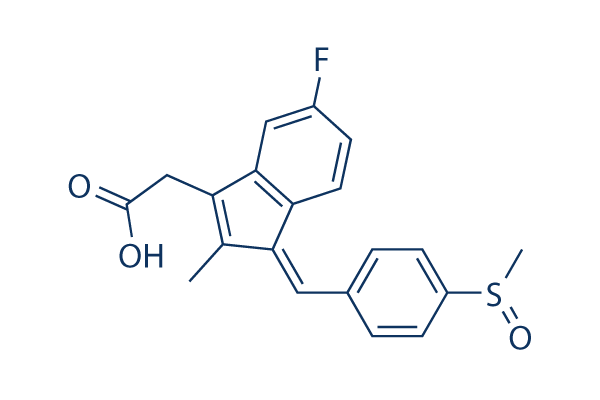
Chemical Structure
Molecular Weight: 356.41
Quality Control
Chemical Information, Storage & Stability
| Molecular Weight | 356.41 | Formula | C20H17FO3S |
Storage (From the date of receipt) | |
|---|---|---|---|---|---|
| CAS No. | 38194-50-2 | Download SDF | Storage of Stock Solutions |
|
|
| Synonyms | MK-231 | Smiles | CC1=C(C2=C(C1=CC3=CC=C(C=C3)S(=O)C)C=CC(=C2)F)CC(=O)O | ||
Solubility
|
In vitro |
DMSO
: 82 mg/mL
(230.07 mM)
Ethanol : 9 mg/mL Water : Insoluble |
Molarity Calculator
|
In vivo |
|||||
In vivo Formulation Calculator (Clear solution)
Step 1: Enter information below (Recommended: An additional animal making an allowance for loss during the experiment)
Step 2: Enter the in vivo formulation (This is only the calculator, not formulation. Please contact us first if there is no in vivo formulation at the solubility Section.)
Calculation results:
Working concentration: mg/ml;
Method for preparing DMSO master liquid: mg drug pre-dissolved in μL DMSO ( Master liquid concentration mg/mL, Please contact us first if the concentration exceeds the DMSO solubility of the batch of drug. )
Method for preparing in vivo formulation: Take μL DMSO master liquid, next addμL PEG300, mix and clarify, next addμL Tween 80, mix and clarify, next add μL ddH2O, mix and clarify.
Method for preparing in vivo formulation: Take μL DMSO master liquid, next add μL Corn oil, mix and clarify.
Note: 1. Please make sure the liquid is clear before adding the next solvent.
2. Be sure to add the solvent(s) in order. You must ensure that the solution obtained, in the previous addition, is a clear solution before proceeding to add the next solvent. Physical methods such as vortex, ultrasound or hot water bath can be used to aid dissolving.
Mechanism of Action
| Targets/IC50/Ki |
COX
|
|---|---|
| In vitro |
Sulindac and its metabolites sulindac sulfide and sulindac sulfone can also inhibit the NF-kappaB pathway in both colon cancer and other cell lines, due to this compound-mediated decreases in IKKbeta kinase activity. The sulfide significantly reduces cell number in both preconfluent and confluent cultures of HT-29 cells with this metabolite showing approximately 4-fold greater potency. It inhibits the growth of a variety of tumor cell lines derived from other tissues, as well as normal epithelial cells and fibroblasts. This sulphide abrogates beta-catenin/TCF-mediated transcription in the CRC cell lines DLD1 and SW480, and decreases the levels of nonphosphorylated beta-catenin. |
| In vivo |
Sulindac not only inhibits tumor formation but decreases small bowel Cox-2 and prostaglandin E(2) to baseline and restored normal levels of apoptosis in a murine modelof familial adenomatous polyposis. This compound reduces the tumor number by 95% but does not alter the levels of PGE2 and LTB4 in intestinal tissues in Min/+爉ice. It reduces tumor number by 82%, whereas eicosanoid levels remained elevates in Min/+ mice. This chemical causes regression of 70-80% of small intestinal tumors in Min/+ mice within 4 days, but does not have the same impact on colonic lesions. |
References |
|
Clinical Trial Information
(data from https://clinicaltrials.gov, updated on 2024-05-22)
| NCT Number | Recruitment | Conditions | Sponsor/Collaborators | Start Date | Phases |
|---|---|---|---|---|---|
| NCT01636128 | Withdrawn | Focus of Study: Drug Response Biomarkers Chemoprevention Neoplasms |
Cancer Prevention Pharmaceuticals Inc.|University of Arizona |
March 2014 | Phase 2 |
| NCT01843179 | Withdrawn | Acute Myeloid Leukemia |
Massachusetts General Hospital |
January 2014 | Phase 2 |
| NCT00392665 | Terminated | Squamous Cell Carcinoma of the Head and Neck (SCCHN) |
Massachusetts General Hospital|Dana-Farber Cancer Institute|Emory University|University of North Carolina Chapel Hill|Genentech Inc.|OSI Pharmaceuticals |
October 2006 | Phase 2 |
Tech Support
Tel: +1-832-582-8158 Ext:3
If you have any other enquiries, please leave a message.

Products are for research use only. Not for human use. We do not sell to patients.
©Copyright 2013 Selleck Chemicals. All Rights Reserved.