
research use only
Gabapentin GABA Receptor agonist
Cat.No.S2133
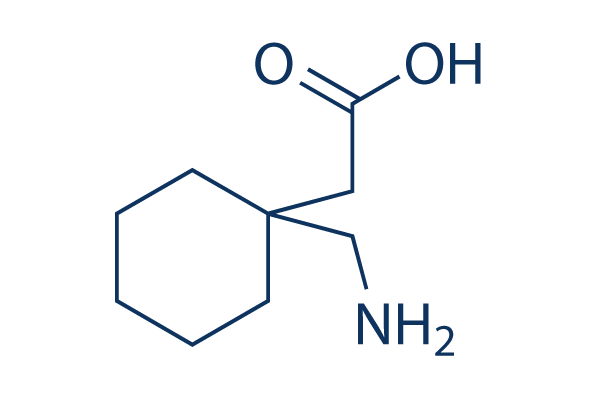
Chemical Structure
Molecular Weight: 171.24
Quality Control
| Related Targets | Adrenergic Receptor AChR 5-HT Receptor COX Calcium Channel Histamine Receptor Dopamine Receptor TRP Channel Cholinesterase (ChE) GluR |
|---|---|
| Other GABA Receptor Inhibitors | Dihydromyricetin CGP52432 Oxiracetam Ginkgolide A Pentylenetetrazol 4-Aminobutyric acid (GABA) Emamectin Benzoate Nefiracetam Piracetam Bemegride |
Chemical Information, Storage & Stability
| Molecular Weight | 171.24 | Formula | C9H17NO2 |
Storage (From the date of receipt) | |
|---|---|---|---|---|---|
| CAS No. | 60142-96-3 | Download SDF | Storage of Stock Solutions |
|
|
| Synonyms | N/A | Smiles | C1CCC(CC1)(CC(=O)O)CN | ||
Solubility
|
In vitro |
Water : 34.2 mg/mL Ethanol : 3 mg/mL
DMSO
: Insoluble
|
Molarity Calculator
|
In vivo |
|||||
In vivo Formulation Calculator (Clear solution)
Step 1: Enter information below (Recommended: An additional animal making an allowance for loss during the experiment)
Step 2: Enter the in vivo formulation (This is only the calculator, not formulation. Please contact us first if there is no in vivo formulation at the solubility Section.)
Calculation results:
Working concentration: mg/ml;
Method for preparing DMSO master liquid: mg drug pre-dissolved in μL DMSO ( Master liquid concentration mg/mL, Please contact us first if the concentration exceeds the DMSO solubility of the batch of drug. )
Method for preparing in vivo formulation: Take μL DMSO master liquid, next addμL PEG300, mix and clarify, next addμL Tween 80, mix and clarify, next add μL ddH2O, mix and clarify.
Method for preparing in vivo formulation: Take μL DMSO master liquid, next add μL Corn oil, mix and clarify.
Note: 1. Please make sure the liquid is clear before adding the next solvent.
2. Be sure to add the solvent(s) in order. You must ensure that the solution obtained, in the previous addition, is a clear solution before proceeding to add the next solvent. Physical methods such as vortex, ultrasound or hot water bath can be used to aid dissolving.
Mechanism of Action
| Targets/IC50/Ki |
GABA receptor
|
|---|---|
| In vitro |
Gabapentin produces concentration-dependent inhibitions of the K(+)-induced [Ca(2+)](i) increase in fura-2-loaded human neocortical synaptosomes with IC50 of 17 mM and maximal inhibition of 37%. This compound may bind to the Ca(2+) channel alpha 2 delta subunit to selectively attenuate depolarization-induced Ca(2+) influx of presynaptic P/Q-type Ca(2+) channels; this results in decreased glutamate/aspartate release from excitatory amino acid nerve terminals leading to a reduced activation of AMPA heteroreceptors on noradrenergic nerve terminals. It produces alterations in the cytosolic and extracellular concentrations of several amino acids, including L-leucine, L-valine and L-phenylalanine, in rat cortical astrocytes and synaptosomes, effects that are postulated to be of pharmacological significance. This chemical reduces potassium-evoked calcium influx via voltage-gated calcium channels in a mouse pituitary cell line that constitutively expresses GABAB receptors comprising the functional gb1a–gb2 subunit heterodimer. It can increase N-methyl-d-aspartate (NMDA)-evoked currents in GABA-positive rat dorsal horn neurones in the presence of protein kinase C, possibly by increasing the glycine sensitivity of the NMDA receptor complex. This agent produces a delayed allosteric enhancement of an unspecified voltage-activated potassium current in rat dorsal root ganglion neurons.
|
| In vivo |
Gabapentin dose-dependently (10-100 mg/kg, p.o.) blocks both static and dynamic allodynia in the rats.
|
References |
|
Clinical Trial Information
(data from https://clinicaltrials.gov, updated on 2024-05-22)
| NCT Number | Recruitment | Conditions | Sponsor/Collaborators | Start Date | Phases |
|---|---|---|---|---|---|
| NCT04613024 | Not yet recruiting | Weight Loss|Pain Postoperative |
Stanford University |
July 1 2023 | Early Phase 1 |
| NCT05276089 | Not yet recruiting | Opioid Use |
Dr Yu Fu|Teesside University|NIHR Applied Research Collaboration for North East and North Cumbria|North East Academic Health Science Network|Newcastle University |
February 1 2023 | Not Applicable |
| NCT05609682 | Recruiting | Post Operative Pain |
University of Oklahoma |
November 29 2022 | Early Phase 1 |
| NCT05750875 | Completed | Pruritus|Uremia|Chronic Kidney Diseases |
King Edward Medical University |
May 1 2022 | Phase 4 |
Tech Support
Tel: +1-832-582-8158 Ext:3
If you have any other enquiries, please leave a message.

Products are for research use only. Not for human use. We do not sell to patients.
©Copyright 2013 Selleck Chemicals. All Rights Reserved.