
research use only
ARN-509 (Apalutamide) AR Antagonist
Cat.No.S2840
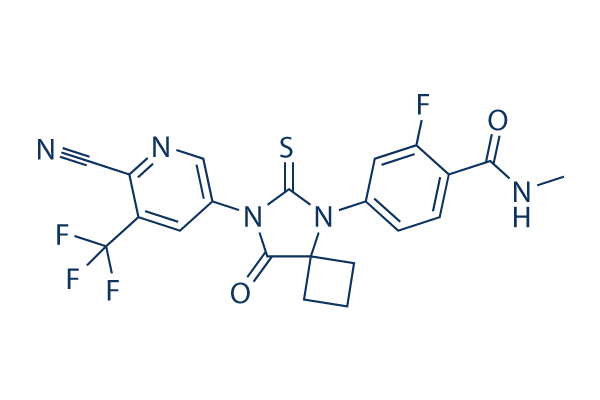
Chemical Structure
Molecular Weight: 477.43
Quality Control
| Related Targets | Adrenergic Receptor Estrogen/progestogen Receptor GPR Glucocorticoid Receptor ACE RAAS Progesterone Receptor Opioid Receptor PGES THR |
|---|---|
| Other Androgen Receptor Inhibitors | Bavdegalutamide (ARV-110) RU58841 EPI-001 Galeterone Cyproterone Acetate 3,3'-Diindolylmethane Ailanthone Proxalutamide (GT0918) AZD3514 Chlormadinone acetate |
Cell Culture, Treatment & Working Concentration
| Cell Lines | Assay Type | Concentration | Incubation Time | Formulation | Activity Description | PMID |
|---|---|---|---|---|---|---|
| LNCAP cells | Proliferation assay | 3 days | Antiproliferative activity against human LNCAP cells after 3 days, IC50=0.174 μM | 26046313 | ||
| PSN1 cells | Cytotoxicity assay | 96 h | Cytotoxicity against human PSN1 cells after 96 hrs by ATP-lite luminescence assay, IC50=0.06 μM | 22247788 | ||
| PSN1 cells | Function assay | 30 nM | 24 h | Induction of cell cycle arrest in human PSN1 cells assessed as accumulation at G2/M phase cells at 30 nM after 24 hrs by flow cytometry | 22247788 | |
| LNCaP | Function assay | 30 mins | Displacement of [3H]-R1881 from AR in human LNCaP cells preincubated for 30 mins followed by [3H]-R1881 addition measured after 30 mins by microbeta scintillation counter method, IC50 = 0.01625 μM. | 28478926 | ||
| U-2 OS | qHTS assay | qHTS of pediatric cancer cell lines to identify multiple opportunities for drug repurposing: Primary screen for U-2 OS cells | 29435139 | |||
| A673 | qHTS assay | qHTS of pediatric cancer cell lines to identify multiple opportunities for drug repurposing: Primary screen for A673 cells | 29435139 | |||
| DAOY | qHTS assay | qHTS of pediatric cancer cell lines to identify multiple opportunities for drug repurposing: Primary screen for DAOY cells | 29435139 | |||
| BT-37 | qHTS assay | qHTS of pediatric cancer cell lines to identify multiple opportunities for drug repurposing: Primary screen for BT-37 cells | 29435139 | |||
| RD | qHTS assay | qHTS of pediatric cancer cell lines to identify multiple opportunities for drug repurposing: Primary screen for RD cells | 29435139 | |||
| SK-N-SH | qHTS assay | qHTS of pediatric cancer cell lines to identify multiple opportunities for drug repurposing: Primary screen for SK-N-SH cells | 29435139 | |||
| BT-12 | qHTS assay | qHTS of pediatric cancer cell lines to identify multiple opportunities for drug repurposing: Primary screen for BT-12 cells | 29435139 | |||
| MG 63 (6-TG R) | qHTS assay | qHTS of pediatric cancer cell lines to identify multiple opportunities for drug repurposing: Primary screen for MG 63 (6-TG R) cells | 29435139 | |||
| NB1643 | qHTS assay | qHTS of pediatric cancer cell lines to identify multiple opportunities for drug repurposing: Primary screen for NB1643 cells | 29435139 | |||
| Fibroblast cells | qHTS assay | qHTS of pediatric cancer cell lines to identify multiple opportunities for drug repurposing: Primary screen for control Hh wild type fibroblast cells | 29435139 | |||
| Rh41 | qHTS assay | qHTS of pediatric cancer cell lines to identify multiple opportunities for drug repurposing: Primary screen for Rh41 cells | 29435139 | |||
| Rh30 | qHTS assay | qHTS of pediatric cancer cell lines to identify multiple opportunities for drug repurposing: Primary screen for Rh30 cells | 29435139 | |||
| SJ-GBM2 | qHTS assay | qHTS of pediatric cancer cell lines to identify multiple opportunities for drug repurposing: Primary screen for SJ-GBM2 cells | 29435139 | |||
| SK-N-MC | qHTS assay | qHTS of pediatric cancer cell lines to identify multiple opportunities for drug repurposing: Primary screen for SK-N-MC cells | 29435139 | |||
| NB-EBc1 | qHTS assay | qHTS of pediatric cancer cell lines to identify multiple opportunities for drug repurposing: Primary screen for NB-EBc1 cells | 29435139 | |||
| LAN-5 | qHTS assay | qHTS of pediatric cancer cell lines to identify multiple opportunities for drug repurposing: Primary screen for LAN-5 cells | 29435139 | |||
| Rh18 | qHTS assay | qHTS of pediatric cancer cell lines to identify multiple opportunities for drug repurposing: Primary screen for Rh18 cells | 29435139 | |||
| Click to View More Cell Line Experimental Data | ||||||
Chemical Information, Storage & Stability
| Molecular Weight | 477.43 | Formula | C21H15F4N5O2S |
Storage (From the date of receipt) | |
|---|---|---|---|---|---|
| CAS No. | 956104-40-8 | Download SDF | Storage of Stock Solutions |
|
|
| Synonyms | N/A | Smiles | CNC(=O)C1=C(C=C(C=C1)N2C(=S)N(C(=O)C23CCC3)C4=CC(=C(N=C4)C#N)C(F)(F)F)F | ||
Solubility
|
In vitro |
DMSO
: 95 mg/mL
(198.98 mM)
Ethanol : 7 mg/mL Water : Insoluble |
Molarity Calculator
|
In vivo |
|||||
In vivo Formulation Calculator (Clear solution)
Step 1: Enter information below (Recommended: An additional animal making an allowance for loss during the experiment)
Step 2: Enter the in vivo formulation (This is only the calculator, not formulation. Please contact us first if there is no in vivo formulation at the solubility Section.)
Calculation results:
Working concentration: mg/ml;
Method for preparing DMSO master liquid: mg drug pre-dissolved in μL DMSO ( Master liquid concentration mg/mL, Please contact us first if the concentration exceeds the DMSO solubility of the batch of drug. )
Method for preparing in vivo formulation: Take μL DMSO master liquid, next addμL PEG300, mix and clarify, next addμL Tween 80, mix and clarify, next add μL ddH2O, mix and clarify.
Method for preparing in vivo formulation: Take μL DMSO master liquid, next add μL Corn oil, mix and clarify.
Note: 1. Please make sure the liquid is clear before adding the next solvent.
2. Be sure to add the solvent(s) in order. You must ensure that the solution obtained, in the previous addition, is a clear solution before proceeding to add the next solvent. Physical methods such as vortex, ultrasound or hot water bath can be used to aid dissolving.
Mechanism of Action
| Targets/IC50/Ki |
Androgen Receptor
(Cell-free assay) 16 nM
|
|---|---|
| In vitro |
Apalutamide (ARN-509) (< 10 μM) inhibits androgen-mediated induction or repression of mRNA expression levels for 13 endogenous genes including PSA and TMPRSS2 in the LNCaP/AR prostate cancer cell line. It also inhibits the proliferative effect of R1881 (30 pM) in the same cell line. At 10 μM, this compound impairs AR nuclear localization and thus reduces the concentration of AR available to bind androgen response elements (ARE) in LNCaP cells expressing AR-EYFP. It is able to effectively compete with R1881 (1 nM) and prevent AR from binding to promoter regions. Additionally, it inhibits R1881-induced VP16-AR–mediated transcription with IC50 of 0.2 μM in Hep-G2 cells expressing a VP16-AR fusion protein and an ARE-driven luciferase reporter. |
| In vivo |
Apalutamide (ARN-509) (10 mg/kg/d, oral) inhibits tumour growth with decreased proliferative index and increased apoptotic rate in castrate male immunodeficient mice harbouring LNCaP/AR-luc xenograft tumours. This compound dose dependently inhibits tumour growth with highest efficacy at dose of 30 mg/kg/day in castrate male immunodeficient mice harbouring LNCaP/AR-luc xenograft tumours. It dosed at 10 mg/kg/d for 28 days results in a 3-fold reduction in prostates weight associated with lacking glandular secretory activity and 1.7-fold reduction in epididymis weight in adult male dogs. The compound (10 mg/kg/d, oral) inhibits cell proliferation of prostate tissues in adult male dogs. It is safe and well tolerated in 24 patients with metastatic CRPC who has progressed on prior treatments and peak plasma concentrations occurred 2 to 3 hours after administration. This agent results in durable PSA declines at doses ranging from 30 to 300 mg in patients with metastatic CRPC. It shows powerful anti-cancer activity and induces durable remissions long after therapy completion in castrate resistant prostate cancer mouse models. |
References |
|
Tech Support
Tel: +1-832-582-8158 Ext:3
If you have any other enquiries, please leave a message.

Products are for research use only. Not for human use. We do not sell to patients.
©Copyright 2013 Selleck Chemicals. All Rights Reserved.