
research use only
Cholesterol Estrogen/progestogen Receptor agonist
Cat.No.S4154
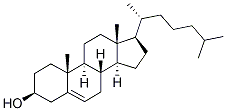
Chemical Structure
Molecular Weight: 386.65
Quality Control
| Related Targets | Adrenergic Receptor GPR Androgen Receptor Glucocorticoid Receptor ACE RAAS Progesterone Receptor Opioid Receptor PGES THR |
|---|---|
| Other Estrogen/progestogen Receptor Inhibitors | Elacestrant (RAD1901) Dihydrochloride Vepdegestrant (ARV-471) MPP dihydrochloride Kaempferol G15 Endoxifen HCl Licochalcone A Chrysin Pregnenolone AZD9496 |
Chemical Information, Storage & Stability
| Molecular Weight | 386.65 | Formula | C27H46O |
Storage (From the date of receipt) | |
|---|---|---|---|---|---|
| CAS No. | 57-88-5 | Download SDF | Storage of Stock Solutions |
|
|
| Synonyms | Cholesterin | Smiles | CC(C)CCCC(C)C1CCC2C1(CCC3C2CC=C4C3(CCC(C4)O)C)C | ||
Solubility
|
In vitro |
Ethanol : 6.25 mg/mL
DMSO
: 0.03 mg/mL
(0.07 mM)
Water : Insoluble |
Molarity Calculator
|
In vivo |
|||||
In vivo Formulation Calculator (Clear solution)
Step 1: Enter information below (Recommended: An additional animal making an allowance for loss during the experiment)
Step 2: Enter the in vivo formulation (This is only the calculator, not formulation. Please contact us first if there is no in vivo formulation at the solubility Section.)
Calculation results:
Working concentration: mg/ml;
Method for preparing DMSO master liquid: mg drug pre-dissolved in μL DMSO ( Master liquid concentration mg/mL, Please contact us first if the concentration exceeds the DMSO solubility of the batch of drug. )
Method for preparing in vivo formulation: Take μL DMSO master liquid, next addμL PEG300, mix and clarify, next addμL Tween 80, mix and clarify, next add μL ddH2O, mix and clarify.
Method for preparing in vivo formulation: Take μL DMSO master liquid, next add μL Corn oil, mix and clarify.
Note: 1. Please make sure the liquid is clear before adding the next solvent.
2. Be sure to add the solvent(s) in order. You must ensure that the solution obtained, in the previous addition, is a clear solution before proceeding to add the next solvent. Physical methods such as vortex, ultrasound or hot water bath can be used to aid dissolving.
Mechanism of Action
| In vitro |
Cholesterol serves as a precursor for the biosynthesis of steroid hormones, bile acids, and vitamin D. It modulates membrane fluidity over the range of physiological temperatures. The hydroxyl group on Cholesterol interacts with the polar head groups of the membrane phospholipids and sphingolipids, while the bulky steroid and the hydrocarbon chain are embedded in the membrane, alongside the nonpolar fatty-acid chain of the other lipids. Through the interaction with the phospholipid fatty-acid chains, Cholesterol increases membrane packing, which reduces membrane fluidity. The structure of the tetracyclic ring of Cholesterol contributes to the decreased fluidity of the cell membrane as the molecule is in a trans conformation making all but the side chain of Cholesterol rigid and planar. In this structural role, Cholesterol reduces the permeability of the plasma membrane to neutral solutes, protons, and sodium ions. |
|---|---|
| In vivo |
Cholesterol is recycled. The liver excretes it in a non-esterified form (via bile) into the digestive tract. Typically about 50% of the excreted Cholesterol is reabsorbed by the small bowel back into the bloodstream. |
Clinical Trial Information
(data from https://clinicaltrials.gov, updated on 2024-05-22)
| NCT Number | Recruitment | Conditions | Sponsor/Collaborators | Start Date | Phases |
|---|---|---|---|---|---|
| NCT01037387 | Recruiting | Chronic Obstructive Pulmonary Disease|Hypercapnic |
Hospital Universitario La Paz |
December 2025 | Phase 4 |
| NCT06159543 | Not yet recruiting | Hyperglycemia|Dyslipidemias|Insulin Resistance|Inflammation|Oxidative Stress |
Loma Linda University|National Mango Board |
September 2024 | Not Applicable |
| NCT06405880 | Not yet recruiting | Cardiovascular Risk Factors|Blood Pressure|Cardiovascular Disease|Diabetes|Dyslipidemia |
University of Alberta |
September 2024 | Not Applicable |
Tech Support
Tel: +1-832-582-8158 Ext:3
If you have any other enquiries, please leave a message.

Products are for research use only. Not for human use. We do not sell to patients.
©Copyright 2013 Selleck Chemicals. All Rights Reserved.