
research use only
Istradefylline Adenosine Receptor antagonist
Cat.No.S2790
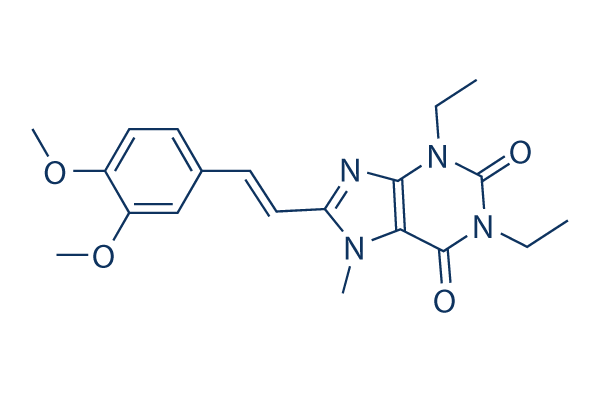
Chemical Structure
Molecular Weight: 384.43
Quality Control
| Related Targets | CXCR Hedgehog/Smoothened PKA Adrenergic Receptor AChR 5-HT Receptor Histamine Receptor Dopamine Receptor Ras KRas |
|---|---|
| Other Adenosine Receptor Inhibitors | Reversine CGS 21680 HCl ZM241385 SCH58261 Etrumadenant (AB928) A2AR antagonist 1 Ciforadenant (CPI-444) Imaradenant (AZD4635) DPCPX Proxyphylline |
Chemical Information, Storage & Stability
| Molecular Weight | 384.43 | Formula | C20H24N4O4 |
Storage (From the date of receipt) | |
|---|---|---|---|---|---|
| CAS No. | 155270-99-8 | Download SDF | Storage of Stock Solutions |
|
|
| Synonyms | KW-6002 | Smiles | CCN1C2=C(C(=O)N(C1=O)CC)N(C(=N2)C=CC3=CC(=C(C=C3)OC)OC)C | ||
Solubility
|
In vitro |
DMSO
: 6 mg/mL
(15.6 mM)
Water : Insoluble Ethanol : Insoluble |
Molarity Calculator
|
In vivo |
|||||
In vivo Formulation Calculator (Clear solution)
Step 1: Enter information below (Recommended: An additional animal making an allowance for loss during the experiment)
Step 2: Enter the in vivo formulation (This is only the calculator, not formulation. Please contact us first if there is no in vivo formulation at the solubility Section.)
Calculation results:
Working concentration: mg/ml;
Method for preparing DMSO master liquid: mg drug pre-dissolved in μL DMSO ( Master liquid concentration mg/mL, Please contact us first if the concentration exceeds the DMSO solubility of the batch of drug. )
Method for preparing in vivo formulation: Take μL DMSO master liquid, next addμL PEG300, mix and clarify, next addμL Tween 80, mix and clarify, next add μL ddH2O, mix and clarify.
Method for preparing in vivo formulation: Take μL DMSO master liquid, next add μL Corn oil, mix and clarify.
Note: 1. Please make sure the liquid is clear before adding the next solvent.
2. Be sure to add the solvent(s) in order. You must ensure that the solution obtained, in the previous addition, is a clear solution before proceeding to add the next solvent. Physical methods such as vortex, ultrasound or hot water bath can be used to aid dissolving.
Mechanism of Action
| Targets/IC50/Ki |
Adenosine A2A receptor
2.2 nM(Ki)
|
|---|---|
| In vitro |
The affinity of Istradefylline for the A2AR is 70-fold greater than that for the A1 receptor with Ki of 2.2 nM versus 150 nM. Exposure of primary rat striatal astrocytes to this compound results in concentration-dependent abolition of bFGF induction of astrogliosis in vitro. Binding affinities (Ki) of this chemical for A1 receptor, A2A receptor, and A3 receptor in human are >287 nM, 9.12 nM, and >681 nM, respectively, for A1 receptor and A2A receptor in rat 50.9 nM and 1.57 nM, respectively, and for A1 receptor and A2A receptor in mouse 105.02 nM and 1.87 nM, respectively. |
| In vivo |
Istradefylline reverses CGS21680-induced and reserpine-induced catalepsy with ED50 of 0.05 mg/kg and 0.26 mg/kg, respectively. This compound is over 10 times as potent in these models compared to other adenosine antagonists and dopamine agonist drugs. Administration of this chemical in combination with LevoDOPA (50 mg/kg) exerts prominent effects on haloperidol-induced and reserpine-induced catalepsy. Oral administration of this compound at 10 mg/kg to MPTP-treated common marmosets produces an increase in locomotor activity to approximately twice that of control and improves motor disability. Administration of this chemical (10 mg/kg, po, 90 minutes before SKF80723/quinpirole/LevoDOPA) in combination with SKF80723 (1 mg/kg, ip), quinpirole (0.06 mg/kg ip), or LevoDOPA (2.5 mg/kg po) produces a significant additive effect on locomotor activity and improvement of motor disability but not dyskinesia. In the MPTP mice model, this compound significantly attenuates striatal dopamine depletion under various conditions. Pretreatment with this chemical (3.3 mg/kg, i.p.) before a single dose of MPTP attenuates the partial dopamine and DOPAC depletions measured in striata 1 week later. Oral administration of this compound protects against the loss of nigral dopaminergic neuronal cells induced by 6-hydroxydopamine in rats, and prevents the functional loss of dopaminergic nerve terminals in the striatum and the ensuing gliosis caused by MPTP in mice. Chronic treatment with this compound does not improve the reversal deficits in dopamine-depleted rats. The tremulous jaw movements induced by pimozide are significantly reduced by co-administration of either this chemical or tropicamide. Pimozide-induced increases in ventrolateral striatal c-Fos expression are reduced by a behaviorally effective dose of this compound, in contrast to tropicamide by which c-Fos expression in pimozide-treated rats is actually increased. |
References |
|
Clinical Trial Information
(data from https://clinicaltrials.gov, updated on 2024-05-22)
| NCT Number | Recruitment | Conditions | Sponsor/Collaborators | Start Date | Phases |
|---|---|---|---|---|---|
| NCT05885360 | Active not recruiting | Parkinson Disease|Tremor |
Georgetown University|Kyowa Kirin Inc. |
January 20 2023 | Phase 4 |
| NCT02610231 | Completed | Idiopathic Parkinson''s Disease |
Kyowa Kirin Co. Ltd.|Kyowa Hakko Kirin Pharma Inc. |
December 2015 | Phase 3 |
| NCT02256033 | Completed | Hepatic Impairment |
Kyowa Kirin Co. Ltd.|Kyowa Hakko Kirin Pharma Inc. |
August 2014 | Phase 1 |
| NCT00455507 | Completed | Parkinson''s Disease |
Kyowa Kirin Co. Ltd. |
March 2007 | Phase 2 |
Tech Support
Tel: +1-832-582-8158 Ext:3
If you have any other enquiries, please leave a message.

Products are for research use only. Not for human use. We do not sell to patients.
©Copyright 2013 Selleck Chemicals. All Rights Reserved.