
Adenosine Receptor Agonists
| Cat.No. | Product Name | Information | Product Use Citations | Product Validations |
|---|---|---|---|---|
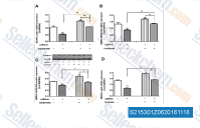
| S2153 | CGS 21680 HCl | CGS 21680 HCl is an adenosine A2 receptor agonist with an IC50 of 22 nM, exhibiting 140-fold over A1 receptor. |
|
|
| S1647 | Adenosine | Adenosine is a nucleoside composed of a molecule of adenine attached to a ribose sugar molecule (ribofuranose) moiety via a ">-"N9-glycosidic bond. |
|
|
| S5358 | Regadenoson | Regadenoson (CVT-3146, Lexiscan) is a selective A2A adenosine receptor agonist with coronary vasodilating activity. | ||
| S0498 | Namodenoson (CF-102) | Namodenoson (CF-102, 2-Cl-IB-MECA) is an orally bioavailable and selective agonist of the A3 adenosine receptor (A3AR) with Ki of 0.33 nM. This compound exerts an anti-NASH effect mediated via the de-regulation of the PI3K/NF-κB/Wnt/β-catenin signalling pathway. | ||
| E4032 | 5'-Deoxy-5'-(methylthio)adenosine | 5'-Deoxy-5'-(methylthio)adenosine (Methylthioadenosine, MTA) is a naturally occurring sulfur-containing nucleoside produced by the decarboxylation of S-adenosylmethionine. This nucleoside is a potent agonist of adenosine receptors with Ki of 0.15, 1.13, 13.9, and 0.68 μM for A1, A2A, A2B, and A3, respectively. | ||
| E2985 | Capadenoson | Capadenoson (BAY 68-4986) is an orally bioavailable, non-nucleoside partial adenosine A1 receptor agonist that exhibits an anti-ischemic effect. | ||
| E4450 | N6-Cyclopentyladenosine | N6-Cyclopentyladenosine is an adenosine derivative and a potent adenosine receptor agonist with Ki values of 2.3 nM, 790 nM and 43 nM for human A1, A2A and A3 receptors, respectively. It acts as an anticonvulsant and might exhibit protective actions against (AMPH)-induced seizures. | ||
| S5678 | trans-Zeatin-riboside | Zeatin Riboside is the most active and ubiquitous form of the naturally occurring cytokinins that promote cell division, stimulate shoot proliferation, inhibit root formation, slow the aging process, and activate gene expression and metabolic activity. Zeatin riboside has an immunomodulatory effect by agonizing the mammalian adenosine A2A receptor. | ||
| E4626 | BAY 60-6583 | BAY 60-6583 is a non-purine and selective agonist of adenosine A2breceptor, with an EC50 of 3-10 nM for human A2breceptors and >10 μM for A1 and A2areceptors. It binds to adenosine A2breceptor in mice, rabbits, and dogs with Ki of 750 nM, 340 nM, and 330 nM, respectively. It also enhances the antitumor activity of chimeric antigen receptor-modified T cells. | ||
| S6347 | 5'-N-Ethylcarboxamidoadenosine (NECA) | 5'-N-Ethylcarboxamidoadenosine (NECA, 5'-(N-Ethylcarboxamido)adenosine, Adenosine-5'N-ethylcarboxamide, 5'-Ethylcarboxamidoadenosine) is a stable, nonselective adenosine receptor agonist. It acts via multiple mechanisms including: reducing diabetes-induced oxidative stress, inhibiting gene expression of IL-18, TNF-α and ICAM-1 (intercellular adhesion molecule 1 (CD54)), and blocking activation of the JNK-MAPK pathway. | ||
| E6040New | Imiquimod maleate | Imiquimod maleate (R 837 maleate) is a small-molecule salt derivative of maleic acid, isolated from the Imiquimod free base and is an immune response modifier, a potent and selective agonist of toll like receptor 7 (TLR7), an antagonist of adenosine A₂A receptor with a Ki of 2.16 μM, and an inhibitor of adenylyl cyclase activity, inducing antiviral proteins like cystatin A. It exhibits strong antitumoral and antiviral efficacy, making it effective for conditions such as COVID 19, HPV warts, molluscum contagiosum, actinic keratosis, basal and squamous cell carcinoma, Bowen's disease, and vulvar intraepithelial neoplasia. | ||
| E6039 | Imiquimod hydrochloride | Imiquimod hydrochloride (R 837 hydrochloride) is a small-molecule immune response modifier, a potent and selective agonist of toll like receptor 7 (TLR7), an antagonist of adenosine A₂A receptor with a Ki of 2.16 μM, and an inhibitor of adenylyl cyclase activity, inducing antiviral proteins like cystatin A. It exhibits strong antitumoural and antiviral efficacy, making it effective for conditions such as COVID 19, HPV warts, molluscum contagiosum, actinic keratosis, basal and squamous cell carcinoma, Bowen's disease, and vulvar intraepithelial neoplasia. |

Products are for research use only. Not for human use. We do not sell to patients.
©Copyright 2013 Selleck Chemicals. All Rights Reserved.